

Where Fish Keep ‘Running Wild’: Inside The Film That Celebrates Salmon
The following appears in the June issue of Alaska Sporting Journal:
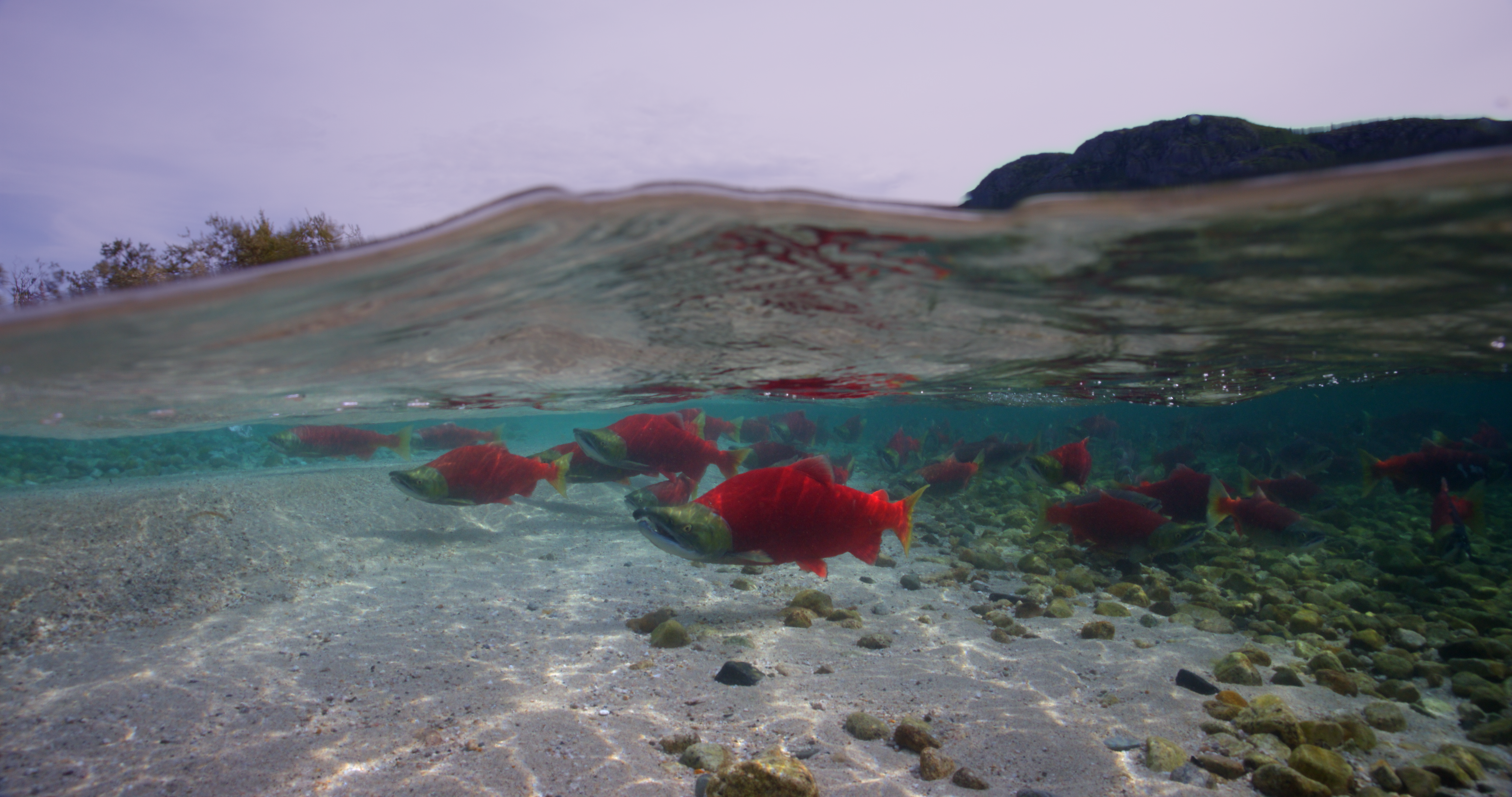
in a new documentary film, Running Wild: Return to the River, which is showing in 3D format on IMAX screens, including Alaska Odyssey Dome in Sitka. (MISSION PARTNERS ENTERTAINMENT GROUP)
BY CHRIS COCOLES
“W e are all salmon people.” Filmmakers are always looking for that go-to line that can define a movie. From “I coulda been a contender” and “Toto, I’ve a feeling we’re not in Kansas anymore” to “I’m gonna make him an offer he can’t refuse,” they are the moments that make a script leap off the page.
When Myles Connolly, a veteran of documentary projects, was searching for the right ending to a new film that honors Pacific salmon as well as the species that rely on these iconic anadromous fish – including the humans who catch them, eat them and vow to protect them – he turned to Chief Na’Moks of British Columbia, Canada’s Wet’suwet’en First Nation, which like many tribes has been harvesting salmon for countless generations.
Produced in a collaboration with the Oregon-based conservation group Wild Salmon Center (wildsalmoncenter.org), Running Wild: Return to the River is being shown in 3D format on IMAX screens in a limited release (it’s currently playing at Sitka’s Alaska Odyssey Dome). Connolly, a longtime documentary cinematographer, producer and director whose credits include films about Alaska’s Arctic region, Mount Everest and blue whales, was moved by his interactions with Chief Na’Moks when he and his crew filmed salmon counting on BC’s rivers and visited the Wet’suwet’en lands (filming also took place in Alaska, California and even Russia).
“I was looking for a strong way to connect back to Indigenous (people),” says Connolly, who got more than he bargained for in his interactions with the chief.
Before we get to that moment that put a bow on an impactful film, let’s take a look at how it all came together.

‘SALMON, HUH? GIVE ME THE WEEKEND’
When Connolly was approached about directing the documentary, despite the Ojai, California, resident’s longtime admiration for fly fishing, he felt some trepidation about taking on the gig.
“‘Salmon, huh? Give me the weekend,’” he told the caller when pitched on the idea.
“Over the course of that weekend, I dug into it and I realized that this is like a Greek drama. There are so many stories and so much stuff going on in that world, so I called back on Monday and said, ‘Sign me up.’ And once I got into it and started to meet people … I started to realize that, to be honest, salmon was just a food for me in the past, but I came to realize that it’s so much more than that. And it is in many places, not just here in the Pacific, but it is the keystone to life and a critical part of life.”
That was the perfect response for Guido Rahr, Wild Salmon Center’s president and CEO, who would serve as the movie’s scientific advisor.
Connolly’s reputation for working on conservation and environmental films has become well known in the industry, so Rahr knew this would be a perfect fit for the director’s chair.
“He is the best of the best; he is incredibly experienced and passionate and extremely good at what he does. That’s why the film looks like it does, because of Myles Connolly,” Rahr says.
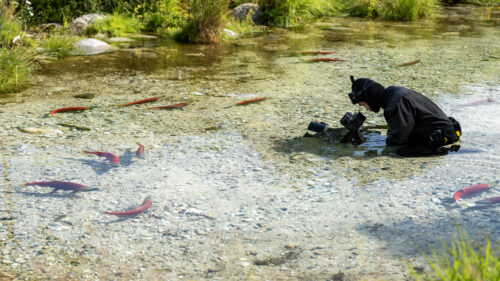
a salmon spawning scene at Lake Iliamna – except the fish weren’t ready. It took a couple weeks and they were almost out of time and camera memory before Campbell finally got a memorable shot. (MISSION PARTNERS ENTERTAINMENT GROUP)
TRADING SCREENS FOR AN EPIC EXPERIENCE
When plotting how Running Wild would be presented, Rahr was willing to trade more initial reach via streaming services to present the film in a 3D format on massive IMAX theater screens for a magnificent cinematic experience.
Rahr recalled an IMAX movie he’d seen some time ago on British Columbia’s Great Bear Rainforest – the Oregon native has fished the province’s pristine rivers countless times – and knew this film had to be presented that way and in 3D, even if it sacrificed some initial screenings.
“I realized how powerful the IMAX medium is. It really is the next best thing to physically being there. You can do a documentary film, which is great, but they can get lost after a while if you’re on television with all those channels (available),” Rahr says. “But an IMAX film has more durability and plays for a long time. It doesn’t get as many eyeballs, but it’s a more powerful impact when you get people in the room.”


STICKING TO THE SALMON
Rahr and the Wild Salmon Center have worked tirelessly as salmon conservation champions. In Alaska, they have stood hand in hand with those who have – for now – blocked the Pebble Mine and its potential threat to Bristol Bay’s salmon-filled watersheds.
But while Running Wild doesn’t back down from reminding how these wild fish must be protected at all costs, it also doesn’t bury the lede on the star of this show: the fascinating life and (eventual) death of the salmon, which Connolly and his team captured so beautifully, from hatch to spawn, in surreal underwater photography sequences.
“There are so many stories both good and bad around it,” Connolly says of the Pacific salmon news cycle, which includes stocks crashing due to various factors, along with the threat of mining, drilling and damming projects that have caused divisiveness and controversy in and out of Alaska.
“People kept asking me, ‘Why aren’t you talking about the Pebble Mine or the Klamath (River) dam removal (in California)?’ And those are all more than worthy stories for a documentary. The problem is it becomes very political and controversial. But what I’m trying to do is just get people to fall in love with the fish. Just look at this amazing animal and all the things that benefit from this animal. We should be loving this fish, and then, if they come away motivated and inspired, they can go learn about Pebble, and we make that available. We have an impact campaign and teachers – all these different things for those of you who are wanting to learn more.”

FOR THE KIDS
And while mostly leaving the political stuff out of the film – Connolly did want to subtly keep shots of the ubiquitous No Pebble signs that adorned many of the Bristol Bay commercial boats the crew interacted with – Running Wild’s main target audience is the younger generation that could make up the next wave of Wild Salmon Center warriors.
“The first goal is getting kids to believe in and love the places, the science and the conservation of the species – and to know that it’s not just about salmon. These are ecosystems,” Rahr says. “If you look at the Pacific Rim and these places – people in Kamchatka or Alaska or British Columbia or Oregon – they don’t really care what an ecosystem is; that’s just an abstract concept. But they tend to love wild salmon. Just by talking about salmon you can put together protections for an ecosystem. … We can prevent significantly degrading them like other rivers that have been destroyed.”
Connolly, who turns 63 in July, wants to see those kids who are 10 to 14 years old make the biggest impact going forward as he enters his golden years. They’re the ones, he concludes, who can change the world when it needs that most.
The editing process was calculated to consider how the youngsters feel when attending screenings with their families. A producer felt like a shot of dozens of dead salmon carcasses along riverbanks would be a powerful visual of the ultimate sacrifice these fish make as they return to the rivers that spawned them. Connolly pondered how to convey the idea that salmon return home to perish with Jason Ching, who provided some of the incredible underwater scenes in Alaska. And indeed, they did get footage of the mass die-off of sockeye.
“When we were editing, I remember putting it together with Jason and I said, ‘I don’t know. It’s kind of a shocking moment, and what I need is for people to understand what happens, not the visuals,’” recalls Connolly.
“And so we went back and (got a shot) of one dead fish. That kind of says it all. It won’t freak them out and no kids will leave the theater
crying, but it’s poignant and sad, and it needs to be. These fish have given everything, and you can give a little something back.”
The team behind Running Wild hopes their production will stick with the audience for years to come and that viewers join the crusade to protect wild salmon.
“I think that our goal is to say, ‘Here’s this amazing animal in the world that we all inhabit and it needs our help, and you’re the generation that can help,’” says Connolly, who after completing all these documentaries has expectations for audiences to take the films’ message and run with it.
“Someone will come to me years later and say, ‘I’m a marine biologist or a conservationist because of a film I saw when I was a kid.’ That’s the best feeling, because you realize that not only have you inspired them, you’ve created an eco-warrior who’s going to go out there and fight the good fight.”

THE BIGGEST, BADDEST BEARS
Salmon and bears are joined at the hip along Alaska’s rivers and streams. The former are looking to get to sea and the latter are among the many predators in search of an easy meal (the film showcases other salmon slayers along the way like orcas, the sea wolves of Vancouver Island and bald eagles).
Connolly considered shooting in two of the state’s most well-known locations where bruins and fish meet: McNeil State Game Sanctuary and Katmai National Park and Preserve’s Brooks Falls, and then decided to consult with his buddy, bear expert, filmmaker and naturalist Casey Anderson, who had another idea.
“I thought, ‘Do I really want to do the same thing that everyone has done?’ So I called Casey and asked, ‘If you could go anywhere, where would you go?’ And he said, ‘Funnel Creek,’” Connolly says of another Katmai National Park bear haunt. “He showed me a couple videos that he had and I thought, ‘We’re going there.’”
The film’s bear-salmon encounters are among its most breathtaking moments. Connolly says Funnel Creek was one of his favorite places to film in, despite some uncomfortable moments with the unpredictable brown bears as they hunted for fishy cuisine.
“The cool thing about Funnel Creek is that you can literally walk down and the bears are right there, so the first day I was kinda spooked, man, because these are big animals. And they’re all around you; at one point, they’d pop out of the bushes behind you 10 feet away. ‘Holy crap,’” Connolly says.
“They’re not there for you. They’re there for the fish. By the third or fourth day, you’re pretty comfortable, because you know which bears are which. But every once in a while a new bear would show up. The rule was, don’t turn your back to the bears. At one point, Casey walked up and he just tapped me on the shoulder and I freaked out, spun around and he said, ‘I could have been that bear right there.’ There was a bear 15 feet behind me, so you had to pay attention.”

A GREAT LAKE
Lake Iliamna is in the heart of the Bristol Bay region most at risk if the idea of the Pebble Mine project, which has been shut down by an Environmental Protection Agency veto and is dead for now, ever surfaces again. For Rahr, the lake and its adjacent streams played a big part in the salmon life cycle portrayed so eloquently in the film.
“My feelings were that I think we’ve stopped the Pebble Mine – I’m hoping – but seeing those watersheds and bringing people up there that can help us has been absolutely key,” Rahr says of the Bristol Bay scenes.
He’s been fishing these waters for trout and salmon for years now, so it’s understandable how passionate he’s been in the fight to keep the massive copper and gold mine out of what’s known as one of the planet’s last major strongholds for Pacific salmon.
“You just can’t understand until you get up there in one of those Beavers and fly over,” Rahr says of Bristol Bay’s scenery and the importance of the watersheds.
Iliamna was also one of the more challenging spots to film, since the goal was to time shooting with the returning salmon in spawning mode. Ching and fellow underwater photog specialist Tavish Campbell had their patience tested. The crew got to Iliamna when told it was the “prime spawning season,” and then they spent two weeks waiting and waiting for the big moment. Connolly says “they got all of the shots of the fish in that crystal clear water across the gravel beds. The fish were there, but they just weren’t spawning.”
“One week got into two weeks and at the end of those two weeks the fish weren’t spawning at all. So we talked to the local guys, who said it was a weird thing about the warming temperatures of the water and there was a lot of stuff they hadn’t seen before.”
Campbell and Ching spent another 10 days filming, hoping they’d get the money shot everyone so badly wanted.
“On the 10th day they filmed the entire day, and nothing. Jason said, ‘You know; I’m done,’ and he’d filled up his card and started packing up the gear. Tavish said he had a little bit of memory on the card and he’d see what he could get. They were pretty beaten up,” Connolly says.
“Tavish ducked his head underwater and waited a couple minutes and this pair came along. You could not choreograph it any better. The action, the behavior; it was perfect.”
REACHING ‘SOCCER MOMS ON LONG ISLAND’
Early in Running Wild, the film’s narrator, Academy Award-nominated actor, angler and conservationist Liam Neeson (see sidebar, page 28) makes a statement that defines the importance of Pacific salmon from California to the Kamchatka Peninsula and to Alaska and the Pacific Northwest. Neeson says, “137 species, including humans, depend on this majestic creature.”
That fact is a conduit for this film to stress the importance of salmon for multiple entities.
“This project came around at the right time. The subject, the style of it and what we’re trying to tell people, it should hit home with audiences all around the world,” Connolly says. “And to bring attention to this amazing fish, but also the plight of nature, we need to pay more attention, to be more engaged and active; whether it’s Pacific salmon, life on the Serengeti or the Great Barrier Reef, the planet needs our help. What we’re hoping for (is) audiences to be inspired and motivated when they leave.”
Rahr makes an appearance in the film as a lone angler on British Columbia’s Dean River. “Nature was my refuge when I was young,” he proclaims in a voiceover that includes him quietly reeling in and releasing one of the river’s most beautiful specimens.
When asked about what this documentary can accomplish, Rahr issued a warning about what could happen as the years go by.
“The world is changing really quickly, and there are threats to these rivers. We’re not pretending to be saving all the salmon or solving all the salmon runs,” he says of his organization. “There are a lot of organizations doing different pieces of this puzzle. And so just because it’s not a stronghold doesn’t mean it’s not a conservation goal; it just means that’s what we’re focused on. We are determined to deliver this network forward, and all the other work that’s happening is super, super important, and it’s complementary to what we’re doing.”
“The second thing I’ll say is that the threats are coming faster and faster. The threats are going to keep multiplying, so we don’t have time. And we’ve got to be really strategic and smart because it’s not going to get easier; it’s going to keep getting harder.”
That’s where we can all make some kind of impact.
“We’re looking to and hopefully providing a conduit so that more people who aren’t just the anglers (care). Maybe like soccer moms on Long Island who say, ‘Wow; this is not just about the salmon,” Rahr adds. “It’s about the northern Pacific Rim and these beautiful rivers, and it’s like the Amazon Rainforest or the Great Barrier Reef – one of these priceless things on the planet that we’ve got to understand and protect.”

MORE THAN JUST THE FISH
During production in British Columbia on Wet’suwet’en First Nation land, some of the film’s crew ate dinner with tribal members, including the aforementioned Chief Na’Moks, who happened to sit next to director Connolly.
“He comes from a world that I typically would not connect to, the Indigenous life. Their world is far enough away from me that it’s hard for me at a dinner to insert myself into it and understand it,” Connolly says candidly. “But we started to talk and I realized that I was underestimating this guy. At one point he was talking about how he was addressing the United Nations and talking about health and habitat. I thought, ‘This guy is freaking amazing.’”
At the end of the night, Connolly went back to his hotel and, at a suggestion from the tribal chief, started watching a 2024 documentary film, Yintah, about the Wet’suwet’en people’s plight, which the movie’s website (yintahfilm.com) states is “about an anti-colonial resurgence – a fierce and ongoing fight for Indigenous and human rights in the face of a colonial government committed to seizing lands at gunpoint.”
Despite an early wakeup call for filming the next day, Connolly watched the entire two-hour production, solidifying his intuition to end the film through Chief Na’Moks’ point of view, and in his voice.
“It was the most amazing and shocking at times exposé on what those people are going through up there. But what was great about that was I suddenly had an understanding of not only the place but the people and the fight they’re going through,” Connolly says. “So later on, when I was going back to interview him for narration, I had some ideas for what I wanted him to talk about. He was super up for it. At one point I said, ‘How should we see ourselves; where do we connect with the Wet’suwet’en?’”
That’s when Chief Na’Moks delivered that critical line for this project, one that became a brilliant call to arms for a remarkable species. Connolly considered giving the quote to his celebrity narrator, the acclaimed Northern Irish actor with the booming voice.
“If Liam had delivered it, it would have been fine. But hearing it from Na’Moks as the last line in the film, it gives it a resonance and a weight that I really wanted,” Connolly says.
During a sweeping shot of the sacred river holding the sacred fish, the chief says, “We know that every year they’re going to come back to us if we do our job to look after the water and the salmon itself. This has happened for thousands upon thousands of years. And if we have respect for the salmon, it will continue for thousands and thousands of years. … Everything is related to nature, because without nature we don’t survive.”
“We are all salmon people.” ASJ
Editor’s note: Find theaters and screenings for Running Wild: Return to the River at wildsalmoncenter.org/running-wild.
Sidebar: ACTOR, ANGLER, CONSERVATIONIST: WHY RUNNING WILD RESONATES WITH NARRATOR LIAM NEESON

From playing a sympathetic German businessman who defied Hitler’s Nazis to save World War II Jews from the Holocaust in Schindler’s List, a Jedi knight in the Star Wars franchise, to a badass avenging dad in the Taken films, Academy Award nominee Liam Neeson has pulled off just about every kind of role in his distinguished career.
And his distinct Northern Irish voice has made Neeson a go-to documentary narrator to hire, and given his passion for fishing and conservation, Running Wild: Return to the River director Myles Connolly had a natural fit for his film.
“It’s not just a job; you’re getting the very best that he brings to it, and he’s also investing his own time and his own personality,” says Connolly, who was part of the crew – as associate editor – for a previous Neeson-narrated documentary, a 1998 production about Mount Everest. “And you can hear it in the narration. It’s not just Liam reading someone else’s stuff; he owns it. He comes across really well.”
At one point in his voiceover work in the film, Neeson says, “Salmon need our help – now more than ever.” And he really means it, given his background as a longtime angler, particularly back in his native United Kingdom fishing spots, and rueing the crashing out of Atlantic salmon runs in European rivers. He’s well known as a conservation and environmental advocate.
“The story of the salmon’s return is one of nature’s greatest odysseys – and a powerful reminder of our responsibility to protect the wild places that sustain us all,” Neeson said in a press release announcing him as Running Wild’s narrator. “I was drawn to this film because it captures both the beauty and the urgency of conservation in a way that’s deeply moving and shows how everything in nature, including us, is connected.”
Guido Rahr, president and CEO of Wild Salmon Center, was thrilled to have such an advocate for fish and the conservation of species on board for a project that’s so meaningful for Rahr’s organization.
“We got so lucky,” Rahr says of Neeson’s attachment to the movie.
Over the course of Neeson’s work with Connolly on the documentary, the duo swapped stories about their shared love of fishing. (Neeson also had a starring role in a flick set in the Alaska wilderness, 2011’s The Grey, about plane crash victims stalked by a pack of vicious wolves.)
“We talked about his fishing experiences in Scotland. He said back when he was a kid he would go down and fish and catch two or three salmon in a day,” Connolly says. “He went out with some friends a few years ago and they fished for a week and they only caught one fish. So he said, ‘I worry that the Atlantic salmon population is too far gone to come back.’ So he was really proud to be a part of this film because he wants to get that message out there as well.”
And while Connolly says other A-list actors he’s worked with on documentary narrations have simply shown up and read the script, Neeson was refreshingly much more hands-on in the creative process.
Connolly loved that Neeson took notes and offered his own opinions on how to present the material.
“He was coaxing me to rewrite lines on the day. He would come up with something spontaneous. ‘What if I did it this way?’” Connolly recalls, adding that Neeson, who turns 74 on June 7, was proud to be a part of such an important project.
“He wants to get that message out there as well. It’s not too late; we can do something; we can help these fish and these places, and all of these species that rely on fish, including us,” he says. “I think he’s not as active in (fishing) as he used to be as a younger man. But he’s still passionate about the subject and his eyes lit up.” -CC

Alaska Salmon 2011: Not Too Shabby

Prime Time For Face Time At Sportsmen’s Shows

EPA: Potential ‘Adverse Impacts’ On Bristol Bay Salmon Fishery With Pebble Mine; Comment Period On Draft Study Open Into July
About Author
