

Study: How Rain, Tongass NF Trees Can Help Slow Down Wildfires
The following press release is courtesy of the Alaska Sustainable Fisheries Trust:
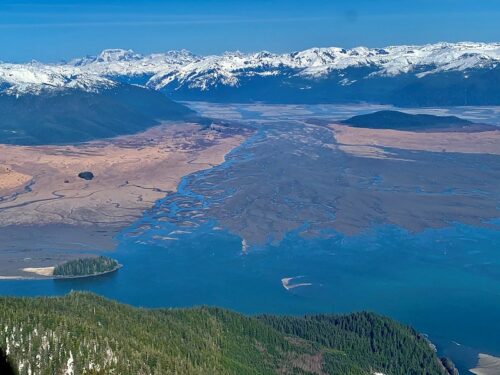
As Climate-Driven Wildfires Increase Globally, Newest SeaBank Report Captures the Value of Trees in Rainy Tongass National Forest
SITKA, AK – In a year of wildfires driven by record-breaking heat and drought, the Alaska Sustainable Fisheries Trust (ASFT) has released its 2026 SeaBank Natural Capital Report: Capturing the economic and ecological value of Southeast Alaska. The report examines the critical role of the region’s rainy Tongass National Forest and connected ocean waters in sustaining local economies, lifestyles, and natural climate solutions.
Among the wettest and most climatically stable forests worldwide, the Tongass plays a unique role as a fire shield in coastal Alaska. “The wet climate of the Tongass is a natural buffer against large wildfires more typical of drier interior and southern locales,” says Dominick DellaSala, Senior Conservation Science Associate in the North America Initiative of the Conservation Biology Institute and author of Temperate and Boreal Rainforests of the World. “Logging will only dry out the rainforest and produce flammable logging slash in clearcuts that provide kindling for out-of-control fires.”
The 2026 SeaBank Natural Capital Report captures other benefits of Southeast Alaska’s rainforest ecosystem—all of which are threatened by the U.S. Forest Service’s plan to rescind the Roadless Rule and increase logging throughout the Tongass in its revised forest management plan:
- Combined, the commercial fishing and visitor industries add $1.8 billion per year to the Southeast Alaska economy. Both industries depend on the region’s tree-rich ecosystem.
- Every $1 of resident fishery earnings generates $1.54 in total community revenue.
- The Tongass stores 2.7 billion metric tons of carbon in its old-growth forests and soils, 20% of all carbon held by the U.S.’s entire National Forest System.
- The Tongass holds 30% of the world’s remaining old-growth temperate rainforest, a forest type that exists in only seven places on Earth.
The ASFT team spent the last two years researching, writing and critically reviewing the newest SeaBank Natural Capital Report, drawing on the latest science and economic data available.
“It is more important than ever that decision-makers look at the full picture when considering how best to manage our public resources and ensure they are maximizing ecological benefits for the public good,” says ASFT President, Linda Behnken. “The SeaBank Natural Capital Report offers that picture.”
For those who say the Tongass is a working forest, SeaBank Natural Capital Report editor Beth Short-Rhoads agrees.
“The Tongass is indeed a working forest,” she says, “and one of its most crucial jobs now is to buffer coastal Alaska against climate-driven fires. Add in its work as a carbon sink and stronghold for salmon, and it becomes clear that logging this rare ecosystem makes no sense. Trees have always been key to our region’s economy and lifestyle—now they’re key to our safety.”
SeaBank report researcher and author, Paul Olson, will be sharing highlights from the 2026 SeaBank report at the upcoming Rising Tides Celebration in Sitka on November 10th. To purchase tickets and learn more, visit: https://thealaskatrust.org/risingtides.
To read the 2026 SeaBank Natural Capital Report and chapter summaries, visit: https://thealaskatrust.org/about-seabank.
###
The Alaska Sustainable Fisheries Trust (ASFT) works to educate, activate, and inspire fishermen alongside coastal communities in programs that promote healthy, community-based fisheries. By combining ecology, economics, and the common good, ASFT works to ensure resilient communities and robust resources throughout coastal Alaska.

Alaska Salmon 2011: Not Too Shabby

Prime Time For Face Time At Sportsmen’s Shows

EPA: Potential ‘Adverse Impacts’ On Bristol Bay Salmon Fishery With Pebble Mine; Comment Period On Draft Study Open Into July
About Author
