

She’s Holding The Line In Bristol Bay
The following appears in the April issue of Alaska Sporting Journal:


BY TIFFANY HERRINGTON
For most anglers who step off a floatplane into Bristol Bay for the first time, the experience feels almost disorienting in its scale. The rivers run broad and cold beneath open sky, salmon push upstream in numbers that defy logic, and the surrounding country remains largely roadless, uncut and unsoftened by the infrastructure that has reshaped so much of the Lower 48. It is the kind of place that does not need to announce its wildness; it simply operates on its own terms, indifferent to trend or convenience.
Kate Crump first came north in 2008 to guide in this wild country, and what she found was not simply opportunity but permanence. “I learned then how this place is like a mirror into the past,” she says, describing Bristol Bay as an image of what North America once was before its rivers were dammed and its salmon diminished. What began as a guiding season quickly became a trajectory, and over time that trajectory narrowed toward one particular bend in the Naknek River that she could not quite shake.

RAISED ON A FARM in rural Virginia, Crump did not grow up assuming she would one day run a remote Alaska fishing lodge. She left home for the Pacific Northwest searching for direction, tried her hand at more conventional work and briefly interned at a veterinary office before realizing that a structured, predictable life was not what she wanted.
“Working 9-to-5 on repeat, patiently waiting for the freedom of retirement” was not going to hold her, she says. What did hold her – unexpectedly and completely – was salmon fishing.
“That beacon in my soul lit up for the first time,” she recalls. “All I knew was that I wanted to be on the water for the rest of my life.”
Guiding in Bristol Bay gave that instinct shape. The work demanded more than casting and knot-tying; it required learning to read glacial rivers that change character by the hour, understanding the timing and biology of all five Pacific salmon species and navigating a logistical reality where weather can ground aircraft and strand even seasoned crews.
Over the years, she and her husband Justin built a guiding business that split time between Alaska and Oregon, chasing steelhead in the offseason and returning north for the salmon runs that remain the economic and ecological backbone of Bristol Bay.
Even with advances in forecasting, she says, “the unpredictability of Alaska’s weather can still shape the day for an Alaskan guide,” which is why satellite communication devices and constant coordination with pilots and neighboring guides are not luxuries but safeguards. In country this remote, margins matter, and the ability to make quick decisions before weather closes in can define whether a day remains productive or becomes dangerous.

SOMEWHERE IN THOSE EARLY seasons of running jet boats up the Naknek and guiding anglers across its gravel bars, Crump passed a particular bluff and felt something shift. “It was the same day I found myself running a jet boat up the river for the first time,” she says. “A love-at-first-sight type of moment.”
The idea of owning a lodge there seemed unrealistic at first, something closer to a passing thought than a business plan, but the image of that bend in the river stayed with her for years. It would eventually resolve in her and Justin’s The Lodge at 58* North.
When the property eventually came up for sale more than a decade later, the decision to buy it was equal parts audacity and inevitability. The existing structures required significant work, and nothing about building in rural Alaska is simple. Materials must be barged or flown in, freight costs run high and timelines stretch when weather and transport fail to cooperate. Days routinely pushed past 20,000 steps as they hauled supplies between the river and the bluff above, rebuilt cabins and constructed a new lodge designed to frame the river through large windows rather than compete with it.
“The dream was rooted in having freedom over our guests’ experiences on and off the water,” Kate Crump says, explaining that ownership allowed them to shape not only the fishing program but the culture of the place. They built raised beds and a greenhouse, added a chicken coop and brought in a chef to elevate meals beyond standard lodge fare, understanding that a week in Bristol Bay should feel cohesive rather than transactional.
Still, the fishing remains the core for this operation. The Naknek and surrounding watersheds offer access to salmon runs that remain among the strongest in the world, and for visiting anglers the sheer volume of fish can feel surreal. Yet Crump is quick to push back against a numbers-only mindset. Salmon, she notes, are fickle, and there are days when conditions or timing do not align perfectly, but those days can still matter deeply if anglers allow themselves to absorb the broader landscape.
“We try to focus on the moments rather than the catches,” she says, emphasizing that an experience rooted in connection to place will hold up even when a run stalls or a bite slows.

to salmon runs that remain among the strongest in the world, and for visiting anglers the sheer volume of fish can feel surreal.” (KATE CRUMP)

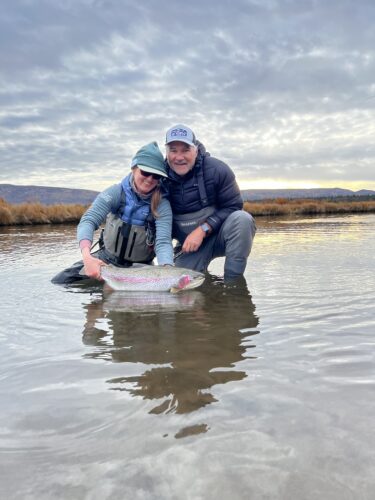
The moments she remembers most clearly are not always tied to fish at all. She recalls watching guests hold hands while crossing creeks, steadying one another on slick rocks and seeing relationships shift in subtle ways when people are removed from routine and placed in wild country. She remembers a guest who hiked into a remote river system to scatter his sister’s ashes, an act that required physical effort and intention, and which underscored how deeply certain places imprint on those who visit them.
“When someone does something like that, it reminds us how impactful these places are,” she says. “The wilderness deeply affects people, including myself.”
That awareness carries weight in Bristol Bay, where the health of the salmon runs is both a biological miracle and a political fault line. Crump serves on the board of Pacific Rivers (pacificrivers.org) and is involved with Oregon-based North Coast Citizens for Watershed Protection, fully aware that while salmon runs across much of the globe are declining, Bristol Bay continues to produce record returns because its watershed remains largely intact.
“The robust health and acknowledged value of the salmon in Bristol Bay are both rare and intrinsically reliant upon one another,” she says, framing the region not as an endless resource but as a system that survives because it has not yet been compromised at its source.
Crump’s own path through the guiding world has not been without friction. When she began in Bristol Bay, female guides were less common, and she often found herself working in male-dominated camps where expectations were unspoken but unmistakable. Rather than shrinking from that environment, she leaned into it, building technical proficiency and command while understanding that her presence carried implications beyond her own career.
“I felt a responsibility to pave a positive way for the female guides coming up behind me,” she says, noting that she now sees more women stepping confidently into roles that once felt out of reach.
In her view, what separates a good guide from a great one has little to do with bravado and everything to do with steadiness. A great Alaskan guide, she says, understands that their role is to safely share the beauty and abundance of the place, to anticipate needs before they are voiced and to maintain control of the day without diminishing the experience for guests who may be fishing waters like these for the first time.

RUNNING A LODGE IN remote Alaska is not a seasonal hobby for Crump; it is a sustained commitment that stretches far beyond summer. Her offseason is spent planning, repairing, coordinating and often guiding in Oregon, while summers are defined by long days on the water followed by evenings ensuring that guests feel cared for and connected.
“It’s a nonstop grind to run a lodge,” she says, acknowledging that fatigue is part of the equation, but so is clarity. The life she and Justin have built is not an accident; it is the product of years of incremental decisions that led back, again and again, to that bend in the Naknek.
On quiet mornings, before boats launch and guests gather their rods, she sometimes stands on the bluff and looks downriver, watching the current slide past the inside bend that first caught her eye years ago. The salmon continue to return, feeding bears, birds and the broader ecosystem that depends on them, and the lodge now stands where once there was only an idea carried forward from season to season.
For Kate Crump, Bristol Bay is not a backdrop but a working landscape, one that demands respect, stamina and vigilance, and one that continues to reward those willing to hold the line. In a place where the salmon still run strong and the margins remain real, she has built more than a business; she has built a life rooted in current, country and the conviction that some waters are worth committing to for the long haul. ASJ
Editor’s note: For more on Kate Crump and The Lodge at 58* North, check out thelodgeat58north.com or call (541) 743-1255. Tiffany Herrington is a writer based in the Seattle area.

Alaska Salmon 2011: Not Too Shabby

Prime Time For Face Time At Sportsmen’s Shows

EPA: Potential ‘Adverse Impacts’ On Bristol Bay Salmon Fishery With Pebble Mine; Comment Period On Draft Study Open Into July
About Author
