

Raising Alaska’s Salmon: Inside Three Last Frontier Hatcheries
The following appears in the May issue of Alaska Sporting Journal:

Editor’s note: Alaska’s fisheries are supported by a vast network of hatcheries, biologists, technicians and field crews working behind the scenes across the state. While anglers and commercial fishermen see the results on the water, much of the work that sustains those opportunities happens far from the spotlight, in remote hatcheries, field camps and research stations.
This series highlights some of these “unsung helpers of the wild,” the professionals responsible for that work. From Southeast Alaska to the Kenai Peninsula, these profiles explore the people who spend their careers raising salmon, monitoring wildlife populations and maintaining the systems that help keep Alaska’s fisheries strong.
BY TIFFANY HERRINGTON
On summer mornings across Alaska, the signs of salmon season begin quietly. Harbor lights flicker on before dawn as skippers check gear and fuel lines. Nets are stacked, rods rigged and coffee cups balanced on gunwales while boats ease away from docks.
Beneath the surface, the first returning salmon move through cold coastal waters, beginning the final leg of a journey that may have started years earlier in a hatchery far from view.
For fishermen, those returning fish mark the start of another season on the water. For the hatchery crews that raised them, the moment represents the culmination of work that began long before the first nets were set.
Across Alaska, salmon enhancement programs guide fish through the most vulnerable stages of life. Eggs are incubated in carefully controlled systems, juvenile fish are monitored as they grow and releases are timed so young salmon enter the wild when their chances of survival are strongest. After that, the fish spend years feeding and migrating in the open ocean before returning as adults to Alaska’s rivers and coastal waters.
Behind those returning runs are the hatchery managers, technicians and field crewmembers who spend their careers supporting the earliest stages of the salmon lifecycle. Much of their work happens far from towns and road systems in facilities where fish culture, infrastructure maintenance and daily life are closely intertwined.
LIFE AT HIDDEN FALLS HATCHERY
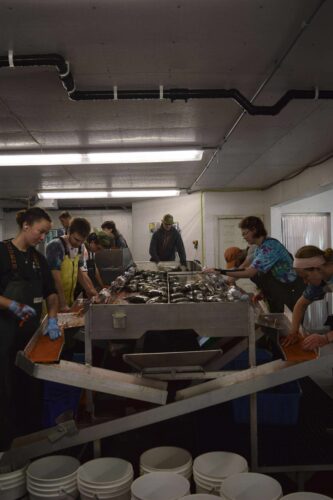
Hidden Falls Hatchery sits on the northeast corner of Baranof Island in Southeast Alaska, surrounded by steep mountains, dense forest and open saltwater. The facility lies far from the road system and can only be reached by boat or floatplane. Staff members live on site in housing provided by the hatchery, and electricity for the entire operation is generated through a hydroelectric system. For hatchery manager Kevin Connell, that setting shapes nearly every aspect of the work. Connell entered the fisheries world while in college, beginning as an intern working with trout in Mississippi. After graduating from Ohio’s Bowling Green State University in 2017, he moved to Alaska and accepted a fish technician position with Prince William Sound Aquaculture Corporation’s AFK Hatchery, where he worked with chum and pink salmon.
Within a year he advanced to a culturist position, supervising technicians and helping oversee daily operations. In 2020, he joined the Northern Southeast Regional Aquaculture Association at Hidden Falls as assistant manager and was promoted to manager in 2023.
Hidden Falls is one of the largest salmon enhancement facilities in Southeast Alaska. Each season the hatchery handles massive production numbers, taking approximately 190 million chum eggs along with nearly eight million coho eggs and about two million Chinook eggs. Those fish are raised through early life stages before being released to support fisheries throughout the region.
Despite the scale of production, Connell says success still depends on careful attention at every stage of the process. Spawning, in particular, requires intense focus. During peak egg takes, hatchery crews may collect more than 10 million eggs and handle over 10,000 adult salmon in a single day. Timing, fish condition and handling techniques all influence survivalratesyearslaterwhenthose fish return from the ocean.
Once fertilized, eggs are placed into incubators where cold, oxygenated water flows continuously across them. The staff monitors development closely and removes eggs that fail to mature properly to prevent disease from spreading to healthy fish. After the salmon hatch and absorb nutrients from their yolk sacs, they remain protected until they begin feeding. At that stage they are transferred into raceways, where feeding schedules, oxygen levels and fish density must be carefully managed.
“When you’re dealing with tens of millions of fish, even small changes can have big biological impacts,” Connell said.
Operating a hatchery of this scale in a roadless location also requires extensive planning. Everything needed to keep the facility running, including fish feed, equipment, fuel, groceries and seasonal staff, must arrive by boat or floatplane. Weather delays are common, and shipments often need to be scheduled weeks in advance.
“You have to think ahead constantly,” Connell said. “You can’t just run to town if something breaks. You need backup systems and spare parts ready.”
Hidden Falls also serves as a hub within Southeast Alaska’s salmon enhancement network. Eggs and juvenile fish are transferred to other rearing locations, and release schedules are coordinated with other hatcheries to help optimize survival in the ocean.
Because the staff lives on site, the culture of the crew becomes just as important as the infrastructure. Connell says strong communication and teamwork are essential when work and daily life overlap in a remote setting.
“When everyone depends on each other, both at work and outside of work, the team culture really matters,” he said. “When that culture is strong, everything else runs better too.”
Life at Hidden Falls also offers constant contact with the surrounding wilderness. Fishing, crabbing and wildlife viewing are common parts of daily life outside working hours. While earlier generations of hatchery staff often relied heavily on hunting and trapping for subsistence, the current crew tends to focus more on fishing and outdoor recreation. The shift reflects changing lifestyles among younger staff, even in a place where nature still defines the rhythm of daily life.
For Connell, the most rewarding part of the job comes when the entire system works as intended.
“Hidden Falls is a complex operation,” he said. “When the team is working well together and the fish are thriving, you know the effort is paying off.”

REMOTE PROJECT AT DEER LAKE
Not far from Hidden Falls, another salmon program unfolds in an even more remote setting.
Deer Lake lies on the southeastern corner of Baranof Island and serves as a satellite project connected to the hatchery. Unlike Hidden Falls, the site functions more like a small field camp than a traditional hatchery facility.
Travis Russell leads the Deer Lake project, a position he reached after first discovering fisheries work during college. While studying wildlife and fisheries management at Northern Michigan University, Russell learned about the University of Alaska Southeast’s aquaculture semester program in Sitka. After enrolling in the program and completing an internship at Medvejie Hatchery, he developed a strong interest in hatchery operations.
During the program he attended a presentation about the Deer Lake project and immediately recognized the opportunity it offered. When a technician position opened, he applied and joined the project. He advanced to project leader within a few seasons.
The Deer Lake site reflects the self-sufficient nature of Southeast Alaska fisheries work. Staff members live in a cabin near the lake that is powered by a generator and battery system, heated by a wood stove and supplied with gravity-fed water from the lake. Boats, generators and equipment must all be maintained on site, and crews often work for weeks at a time without direct outside support.
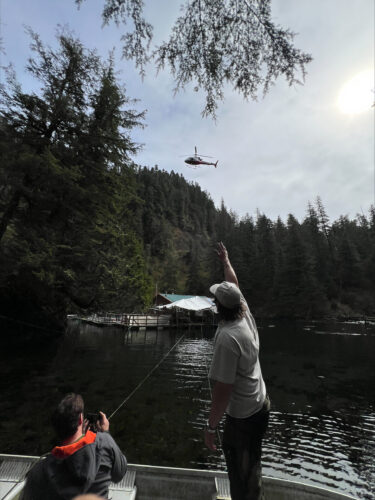
Each year the project raises roughly three million coho salmon from fry to smolt before releasing them to the ocean. Unlike traditional hatcheries, Deer Lake does not incubate eggs. Instead, very young coho fry are produced at Hidden Falls Hatchery and flown to the lake by floatplane, where they are stocked into net pens to grow throughout the season, which essentially makes it an acclimation, or rearing, pond.
The geography of the lake presents a unique challenge. Deer Lake drains through a steep gorge and over a waterfall too high for juvenile salmon to survive. To address that obstacle, crews install a smolt weir and pipeline that safely carries outmigrating fish past the falls and down to Mist Cove, where they enter saltwater.
During peak migration periods, a crew member remains stationed at the pipeline’s float house around the clock, monitoring fish movement and collecting biological data as smolts begin their journey to the ocean.

Daily life at Deer Lake blends fish culture with the responsibilities of maintaining a remote camp. Staff feed fish, monitor the lake environment and maintain the infrastructure that keeps the project running. Plankton surveys help track the lake’s productivity, nets must be cleaned regularly and engines, boats and trails require routine maintenance.
A small crew of four people typically runs the entire project. Many are drawn to the job because they enjoy remote living and outdoor recreation, including hiking, fishing and subsistence hunting.
Completing a season at Deer Lake has become something of a badge of honor within the organization.
“It takes people who can adapt and solve problems,” Russell said. “Out here you’re working with fish, but you’re also maintaining a camp and figuring things out as they come up.”
The project also includes cost-recovery harvests in nearby Mist Cove. As adult coho return, a contracted purse seiner harvests a portion of the fish to help offset project costs. The program provides additional fishing opportunities for communities throughout southern Chatham Strait, particularly for the region’s troll fleet.
For Russell, the most rewarding moments come when thousands of smolts leave the lake and begin their journey toward the ocean.
“You’re watching months of work head out into the wild,” he said. “That’s when you really see what the project is accomplishing.”
RAISING SALMON ON THE KENAI PENINSULA
Hundreds of miles away on Alaska’s Kenai Peninsula, another hatchery program is preparing salmon that will eventually return to support fisheries in Cook Inlet.
At Trail Lakes Hatchery near Seward, Ryan Schuman oversees operations for the Cook Inlet Aquaculture Association. Schuman became manager of the facility in 2024 after previously managing Gunnuk Creek Hatchery in Southeast Alaska for several years.
Trail Lakes raises several groups of fish, including Bear Lake sockeye, Tutka Bay Lagoon sockeye and Bear Lake coho. The process begins with broodstock collection in streams feeding Bear Lake, where hatchery crews capture returning adults using beach seines. Males and females are separated before eggs and milt are extracted to fertilize the next generation of salmon.
Fertilized eggs are transported back to the hatchery, disinfected and placed into incubators, where the staff carefully monitors their development. After several weeks, hatchery crews perform a process known as “shock and pick,” which removes eggs that failed to develop properly and prevents disease from spreading among healthy fish.
Once the eggs hatch, the young salmon remain hidden in gravel-like substrate while absorbing nutrients from their yolk sacs. When the yolk is nearly depleted, they emerge and begin feeding. At that stage, the fish are moved from the incubators into raceways through a drain hose.
“The fish essentially take a long waterslide out of the incubator to their future home,” Schuman said.

Over the following months, hatchery staff monitor growth, adjust feeding schedules and track fish health. Some fish are released early as fry weighing only fractions of a gram, allowing them to grow naturally in nearby lakes. Others remain longer and are released as smolts ready to transition to saltwater.
Release operations begin in April and continue into early summer. In some cases, the fish are transported by truck, plane or boat to remote lakes and waterways.
Another major part of the program takes place at the Bear Creek weir near Seward. During the height of the salmon run, the weir operates nearly nonstop as staff monitor returning sockeye and ensure enough fish continue upstream to spawn.
Seasonal technicians staff the site around the clock for eight to 10 weeks each summer, passing fish through the structure and collecting broodstock needed to continue the hatchery cycle. The work is demanding but provides valuable hands-on experience for students and recent graduates pursuing careers in fisheries science.
For Schuman, the most rewarding aspect of the job is seeing the results where they matter most.
“The best part is watching people out enjoying the fish we raise,” he said.

WATCHING THE FISH RETURN
For Connell, Russell and Schuman, the work follows a cycle that never really stops. As one group of fish moves out into the ocean, planning and preparation for the next brood year are already underway.
There are eggs to collect, systems to maintain and young fish to monitor. Seasonal crews will arrive, projects will begin again and another generation of salmon will start its earliest stages of life in hatcheries and remote field sites across Alaska.
For the people doing this work, that rhythm is simply part of the job. Each season brings a new round of challenges, new crews and the important work of raising the next generation of Alaska’s salmon. ASJ
Editor’s note: Check out the following websites for the hatcheries featured in this feature: Hidden Falls (nsraa.org/?page_id=391), Deer Mountain (ssraa.org/deer-mountain) and Trail Lakes (https://ciaanet.org/trail-lakes-hatchery-ciaas-central-hub/). Tiffany Herrington is a writer based in the Seattle area.

Alaska Salmon 2011: Not Too Shabby

Prime Time For Face Time At Sportsmen’s Shows

EPA: Potential ‘Adverse Impacts’ On Bristol Bay Salmon Fishery With Pebble Mine; Comment Period On Draft Study Open Into July
About Author
