

Paddling, Pedaling On Her Own Power In Alaska
The following appears in the March issue of Alaska Sporting Journal:

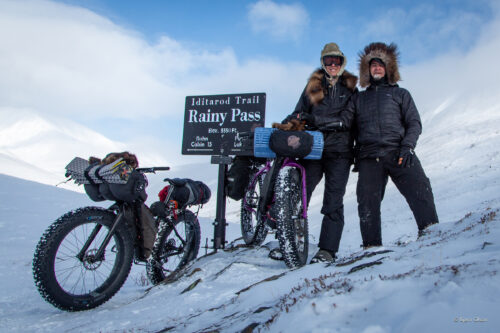
Editor’s note: Alaskan Women and the Outdoors is an ongoing Alaska Sporting Journal series highlighting women whose lives and work are deeply rooted in Alaska’s wild places. Through hunting, fishing, wilderness travel and stewardship, these women are building meaningful relationships with the land and shaping what it means to live outdoors in Alaska today.
Based in Homer, Kim McNett is a wilderness traveler, educator and artist whose life in Alaska has been shaped by long, human-powered journeys across the state. Traveling by fat bike, packraft and sea kayak, she has crossed some of Alaska’s most remote terrain while building a life centered on wild food, stewardship and moving through the landscape at the pace it demands.
BY TIFFANY HERRINGTON
The wind had been building for days by the time Kim McNett and her expedition partners reached the Lisburne Hills in far Northwest Alaska. Gusts pushed past 50 miles per hour, strong enough to knock riders off fat bikes and send loose rock sliding across open tundra. Travel became less about pedaling and more about staying upright, reading the ground ahead and choosing carefully when to move and when to wait.
They retreated from the coast, where cliffs and gullies concentrated offshore wind into an overwhelming and unpredictable force. It was only because the wind was at their backs that the group could move at all. Even then, control was never guaranteed. At one point, a gust came down a narrow valley and knocked all of them off their bikes at once.
When they finally reached the Arctic Coast, the wind was still driving hard. Sunglasses and hoods stayed on to protect against flying debris. Out over a lagoon, a flock of swans circled and called, holding themselves upright against the wind. Against a landscape with almost no vegetation, the birds appeared much larger than they were.
“They say a sense of awe comes from seeing beauty while feeling fear,” McNett says. “That was the time I saw angels.”
That pairing of beauty and consequence is familiar territory for McNett. Based in Homer, she has built her life around long-distance, human- powered travel through Alaska’s backcountry, crossing large portions of the state by fat bike, packraft and sea kayak. Her routes are not about efficiency or novelty. They are about moving through wild country at the pace the land allows and earning distance through steady effort and careful decisions. Alongside that travel runs a deep commitment to wild food and stewardship, shaped by years spent moving slowly through remote terrain and watching Alaska change in real time.

DRAWN NORTH BY THE UNTAMED
McNett did not grow up in Alaska, but she arrived already oriented toward wild places. She was raised in the mossy Pacific Northwest, deep in forests of red cedars with a stream running through. That water, she says, shaped her sense of the world. “That water is the primordial soup of my soul,” she explains, and it inspired a lifetime of curiosity about the natural world.
She went on to earn a degree in ecology, a foundation that still informs how she understands landscapes and systems. In 2009, she moved to Homer to work as an outdoor educator, drawn by Alaska’s scale and by the way the land still resists being controlled.
“I love Alaska for its smaller human impact,” McNett says. “Humans tend to try to control the world around them, whether it’s for security, predictability, efficiency or fear of the unknown. But the more we try to control it, the worse off we become.”
For McNett, Alaska’s refusal to bend easilyisnotabarrier.Itisaninvitation. Traveling under her own power forces her to confront limitations and adapt. “By using human power to travel long distances of wild terrain, we confront our limitations and learn humility,” she says. “Nature is the reference, and we belong within it.”
Soon after arriving in Homer, she met Bjorn Olson, a lifelong Alaskan who would become her husband and long- time expedition partner. Olson taught her to sea kayak, fat bike and travel confidently through winter conditions, but McNett emphasizes that what sustained their partnership was not just shared skills. It was a shared intent.
“Long trips put any relationship to the test,” she says. “Each day is filled with a hundred little spontaneous choices, most of them trivial and some very serious.” Over time, they learned that when you depend on each other in remote country, helping your partner is not optional. It is essential.

WHY HUMAN POWER WORKS IN ALASKA
McNett’s preference for human- powered travel is rooted in practicality as much as philosophy. People often look at a loaded fat bike and suggest an obvious upgrade: a motor.
“You could put a motor on that,” she says. “But the truth is, we can go way farther without one.”
In Alaska, weight determines what is possible. Motors and fuel add complexity and limit flexibility. Human power, by contrast, allows McNett and Olson to move lightly and adapt to changing terrain. Packrafts play a central role in how they travel. Without motors, they can lift their bikes, load them onto a raft and cross rivers and lakes that would otherwise stop them.
“As soon as you make that first water crossing, you are really in the wilderness,” McNett says, “because you’ve gone beyond where motors can go.”
The logic is familiar to hunters and anglers who understand that effort often determines access. Whether hiking past the end of a trail or floating into the backcountry, distance earned under one’s own power often brings a deeper relationship with the place itself.
WINTER MILES ON THE IDITAROD TRAIL
One of McNett’s defining journeys came in the winter of 2013, when she and Olson fat-biked the Iditarod Trail, then turned north at Koyuk toward Kotzebue. They were on the trail for more than a month, riding frozen snow during the day and sleeping at night in a floorless pyramid tent warmed by a small titanium wood stove.
Winter travel demands discipline. Stay dry. Manage sweat. Keep small problems from becoming large ones. Build camp with enough daylight to address what needs fixing. Melt snow. Eat. Rest. Repeat.
Over time, the routine narrowed their focus. Conversation dropped away. Their bodies adapted to repetition and cold. McNett describes moments of deep mental concentration that came from days of steady movement.
By the time they reached Unalakleet on Norton Sound and sat down on bare sand, euphoria set in. “Our bodies were so activated,” she says. Along the way, they detoured to a hot spring in the mountains, where they met a Native family from Elim. The family shared pickled beluga, as well as caribou hides for bedding. In turn, McNett and Olson shared smoked Kenai reds. They traded stories and talked about food preservation and daily life.
When it was time to get back on the trail, McNett was asked if she was ready to be done. Her answer surprised her. She felt like she could keep going. Looking down a long white line marked by wooden tripods, descending into lowlands where temperatures would drop sharply that night, she knew they would make it to Kotzebue.
“That moment when I mounted my bike and dropped down into the valley was the highest point in my life,” she says.

BOAT BUILDING, TRUST BUILDING
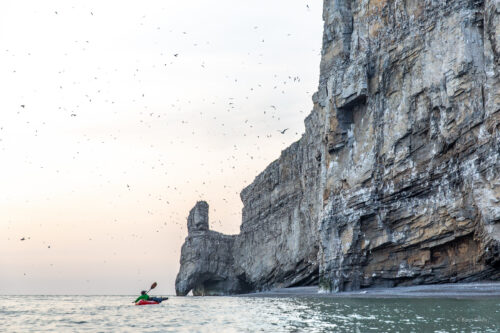
Some of McNett’s most formative experiences came on the water. During their first winter together, she and Olson built a double kayak from plywood using a stitch-and-glue method. Neither of them had done it before. The project became an early test of how they would make decisions together and work through disagreement.
By the time they launched the kayak, McNett felt confident they would make a solid crew. That confidence was put to the test during a month-long circumnavigation of Prince William Sound.
It rained every day. By the time they reached Montague Island, McNett’s shoulders were inflamed from constant paddling. Then came Hinchinbrook Entrance. Fog moved in and out, revealing and hiding their heading 9 miles away. Turning back meant camping on wet rocks in bear country. Going forward meant exposure and commitment.
They launched.
Once underway, the reality of distance and vulnerability became unavoidable. The heading appeared, disappeared, then appeared again. When they finally reached the far shore, McNett took off her hat and realized her hair had turned gray.
WILD FOOD AND RESPONSIBILITY
McNett and Olson have increasingly focused on filling their freezer with local wild food. The work extends far beyond the moment of harvest. Gear maintenance, processing, cooking and sharing all require time and effort.
“We eat organs and all kinds of weird bits,” McNett says. “We salvage and scavenge.” Beneath the humor is a serious ethic. Wild food is not just sustenance; It is a relationship.
“Wild food is better,” she adds. “I can taste the minerals and see vitality in the color.”
She frames humans as stewards within natural systems, capable of seeing the larger picture and therefore responsibleforhowmuchpressurethey place on wildlife and habitat. Hunting, fishing and foraging, she says, can be practiced with restraint and appreciation, or they can become exploitative. The difference lies in intent.

ALASKA, CHANGING UNDERFOOT
Because McNett travels slowly and often returns to the same places, she sees change clearly. Brush is overtaking open tundra. Winter trail formation and ice stability are less predictable. Coastlines are eroding. Glaciers are retreating. Storms behave differently.
Within her lifetime, she believes some of the routes she has traveled by bike will no longer be possible. These shifts are not abstract. They affect access, safety and the landscapes people depend on for hunting, fishing and travel.
PAYING ATTENTION AS A BACKCOUNTRY SKILL
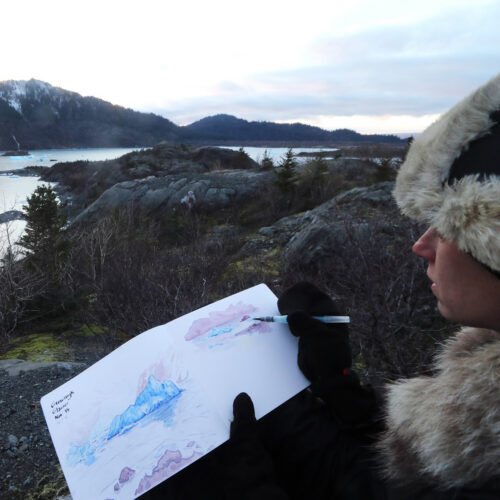
McNett’s work blends science, art and adventure, but at its core is attention. She keeps illustrated journals during her travels as a way to notice patterns, record observations and reflect on what she sees. For her, journaling is not about producing an object; it is a practice of awareness.
In Alaska, that awareness translates directly to safer and more thoughtful travel. Reading weather, ice, water and animal behavior is a skill developed over time, whether recorded on paper or held in memory.
WHAT COMES NEXT
McNett’s plans are always forming. A winter fat-bike trip; a sea kayak journey; time in the field with family. In 2026, she looks forward to teaching workshops in Seward and Denali and to spending more time painting.
For Kim McNett, Alaska continues to be learned a mile at a time, through effort, restraint and attention. The reward is not simply distance covered, but a deeper understanding of what it takes to move through the land responsibly and remain part of it. ASJ
Editor’s note: For more on Kim McNett’s artwork, go to kimsnaturedrawings.com, and follow on Facebook and Instagram (@kimsnaturedrawings). Tiffany Herrington is a Seattle-based writer.

Alaska Salmon 2011: Not Too Shabby

Prime Time For Face Time At Sportsmen’s Shows

EPA: Potential ‘Adverse Impacts’ On Bristol Bay Salmon Fishery With Pebble Mine; Comment Period On Draft Study Open Into July
About Author
