

No Way But Through: Inside An Anti-Pebble Mine Crusader’s Journey
The following appears in the May issue of Alaska Sporting Journal:
BY TIFFANY HERRINGTON
Shoren Brown is no stranger to a fight. As director of the U.S. Nature Initiative and a principal at Riverrun Consulting, Brown has spent over two decades building conservation campaigns that bring together unlikely allies across political lines.
He was the strategic architect of the federal campaign to protect Bristol Bay, helped lead the national field effort that safeguarded the Arctic National Wildlife Refuge in 2005 and has worked on public lands campaigns across the West.
Raised in the swamps of southern Louisiana, Brown’s early love of wild places and rural communities shaped a career that’s taken him from Southeast Alaska to the halls of Congress. His contribution to the recently published book Tools to Save Our Home Planet (read an excerpt on page 43) distills hard-earned lessons from a life spent defending landscapes, watersheds and the people who depend on them.
In our conversation, Brown reflects on the gritty realities of grassroots organizing, the unexpected allies who helped turn the tide and what it truly takes to protect one of the last great wild fisheries in the world. From his early days at the Southeast Alaska Conservation Council, to his long-running role as a strategist and spokesperson in the fight against the Pebble Mine, Brown shares stories that are as sharp as they are inspiring.
What follows is an unfiltered look at a man shaped by wilderness, driven by justice and determined to make sure the next generation inherits more than just a memory of wild places.

Tiffany Herrington Shoren, you’ve had quite the journey – from the swamps of Louisiana, often called a sportsman’s paradise, to the wilderness of Alaska.
How have these very different places influenced you and shaped your take on environmental activism?
Shoren Brown Yeah, I mean, I grew up running around the swamps as a kid. The three of us were homeschooled. We were pretty wild. My parents were pretty anti-establishment, so all my early memories are of running around with sticks and machetes, being in nature with my little brother and our friends. That upbringing totally shaped the way I interact with people and with nature.
In some ways, I’ve been trying to get back to the way I grew up my whole life, because it was incredible. We ran around the woods, set ant hills on fire, chopped down trees, chased snakes and alligators, tried to kill ourselves on the neighbor’s three-wheeler; thank god those things got banned.
Growing up that way, connecting with people in the woods, in nature – that’s just how we lived. Me and my closest friends spent time outdoors together, whether we were hunting or fishing or burning ant hills. There’s a kind of connection that happens in that space that doesn’t happen in development. It just doesn’t.
After undergrad, I moved to Juneau. That place rocked me. I was blown away by how vast it was, how wild, and how many people there were who were born from that place – people living in extremely rural Alaska, harvesting their own food from the water and land. I totally fell in love with it. I worked for the Southeast Alaska Conservation Council, met tribal leaders, talked to commercial fishermen on the docks, worked with Mark Kaelke, who ran a sportfishing business, and learned how to fly fish for the first time in the Gastineau Channel.
That experience led me to D.C., where I found myself one of the few people who’d worked in conservation in Alaska and was also willing to put on a suit every day. That duality made the transition into national work and the fight for Bristol Bay a pretty easy one.
TH So what led you into the fight for Bristol Bay?
SB I was a lobbyist for Trout Unlimited and the National Wildlife Federation, working in D.C. for a bunch of conservation-focused hunting and fishing groups, mostly on salmon issues around the Snake River dams and the Pacific Northwest.
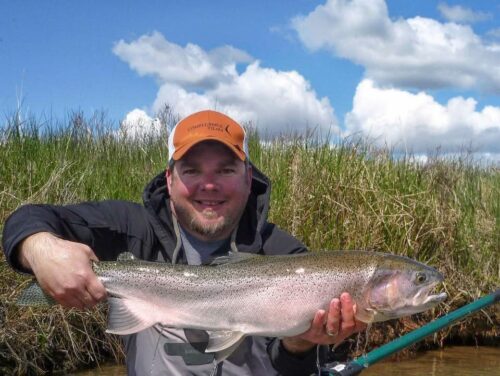
I’d worked with [SalmonState director] Tim Bristol before – back in the day at Southeast Alaska Conservation Council in like 1999. We shared an office wall, and I’d hear him yelling through it all the time. I remember thinking, “I want to be like that guy someday.” Later, he was working for TU and invited me up to a meeting in Bristol Bay. I fished during the season opener at Brian Kraft’s [Alaska Sportsman’s Lodge], guided by Kate and Justin. I got to fish the Naknek River for the first time and caught what I thought was a giant rainbow trout; turns out it wasn’t actually that big.
I met tribal leaders, went to the boatyard in Naknek, and talked to commercial fishermen. It was like my Juneau experience on steroids. At that time in the campaign, there was real unity in opposition to the mine, but no central strategy. Everyone was coming together, but the mine still felt like a done deal. I remember thinking, “This is a ripe environment for someone like me.” I’d worked with the White House, Congress, grassroots groups – you name it. The foundation was there, but the house hadn’t even been designed yet.
Right around then, the film Red Gold came out. I had just gotten married – it was 2009 – and I remember telling my wife, “This is it. I’m gonna do this, no matter what it takes.” I had that gut feeling. I’ve only had it a few times in life – when my kid was born, when I got married and that trip to Bristol Bay. I knew it was worth the fight. And I did. For nearly eight years, I woke up every day trying to move the ball forward on the Clean Water Act 404(c). It became a little bit of an obsession. But it was worth it.
TH Looking back at your time fighting Pebble Mine, was there a moment that really changed the course of the Bristol Bay campaign?
SB So many moments. A lot of personal connections … with people who had grown up in Bristol Bay and were just incredibly appreciative that someone from the Lower 48 was showing up and trying to help protect their jobs, their way of life.
And then there were the big ones. Like when some of the mining companies actually surrendered their leases. They gave up their stock, donated it to local groups, and just walked away. That was during the Obama Administration. It was huge. I remember we were on a trip in D.C. and the gravity of it hit us. We were up against three or four multinational companies. And suddenly, one of them drops out. You start thinking, “Wait, we might actually pull this off.”
Getting the [Environmental Protection Agency] to do the original watershed assessment was another key moment. Bringing scientists together, getting real data. It confirmed that there would be irreversible damage. It breathed new life into a lot of folks who’d been at this much longer than me. Some of them had been opposing Pebble for over a decade.
And when President Obama came to Bristol Bay – that was incredible. He went to the elementary school in Dillingham. Kids were in traditional regalia. A salmon spawned on his shoe. The whole thing was surreal. He listened to the people. And love or hate him, he showed up. That matters.
TH Can you share a story where local community efforts made a real difference?
SB Sure. It took Senator Mark Begich long time to get to the right place on Bristol Bay. We brought in Paul, this incredible grassroots advisor who had worked with the Democratic Party. He helped us understand that unless we got Alaska’s elected officials on board, we weren’t going to get the White House to act.
So we focused. We poured energy into getting constituents to call, write, show up. Senator [Lisa] Murkowski too. I remember this meeting in D.C.: Murkowski walks into the room and there’s this wild cast of characters – sportfishing lodge owners, commercial fishing leaders, tribal elders, conservationists – all sitting together. She said, “What are you all doing here?” That was the moment.
People who typically argue over fish allocation were unified. [Former state Senator] Rick Halford was there. He used to brag about his 4 percent League of Conservation Voters rating. Now he’s sitting there talking about how important a 404(c) is for Bristol Bay. When you create enough on-ramps for everyone to be involved, and don’t shut people out for being too conservative or too liberal, amazing things can happen.
TH Facing off against a behemoth like [Pebble Limited Partnership] must’ve been daunting. What were some of the toughest challenges you dealt with?
SB One of the toughest things? They bought up almost every major lobbying firm in D.C. out of the gate. Their strategy was to retain every big-name lobby shop with access so they’d be conflicted out of working with anyone else. Literally just dropped $100,000 here, $100,000 there, to lock up firms and control the narrative. It was disgusting. That’s part of what gives D.C. a bad name.
I remember doing a talk at Yale – this was at the height of the conflict – and Tom from PLP was on the panel via Zoom. It was me, Jason Metrokin from [Bristol Bay Native Corporation], Bob Waldrop from [Bristol Bay Regional Seafood Development Association], and a few others. Tom’s up on this massive screen behind us, saying things that just weren’t true, over and over. Finally, I couldn’t take it and said, “Respectfully, Tom, you’re full of sh*t.” And you could’ve heard a fish fart in that room; it went completely silent. Then he just laughed. That was a moment. It really showed how little they cared. These guys were in it for the money, period. They’d say or do anything.
And to be clear, that’s not representative of the entire mining industry. Most of them are actually pretty responsible. But PLP? They fought dirty. They made the whole industry look bad.

TH How did engaging with lawmakers and political pressures shape the direction of your campaign? And were there any unexpected surprises along the way?
SB It shaped a lot of what we did. I think one of the biggest surprises for me personally was when the first Trump Administration denied the Pebble Mine permit through the Army Corps of Engineers. It wasn’t a nail in the coffin, but it was a massive step forward. I mean, even a pro-development, anti- regulation administration looked at that project and said, “Wrong mine, wrong place.” And that’s what we’d been saying for decades at that point.
And here’s the thing: We didn’t dismiss anyone. We didn’t say, “Oh, we’re not talking to Donald Trump Jr.” We had multiple conversations with him, through various channels. He’d fished in Bristol Bay six or seven times before his dad was even president. Same with [Fox News host] Tucker Carlson. I don’t have much in common with the guy, but I helped fund some of the people who built a relationship with him around this issue, and he ended up playing a huge role in the permit being denied.
We all came together. The threat was so big, and we were so focused on winning, that the strategy was, we don’t say no to anyone unless they’re actively hurting someone on the team.
People are calling me again now, with Trump back in the picture, asking how we did it. And the truth is, there’s no secret sauce. Just stop setting up your campaign in a way that automatically excludes massive portions of the American public. We’ve got polling – like the Colorado College poll, which oversamples MAGA voters – and it shows the same thing every year: People overwhelmingly support conservation, public lands and clean water. We’re talking 60 to 70 percent support.
But a lot of those folks are never engaged by conservation organizations, because so much of the messaging leans left and doesn’t speak to their values. That’s a huge missed opportunity. Those people could be allies, donors, champions – if we just made space for them.
TH Campaigns like Bristol Bay take years to build. What kept you going when progress felt slow or setbacks hit hard?
SB The community. The people. I’ve got friends from the Bristol Bay effort who will be my friends forever. It was those calls when things got tough – when someone picked up the phone and said, “I believe in you. We can do this.” That mattered way more than any talking points, memo or website.
We live in a culture that’s obsessed with instant gratification. But if you want to do something meaningful – something that actually makes this country a better version of itself – you’ve got to be willing to bleed for it. And you’ve got to do it over the long haul. Durable change doesn’t come easy. Quick wins? They get undone fast. But long, difficult, committed work – that’s what lasts.
It’s hard to accept that in an age where you can press a button and have something show up at your door in 48 hours. But I don’t think that’s what America was built on. I think we have to get back to having the hard conversations and doing the long work it takes to make things better. Makes me sound like an old guy; but that’s where I’m at.

TH You often talk about balancing wise advice with trust in your own gut. How did you decide when to stick with conventional wisdom and when to forge your own path?
SB I have no idea [laughs]. I mean, you’ve got to trust your gut, and you’ve got to know who your people are. When you’re at the center of something like I was in the Bristol Bay campaign, you talk to different people for different reasons. Some you talk to every day because you need to keep them engaged and on the team. Others, you talk to them because they’re your people. They’ll tell you the truth. They’ll push you when you need it, and catch you when you smash your face on the ground.
Learning who those people are – and the difference between those two types of conversations – that’s critical. I learned a few hard lessons around that. But once you figure it out, it becomes a kind of compass.
Most of what I work on now? It’s as much art as science. I’ve been doing this for 25 years .You gather good data, you base your decisions on it but don’t ignore your instincts. There are things in this work that are simply unknowable. And if you only operate from what’s known, you’re going to miss opportunities.
We throw around phrases like “fail forward” or “don’t be afraid to fail,” and that’s fine. But they’re a lot harder to live than they are to say. Especially in conservation right now – we’ve got to rewrite the playbook. The last 90 days alone have shown that the old way of doing things doesn’t cut it anymore.
If you’re still approaching saltwater, freshwater or land conservation like you did 10 years ago, you’re going to struggle. This is one of those “watch the horizon” moments. You have to get creative. Listen to your gut. Maybe the thing you’ve believed for 25 years doesn’t match the moment anymore. That’s when it’s time to pivot.
TH In today’s fast-paced world, what do you think the future holds for long-term, sustained activism like the kind you led in Bristol Bay?
SB I actually think we’re going to see a lot more of it over the next few years. What’s happening right now with the Park Service and other federal agencies – the massive layoffs, the frozen funding – it’s bad. And I’m not saying the federal government is perfect, but I also know a lot of good people who work at [Bureau of Land Management], the Forest Service, [US] Fish and Wildlife [Service]. And when those positions vanish, it doesn’t just hurt public lands; it hurts businesses, communities.
I live in Missoula [Montana]. In the Bitterroot Valley, you’ve got hundreds of guys who do restoration work – fixing culverts, managing fire breaks, making sure homes don’t burn down in the summer. Right now, a lot of them don’t know how they’re going to make ends meet because the funding’s frozen or the phones aren’t even being answered anymore. That’s going to hit hard.
One of the biggest lessons I learned in Bristol Bay is that it’s one thing to say you care about the environment. It’s another thing when your family’s future, your personal finances, your livelihood – when those are tied to a place that’s under threat. That’s when people fight like hell.
And I think we’re only months away from a whole lot of people waking up and saying, “This isn’t working for me.” And when that happens, I hope to be involved in helping them fight for what matters.
TH Could you share one memorable story from your time in Alaska that really captures the spirit of your work and the passion behind these conservation efforts?
SB I’ve told a lot of the good ones already – at least the ones that are fit for print [laughs]. But the one I always come back to is being in the gym in Dillingham. The whole community was there: Kids in traditional regalia, commercial fishermen, elders. And then the president of the United States [Barack Obama] walks in.
That moment – it was the pinnacle. We had fought so hard and for so long to get Bristol Bay and the Pebble issue on the national radar. And then here’s one of the most powerful people in the world saying, “Yeah, I’m going to fly halfway across the globe to sit in this gym and listen to these people.”
That’s what democracy is supposed to be. No one in that room was thinking about who made what, or how their grandfather voted. They were thinking: we pulled together and fought for over a decade. And the president came to hear us.
That moment will stay with me forever. Honestly, it could’ve been any president. If it had been Donald Trump, that would’ve been great too. The point wasn’t who; it was that we managed to shine a spotlight on a place and a people who were being threatened and deserved to be heard. That’s the kind of moment that makes it all worth it. ASJ
Editor’s note: To learn more about what Shoren Brown does, check out natureinitiative.org. Tiffany Herrington is a writer based in the Seattle area.

Alaska Salmon 2011: Not Too Shabby

Prime Time For Face Time At Sportsmen’s Shows

EPA: Potential ‘Adverse Impacts’ On Bristol Bay Salmon Fishery With Pebble Mine; Comment Period On Draft Study Open Into July
About Author
