

Native American Rights Fund On Protecting Alaska’s Subsistence Fishing Opportunities
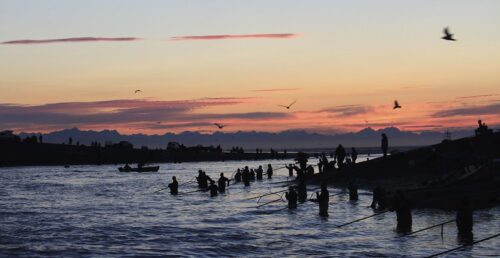
The Native American Rights Fund published a report on the importance of protecting Alaska’s subsistence fishing rights and opportunities, as part of its nationwide Headwaters Report.
Here’s a sample of that report:
For generations, Katie John and her family subsistence fished at Batzulnetas, a revered fishing site on the Copper River. When Alaska became a state in 1959, the state government assumed management of hunting and fishing. By 1964, the state had completely closed subsistence fishing along the upper Copper River, preventing Katie John and other Tribal members from exercising their fishing rights and maintaining their way of life.
In 1980, Congress passed the Alaska National Interest Lands Conservation Act (ANILCA), which included two critical components to protect subsistence practices by Alaska Native people. First, ANILCA established 100 million acres of conservation system units such as national parks, preserves, and refuges that are managed by the federal government as federal public lands. Many areas critical for Tribal subsistence hunting and fishing were covered in those conservation system units. Second, Title VIII of ANILCA established a priority for rural subsistence hunting and fishing on federal “public lands” whenever it becomes necessary to restrict hunting and fishing in times of shortage. This ensured that Katie John’s ability to catch salmon would be prioritized over the needs of the commercial fishing industry. In enacting Title VIII, Congress recognized that subsistence fishing is essential to Alaska Natives’ physical, economic, traditional, and cultural existence.
Congress expected Alaska to manage the rural subsistence priority and provided multiple extensions to allow for the State to assume management responsibility under ANILCA. Unfortunately, the State failed to enact an enduring subsistence priority for rural residents. Therefore, in 1990, the Departments of the Interior and Agriculture established the Federal Subsistence Board to manage subsistence resources on federal public land and waters. The board includes voting members who represent rural subsistence users. This enables people who rely on subsistence to have direct input into decisions.
The state has consistently argued that the federal government cannot regulate fishing on navigable waters such as the Copper River. Roughly speaking, a river is a “navigable water” if someone can comfortably paddle down it in a large raft. That means all major salmon bearing rivers in Alaska are navigable waters. At statehood, the federal government transferred ownership of the land beneath navigable waters to Alaska. Therefore, the state argues that it has management authority over what happens in navigable waters. The state wants to manage fishing on rivers even if they run through federally owned land that ANILCA designated as part of a conservation system unit. However, that argument does not make sense when considering ANILCA’s goal of protecting subsistence fishing. If ANILCA excludes major salmon rivers, it cannot protect subsistence fishing.
Alaska’s Native organizations have worked tirelessly to preserve wilderness areas to continue subsistence fishing and hunting, and with the newest moves of the Trump administration to pursue drilling and mining projects on Alaska’s National Petroleum Reserve, Arctic National Wildlife Refuge, the Chilkat River Valley and along the Ambler Road route.

Alaska Salmon 2011: Not Too Shabby

Prime Time For Face Time At Sportsmen’s Shows

EPA: Potential ‘Adverse Impacts’ On Bristol Bay Salmon Fishery With Pebble Mine; Comment Period On Draft Study Open Into July
About Author
