

More Reaction To Alaska Drilling Plans, This Time Over Arctic National Wildlife Refuge
As the federal government races towards its goals to “drill, baby, drill” in Alaska with several projects being pursued, including plans to drill on formerly protected public land within Arctic National Wildlife Refuge.
Here is some reaction, first from the Arctic Defense Campaign:
Amid Shutdown, Trump Administration and Congress Push to Sell Off Nearly 1.6 Million Acres of Public Lands in the Arctic Refuge for Oil and Gas Development
Expanded Leasing and Drilling in the Arctic Refuge Would Harm Indigenous Communities and Wildlife, and Is A Bad Deal for Taxpayers
(Washington, DC) — Today, Secretary of the Interior Doug Burgum announced the repeal of a Record of Decision (ROD) for the Arctic National Wildlife Refuge leasing program issued by the Biden administration. In its place, the Department of the Interior opened the entire 1.56 million acres of public lands in the sensitive Coastal Plain to oil and gas leasing and drilling. Additionally, Sec. Burgum stated that he would unsuspend the Alaska Industrial Development and Export Authority’s (AIDEA) oil and gas leases, which cover more than 365,000 acres in the Coastal Plain.
Oil and gas leasing and development in the Arctic Refuge directly threaten Indigenous communities’ subsistence lifestyle, particularly the Gwich’in Nation, who rely on the Porcupine Caribou Herd as their cultural cornerstone and food source. The Porcupine Caribou Herd’s birthing and nursery grounds is the Coastal Plain. Moreover, the Arctic Refuge drilling program has now been real-world tested twice and proven to be a bad investment for taxpayers–failing to generate anywhere close to the $1-2 billion in revenue the administration and Congress promised it would.
Today’s announcement follows the introduction of a Congressional Review Act Resolution last week to overturn the Arctic Refuge leasing program adopted by the Biden Administration. The Trump administration and its allies in Congress have made expanding oil and gas development in the Arctic a clear priority, even during an ongoing government shutdown. Attacks on key protections for these landscapes are coming from all fronts, targeting places like the Arctic National Wildlife Refuge and the National Petroleum Reserve – Alaska in the Western Arctic, which received critical protections under the previous administration that this administration and Congress are also pushing to undo.
In response, Members of the Arctic Defense Campaign shared the following statements:
“This action by the Trump administration is a direct attack on the Gwich’in, who have for decades been a voice for the caribou and stood against the destruction of the Arctic Refuge. A leasing program that would open the entire Coastal Plain completely ignores the impacts that oil and gas development would have on the land, on wildlife, and on our communities,” shared Kristen Moreland, executive director of the Gwich’in Steering Committee. “We condemn these efforts by the Trump administration to exploit the calving grounds of the Porcupine Caribou herd for short-term gain, and we know that we are not alone. We will continue to raise our voices and fight for the protection of this sacred land and for our way of life.”
“We’re committed to protecting the Arctic not just for ourselves, but for future generations. Stewardship is a shared responsibility—and it’s time for policies that reflect that truth,” said Nauri Simmonds, Executive Director of Sovereign Iñupiat for a Living Arctic (SILA). “Many Alaska Native communities, like Nuiqsut, are already facing negative health impacts from oil and gas development on their lands, and are struggling to provide for their families due to impacts on the local fish and wildlife populations. Opening the Coastal Plain to oil and gas development would only serve to do the same for more Alaska subsistence communities–all for short-term gain.”
“The Arctic Refuge is the crown jewel of our public lands system. During a government shutdown, when everyday Americans are left without basic services, this administration has chosen to double down on failed policies that prioritize oil corporations over people. Alaska is under relentless attack, and Alaska’s iconic wild places are a powerful reminder of what we all have lost as we face continued efforts to dismantle public lands across the country,” said Kristen Miller, executive director at Alaska Wilderness League. “Opening the entire Coastal Plain of the Arctic Refuge to drilling would destroy one of the most ecologically significant landscapes on Earth—the birthing grounds of the Porcupine Caribou herd, vital habitat for polar bears and migratory birds, and sacred land for the Gwich’in people who have stewarded its resources for millennia.”
“Today the Trump administration said it intends to wholly exploit the coastal plain of the Arctic National Wildlife Refuge for the benefit of the oil industry by overtly ignoring the sanctity of lands held sacred by the Gwich’in of Alaska and Canada, and essential to the health of the Porcupine caribou herd and other Arctic animals,” said Vicki Clark, executive director with Trustees for Alaska. “The administration does not care about, let alone acknowledge, the concerns of people whose ways of life are directly impacted by leasing and drilling. It does not care about prior analysis and the known facts about the harm drilling would do to people and animals. It does not care about decision-making norms, legal obligations, and public participation. What it does care about is picking and choosing corporate interests over the public interest and people who have sustained healthy relationships with these landscapes for thousands of years. We will today, and every day after, stand with the Gwich’in and partners to protect the Arctic Refuge.”
“Today’s Arctic Refuge announcement puts America — and Alaska — last,” said Earthjustice Attorney Erik Grafe. “Expanding oil drilling in the Arctic threatens irreplaceable wildlife and cultural traditions that exist nowhere else in the world.?It worsens the climate crisis and undermines energy security by seeking to lock in reliance on fossil fuels.?The Gwich’in people, most Americans, and even major banks and insurance companies know the Arctic Refuge is no place to drill. Today’s decision by the Trump administration is irresponsible as a policy matter, a poor economic decision and flouts laws that protect this irreplaceable landscape.”
“Drilling in the Arctic Refuge is reckless,” said Bobby McEnaney, Director of Land Conservation at NRDC. “The Coastal Plain is sacred to the Gwich’in people and the nursery for caribou and polar bears. The market has said no—banks and insurers won’t back it, lease sales flopped, and taxpayers are left holding the bag. Public lands must serve people, wildlife, and a livable climate—not host a fire sale for fossil fuel companies.”
“Today’s reckless and rash decision invites the oil industry to industrialize the entire coastal plain of the Arctic National Wildlife Refuge, unconscionably selling out an irreplaceable part of our nation’s natural heritage,” said Nicole Whittington-Evans, senior director of Alaska and Northwest programs at Defenders of Wildlife. “This treasured landscape supports unparalleled wildlife like polar bears, migratory birds from around the world, and the Porcupine Caribou Herd, upon which the Gwich’in people depend for physical, cultural and spiritual sustenance. We remain steadfast in our resolve to protect the priceless coastal plain of the Arctic National Wildlife Refuge.”
“Efforts to double down on the industrialization of the sacred coastal plain in the Arctic Refuge put short-term profits ahead of our long-term responsibility to safeguard the wild places that sustain us,” said Alaska Senior Manager Meda DeWitt of The Wilderness Society. “It’s common sense to never allow oil and gas development on sacred caribou calving grounds. We owe it to future generations to protect the Arctic’s wildlife, communities, and this pristine landscape from irreversible harm.”
“The decision to revive the Trump-era leasing plan for the Arctic Refuge is a reckless betrayal of Alaska’s people, wildlife, and future,” said Krystal Lapp, President of the Northern Alaska Environmental Center Board of Directors. “Opening the Coastal Plain to drilling endangers the Porcupine Caribou Herd, threatens the Gwich’in Nation’s food security and cultural survival, and ignores the proven economic failures of this program. At a time when banks, insurers, and the public have all rejected this project, the administration’s choice to prioritize corporate interests over communities and the climate is both irresponsible and shameful.”
“The decision today threatens the integrity of one the most biologically important national wildlife refuges in the entire National Wildlife Refuge System,” said Desirée Sorenson-Groves, President and CEO of the National Wildlife Refuge Association. “Today’s actions undermine 65 years of conservation precedent and weakens protections for all public lands.”
Additional Background:
The Arctic Refuge is one of our nation’s most majestic and treasured public lands, home to the Porcupine Caribou Herd, denning polar bears, musk oxen, wolves, and nearly 200 species of migratory birds. The Gwich’in Nation, living in Alaska and Canada and 9,000 strong, has worked to protect these lands for generations. They – along with Iñupiat land protectors – strongly oppose this dangerous rush to drill, which threatens to alter caribou migrations and population, risking the Gwich’in way of life.
The fact that banks won’t fund it, insurance companies won’t underwrite it, and drilling in the Refuge has broad, long-standing opposition from the Gwich’in Nation and the American public clearly shows that there is nothing to be gained, but much to be lost from developing this irreplaceable landscape.
###
The Arctic Defense Campaign was created in 2023, when the Arctic Refuge Defense Campaign (ARDC) merged with a coalition of groups working to protect the National Petroleum Reserve-Alaska (Reserve) to defend America’s Arctic from destructive oil and gas development. ADC is supported by a diverse constituency of organizations.
October 23, 2025
Trump Administration Opens the Entire Coastal Plain of the Arctic National Wildlife Refuge to Oil and Gas Leasing
At the expense of communities and our climate, this massive public lands attack auctions off treasured lands in the nation’s largest wildlife refuge to benefit fossil fuel companies
CONTACTS
Elizabeth Manning, Earthjustice, emanning@earthjustice.org
ANCHORAGE, AK —
Secretary of the Interior Doug Burgum today announced that he will open the entire 1.56 million acres of the Coastal Plain of the Arctic National Wildlife Refuge to oil and gas leasing. These lands are sacred to the Gwich’in Nation, home to irreplaceable wildlife, wilderness and cultural values, and have never seen industrialization.
In an action taken during a government shutdown, the Department of Interior held a press conference to announce a series of resource development actions aimed at opening up Alaska for the benefit of corporate polluters. A key announcement made today was the rescission of the Biden administration’s drilling program for the refuge. DOI is instead replacing that program with a previous Trump-era plan that fully opens the Coastal Plain of the Refuge to maximum oil and gas development.
In addition to the Refuge announcement, Sec. Burgum also announced that DOI has completed the land exchange which will allow a road to cut through the Izembek National Wildlife Refuge.
Sec. Burgum also announced the issuance of right-of-way permits and another permit allowing the Ambler Road to be built to build potential new mines. The proposed Ambler Road is a financial boondoggle that has been opposed by 88 Alaska Native Tribes and First Nations, and will cause substantial harm to wildlife, including caribou.
The move to open the Arctic National Wildlife Refuge’s coastal plain to oil and gas leasing also follows a Congressional Review Act resolution introduced earlier this month by Rep. Nick Begich (R-AK) that would accomplish the same thing — overturning the Biden administration’s previous Record of Decision for oil and gas leasing in the Refuge.
Simultaneously, DOI announced it is reaffirming unlawful Coastal Plain leases issued to the State of Alaska-sponsored corporation, the Alaska Industrial Development and Export Authority, covering about 370,000 acres within the Coastal Plain.
With Alaska’s Arctic warming 3–5 times faster than the rest of the planet, the climate consequences of expanded Arctic oil and gas drilling will be disastrous for Alaska’s communities, as well as Americans nationwide. Communities and infrastructure in Alaska are at risk from thawing permafrost, the loss of sea ice, and rapid coastal erosion, with communities in Alaska and elsewhere suffering devastation and in some cases having to relocate due to intensified storms linked to climate change. These climate impacts also come with dire economic consequences that the government is not adequately factoring in its decision-making. In addition, few companies have expressed interest in bidding on these leases, resulting in those that do go up for sale generating far less than the income touted by the Trump administration.
Earthjustice statement in response to today’s actions:
“Today’s Arctic Refuge announcement puts America — and Alaska — last,” said Earthjustice Attorney Erik Grafe. “Expanding oil drilling in the Arctic threatens irreplaceable wildlife and cultural traditions that exist nowhere else in the world.? It worsens the climate crisis and undermines energy security by seeking to lock in reliance on fossil fuels.?The Gwich’in people, most Americans, and even major banks and insurance companies know the Arctic Refuge is no place to drill. Today’s decision by the Trump administration is irresponsible as a policy matter, a poor economic decision, and flouts laws that protect this irreplaceable landscape.”
Background
The Arctic National Wildlife Refuge covers about 19.3 million acres in northeast Alaska and is the largest national refuge in the United States. It borders Canada to the east and the Beaufort Sea to the north.
The Refuge includes diverse habitat that support a broad range of species including caribou, brown, black and polar bears, Dall sheep, moose, foxes, muskoxen, marine mammals including whales and seals, and numerous birds. The calving grounds of the Porcupine Caribou herd, which have sustained Gwich’in people for generations, are within the Coastal Plain of the Refuge. The Refuge’s coastal plain also provides an important denning area for female polar bears in winter.
Earthjustice has long defended the Refuge against oil and gas development. In 2021, we challenged the first Trump administration’s plan to pursue oil and gas development in the refuge along with leases purchased at an extremely low price by the Alaska Industrial Development and Export Authority (AIDEA), a State of Alaska sponsored corporation. That lawsuit is currently on hold, but Earthjustice stands ready to again defend against these leases, as well as other threats to the Refuge that don’t follow the law.
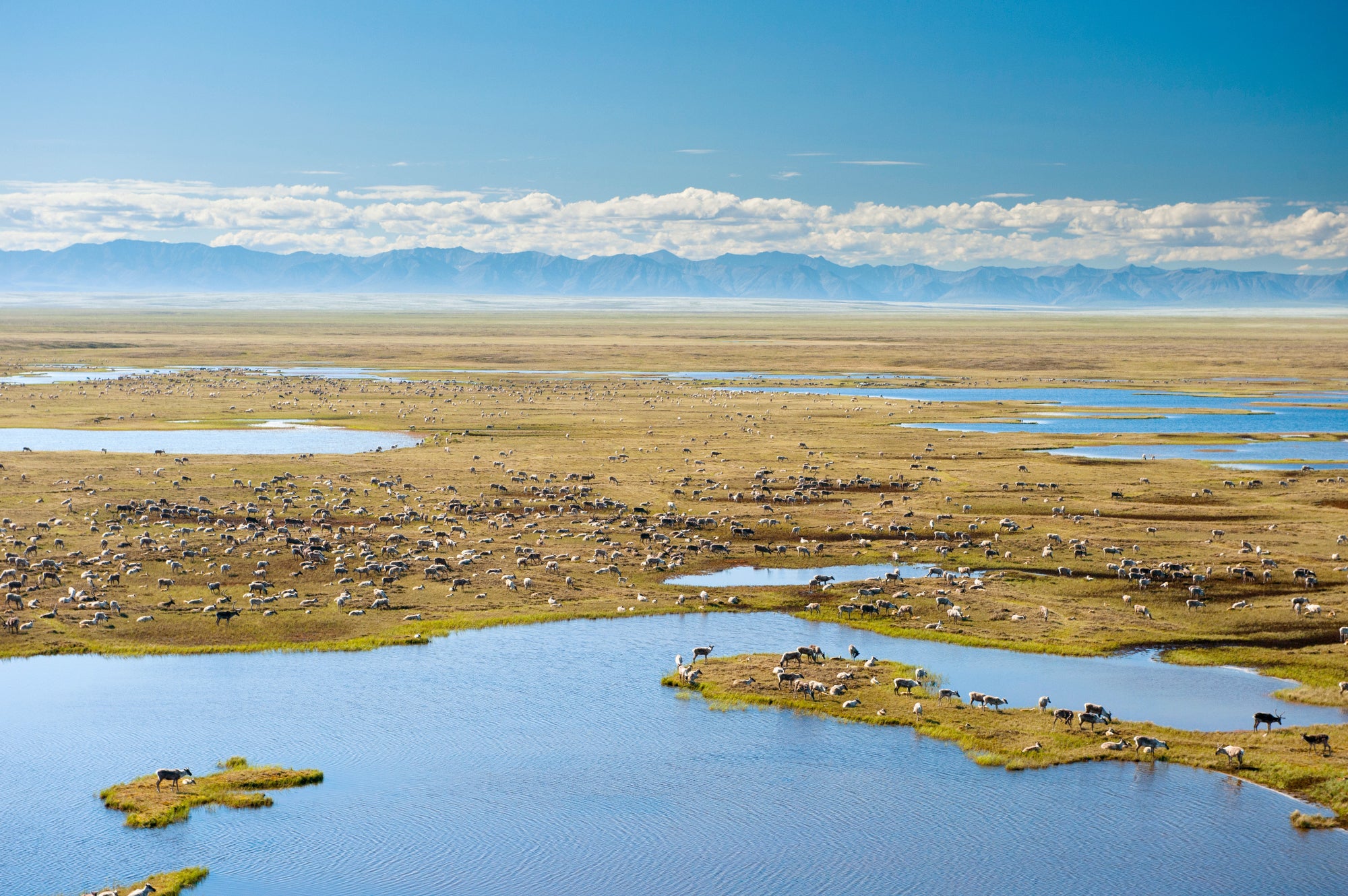
Caribou on the Coastal Plain of the Arctic National Wildlife Refuge in Alaska. (Florian Schulz / protectthearctic.org)

Alaska Salmon 2011: Not Too Shabby

Prime Time For Face Time At Sportsmen’s Shows

EPA: Potential ‘Adverse Impacts’ On Bristol Bay Salmon Fishery With Pebble Mine; Comment Period On Draft Study Open Into July
About Author
