

Fin Whale, Possibly Pregnant, Killed In Collision With Cruise Ship Enroute To Seward (Update)
A tragic accident involving a cruise ship and a fin whale resulted in the dead mammal that may have been pregnant. Here are some details from Alaska’s News Source:
Based on initial findings, NOAA said the whale may be pregnant. NOAA is asking the public to stay away from the site while it collects samples.
The vessel that hit the whale was the Ovation of the Seas, owned by the Royal Caribbean Group. The company said in a statement to Alaska’s News Source they are cooperating with the NOAA and are awaiting the necropsy results.
“We are saddened to hear that one of our ships struck a whale while on its way to Seward. We take any impact to marine ecosystems very seriously,” the statement read in part. “The ship immediately reported the incident to the proper authorities.”
Fin whales are on the endangered species list.
NOAA posted the following on its Facebook page:
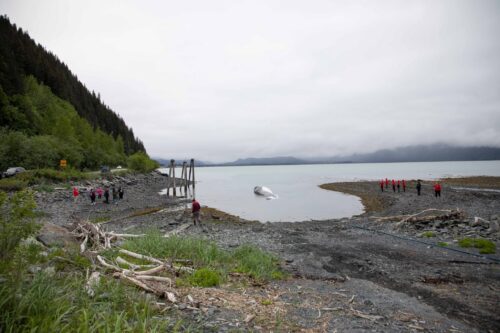
On Friday, June 19, a cruise ship arrived at the dock in Seward, Alaska, with a dead fin whale on top of the ship’s bulbous bow. A local company towed the whale to a nearby beach for a necropsy (animal autopsy).
We are working with the Alaska SeaLife Center to perform a necropsy on the 61-foot, adult female fin whale to determine the cause of death. Initial findings indicate the whale was pregnant. Please stay off the beach at the necropsy site for your safety and to allow space for the team to perform the examination and collect samples.
The NOAA Fisheries Office of Law Enforcement is investigating the incident. If you have any information, please call the 24-hour enforcement hotline at (800) 853-1964.
Fin whales are listed as endangered under the Endangered Species Act. We remind the public that it is illegal for anyone to collect tissue, baleen or any part of the whale, unless you are an Alaska Native collecting tissue or parts for subsistence or use in handicrafts.
The Center For Biological Diversity also weighed in on the incident:
“It’s heart-wrenching that this endangered pregnant fin whale was likely killed by this monster cruise ship,” said Cooper Freeman, Alaska director at the Center for Biological Diversity. “We’re sick and tired of the cruise ship industry polluting our waters, hitting our whales, and overwhelming local communities. This deserves a full investigation, with hard questions asked about how it happened. But the real solution is mandatory speed limits in whale hot spots, which have been shown to dramatically reduce the risk of tragedies like this.”
Update: Center for Biological Diversity issued a press release urging Royal Caribbean ships to show more caution to avoid similar incidents:
Following Whale Death, Royal Caribbean Cruises Urged to Slow Down to Prevent Ship Strikes
Preliminary Findings Indicate Pregnant Fin Whale Killed by Ship Strike in Alaska
ANCHORAGE, Alaska— The Center for Biological Diversity today urged Royal Caribbean to adopt a policy of slowing its cruise ships to 10 knots or less when traveling through important whale habitat.
Today’s letter to the company follows a June 19 incident where a Royal Caribbean mega-cruise ship arrived at port in Seward, Alaska, with a dead endangered fin whale on the bow. Federal officials determined that the whale was pregnant and had suffered blunt force trauma to the spine, ribs and jaw — consistent with a ship strike.
“I’m infuriated that this supersized cruise ship hit an endangered whale in such a horrific way,” said Cooper Freeman, Alaska director at the Center for Biological Diversity. “The death of this mother and baby fin whale sets back the entire population. Royal Caribbean must be held accountable for this gruesome death and take immediate action to avoid this happening again.”
Vessel strikes are a leading cause of death for large whales, with hundreds of whales killed in U.S. waters every year by ship strikes. Scientists regard documented cases as an undercount, because most whales struck by ships sink to the bottom of the ocean, going unnoticed or unreported.
Except for Alaska Native subsistence harvest, killing a whale, even accidentally, is illegal under the Marine Mammal Protection Act and the Endangered Species Act for listed species such as the fin whale. The June 19 incident is under investigation by federal authorities.
“People deserve to know how this happened, including whether the crew knew there were whales in the ship’s way and how fast the ship was traveling,” said Freeman. “For years we’ve been calling on the federal government to implement mandatory vessel speed reductions in whale hot spots, but Royal Caribbean can take immediate action to avoid hitting more whales with its ships. It’s so frustrating that government and industry fail to enact common-sense solutions to this problem while our endangered whales suffer deadly consequences.”
The Center’s letter urges Royal Caribbean to “adopt a policy requiring your cruise ships to slow to 10 knots or less when traversing through important whale habitat areas.” Studies show that slowing ships to 10 knots or less can prevent deadly ship strikes.
The Center also has a lawsuit pending against the U.S. Coast Guard over the agency’s failure to protect whales in designated shipping lanes off the West Coast of the United States.
The Center for Biological Diversity is a national, nonprofit conservation organization with more than 1.8 million members and online activists dedicated to the protection of endangered species and wild places.

Alaska Salmon 2011: Not Too Shabby

Prime Time For Face Time At Sportsmen’s Shows

EPA: Potential ‘Adverse Impacts’ On Bristol Bay Salmon Fishery With Pebble Mine; Comment Period On Draft Study Open Into July
About Author
