

Baiting, Waiting, And More Waiting For Bear Hunters
The following appears in the September issue of Alaska Sporting Journal:
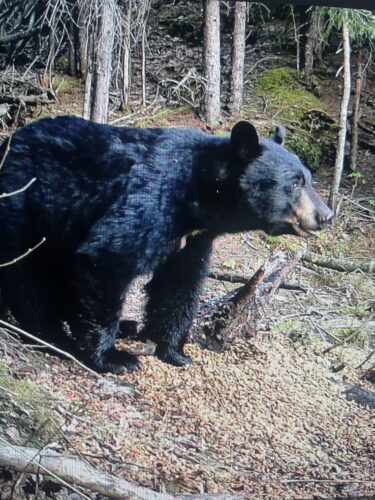
bruin. As author Brian Watkins writes, “Baiting takes thought, knowledge and skill.” (BRIAN WATKINS)
BY BRIAN WATKINS
Bear baiting may be one of the most controversial and debated subjects within the hunting community. Hunter ethics and fair chase come into question.
But there is a reason some bear hunters, specifically baiters, are often more successful than others. Baiting is hard work. It takes dedication and persistence. It also takes self-control to avoid mistakes such as: sitting on a bad wind; letting a bait go dry; not consistently checking or hunting the site. Indeed, there are a lot of factors that make or break success when baiting.
In people’s heads, bear baiting is throwing food on the ground and sitting over the pile until a bear comes in. Yes, success can be achieved that way by the lucky – but not often. Baiting takes thought, knowledge and skill. There are people who consistently find success in bear baiting. You’ll likely find that those people also have success in the field on other game animals, or spotting and stalking bears as well.
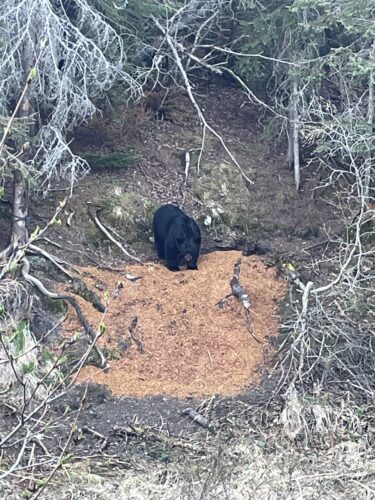
“Refreshing a bait with scent and food keeps the bears in the area,” the author writes. “I check my site twice a week. I also put out a ton of food so that they never eat it dry. (BRIAN WATKINS)
THINK AHEAD Finding a baiting spot takes a lot of thought. You have to have knowledge of bears’ travel corridors, comfort zones and natural habitat, plus you have to distance yourself from areas people normally travel to or spend time in. Contrary to popular opinion, bears are shy by nature and reclusive in presence. It’s also imperative to distance yourself from other baiters.
Not all people know how to hunt baits, and an increase in pressure tends to have the inverse effect on success. Those who are successful watch the wind and weather. When setting up a stand, pay attention to the prevailing wind direction. Nothing kills a baiting spot like hunting in bad wind.
I’ll stay out of a stand not only due to a bad wind direction, but if it’s blowing over 15 miles per hour. Bears don’t like to move on windy or rainy days. There’s no use putting unneeded pressure on an area when the bears aren’t typically there. Save it for a nice calm day when the wind direction is favorable.
DETAILS MATTER
Consistency is key with baiting as well. Refreshing a bait with scent and food keeps the bears in the area. I check my site twice a week. I also put out a ton of food so that they never eat it dry. Bear baiting is expensive and takes a lot to run. The only time I let a bait run out of food is when a sow and cubs come in. I’ll let it go dry for three days. The reason for that is in hopes the bears move on and don’t eat all of my food, which costs a lot.
This season, I had two black bear sows with three and four cubs coming in. I let the bait go dry twice, but they came back and ate roughly 50 pounds of dog food a day. That was fun.

DON’T GET DISCOURAGED
This hunting season was extremely slow. Spring held on and it was below freezing through the end of May. Most bear hunters gave up. As I said, be consistent. Know how the bears act as well. I constantly monitor trail cameras and track what bears are in.
Learn how to tell a sow from a boar. The sows will eventually bring the boars in. I had assistance this spring as well. For the first time in years, I had a partner run the bait with me. We stocked the bait and kept it replenished throughout the spring. The families of black bears kept eating piles of dog food all spring. I went through 1,500 pounds of dog food, with most of it keeping those two families fed. We had a couple of other bears in and out, but nothing consistent. We passed on some smaller black bears and one small brown bear that liked to camp on the bait too.
BROWN BEAR VISITORS
The season was winding down, and with 10 days left, a breeding pair of brown bears started to show up. We sat one night after the pair had been in the previous two nights. They came in between 1 and 2 a.m. Knowing that a breeding pair can be on station any time of day, I advised my buddy Dave to be ready all night.
At first, brown bears tend to come in in the middle of the night, then they’ll begin arriving earlier and during daylight. They’ll do this for between four to six days on average. Once the boar breeds the sow, they’ll both leave. As I said before, consistency is key, so we hunted as soon as we saw them on camera. Since we check twice a week, it increases the odds of bears on bait when they’re there.
Dave had never shot a brown bear before and I’d made up my mind he could shoot the first nice one that came in. This was our ninth sit together. The boar came in first. Dave took his time and waited for the bear to be at a good broadside position, then took a shot. The bear spun around and took off. What I didn’t tell Dave was that I’d seen another bear behind the bait as his boar came in. I knew it was the pair, but I didn’t want to pull his attention away from his shot. I also knew it was the boar he’d drawn back on.

DOUBLE DOWN!
Seconds after Dave’s bear took off, the sow came in. I typically wouldn’t shoot a sow, as there are strict guidelines on how many Kenai Peninsula sows can be harvested in a season. I had called earlier that day and knew that only two of the 12 in the quota had been taken. With a little more than a week of hunting left, I knew the sow count wouldn’t be met, so I let an arrow fly for a double brown bear harvest.
I double-lunged my bear. Both animals were dead within 100 yards of the bait! A slow season had turned into an epic night. After things settled, Dave looked at me and said, “My whole body is shaking! I have never felt this before!” I replied, “Welcome to hunting brown bears!”
As college friends, I don’t think either of us would’ve thought we’d be hunting brown bears together in Alaska. But here we were with a double. ASJ

Alaska Salmon 2011: Not Too Shabby

Prime Time For Face Time At Sportsmen’s Shows

EPA: Potential ‘Adverse Impacts’ On Bristol Bay Salmon Fishery With Pebble Mine; Comment Period On Draft Study Open Into July
About Author
