

An Ode To 2025: Our Favorite Stories Of The Year
Happy New Year’s Eve! Before we toast to day one of our country’s 250th birthday celebration, here’s a look back at some of our publication’s best stories of 2025:
JANUARY: PRACTICING SOME ZEN IN THE NAME OF MOOSE HUNTING

How do you practice shoshin? First, explain a theory to yourself or someone else. Dave and I talked about how to hunt these moose. It was a warm fall. Do we sit and call or move and find the moose?
The area was flat and lacked an easy spot to glass from. We would call and move. I knew not to do it, but we got antsy. We talked about it every evening as we failed to turn up moose. We knew the moose would respond as the season progressed, but it was a short season that ended as the rut came into full swing. We decided it would be best to sit still and call, even with the boredom of the strategy.
Another strategy of shoshin is to argue with yourself. Why are we where we are? Is our strategy successful? How can we do things differently? We would change where we called based on the wind. We would call where we saw the most sign. But was this effective? How could we create success? It’s a constant battle I always have.
I would go back and forth on cow calling and bull grunting. I would look at maps for better areas. Success is synonymous with being open to change. Finally, I saw a spot where there was a lake that looked great. It had marsh, grass, willows and spruce. Those three environments are great for moose because they provide food, cover and protection. After seeing a lot of sign in one part of the unit, studying the map led us to this area.
Look to the stars. It’s important not to get wrapped up in your own ego and be willing to look for guidance.
We were new to the area; new to the heat of a warm fall; new to the low-lying terrain of this tag. At a loss, we reached out to area biologists for insights. One biologist suggested that we stay away from cow calling, keep the bull grunts to a minimum and just scrape. I had heard of just scraping before, but it didn’t give me visions of success. I had to remember the magic word: shoshin. -Brian Watkins
FEBRUARY: A HUSBAND AND WIFE EXPERIENCE ALASKA TOGETHER

On one of our boating excursions, we rode by a small group of islands where seals lived. The orcas passed right through that area and spent an hour or so hunting.
As they moved closer to us and eventually turned south along the coast, we jumped into our car and followed them down the Tongass. We spent a little over four hours in total chasing the killer whales and taking pictures. Locals and tourists alike followed them south with us, all equally excited to watch the whales. A mother and her calf were the most popular of the pod. We could not stop smiling and I was yet again wowed by the incredible beauty that Alaska holds.
We enjoyed multiple excursions – kayaking, halibut fishing, whale watching (we saw more humpbacks on the Aleutian Ballad crab boat tour) and ate as much crab as we possibly could.
I schooled a couple of elderly Ohioans on manners during our halibut trip. I was catching more fish than anyone else, and one made the remark, “This is why girls shouldn’t be allowed on boats.” I made him aware that I had not been a girl for a long time and that I was a “full-fledged woman.” (Yes; I said that; it’s OK to cringe.) I then proceeded to immediately call out “Fish on!” as I had yet again hooked another fish. We all made nice and Brian and I ensured they went home with fish for their freezer since they did not catch their limit on their own.
We spent very little time in the tourist traps, as we preferred to be immersed in nature and with each other rather than surrounded by all the people who came in by cruise ship daily. -Anne Kelly
MARCH: AN ANGLER THINKS PINK IN YAKUTAT

Some of my favorite trips as a Situk guide were taking families on trips to intentionally target pink salmon. Any other species that went into the bag limit was a pleasant surprise rather than an expectation. Seeing kids rope in fish after every cast and make their Alaskan adventure dreams come true is hard to beat.
There are big bag limits for Lower 48 fishermen who just want to fill their freezer, which keeps the fish processors at the lodge busy. Savvy anglers know not to take resources for granted, especially when that resource provides subsistence, entertainment and employment.The pace of this fishery is a little different too. Not having to play hopscotch with a ton of other boats redirects our priorities in the right place to simply enjoy the ride and our time on the water.
The availability and accessibility of DIY adventures is easier to come by for independent anglers as well. Remote Southeast Alaska streams like Tawah Creek provide opportunities to fish where you’re more likely to share space with a brown bear than another angler.
While pink salmon aren’t at the top of the list for most anglers planning a trip to Alaska, the fishery offers some great opportunities for both less experienced and younger anglers. Not only are they plentiful and easy to catch, but there’s far less traffic on the river during those transition times between sockeye and silver season. There’s also the opportunity to possibly catch all three species, as well as kings in the salt. Booking saltwater charters is easier when there’s not as many guests to compete with for seats. And last but not least, when booking is slow at the lodges, you’re quick to get a drink at the bar. -Randall Bonner
APRIL: PHEONIX RISING: FROM THE RINKS OF ALASKA TO PRO HOCKEY
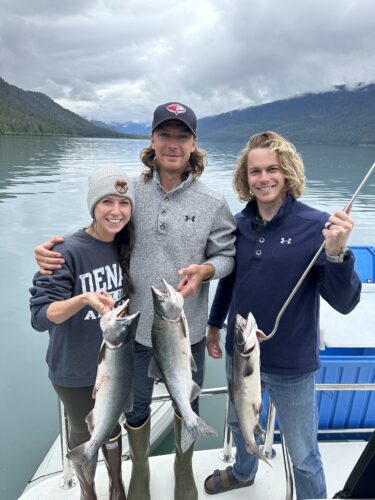

Each summer, Pheonix and his wife Jess usually return to Alaska at least once, sometimes twice, before he heads back to the Lower 48 for his hockey teams’ training camps. The area in and around Valdez is a favorite family gathering spot, where they’ll fish, hike and even jump into cold water for a refreshing dip.
“It’s awesome. It’s unbelievable to go up there and see my old buddies and family. I’ll always want to go back to Prince William Sound every summer. It’s such a quiet place, so much natural beauty and the town of Valdez is awesome,” he says. “It’s great to get there and recharge and soak up nature. It does rain, but when you get a sunny day, it’s unbelievable. Getting up there at the end of the season and unwinding.” “When I think about fishing right now, when you’re out on the ocean or the river, it’s just so peaceful. Just waking up and fishing. I remember a couple times being out on our kayaks and then heading back to shore. There are some glacial-fed rivers we’ll jump in, and the water’s freezing cold, but it’s so refreshing; the mountains are all around you. It’s quite the place. But that’s what I think about in my Alaska memories.”
Preseason practice means he usually misses out on Navarone’s and Matt’s fall hunting trips. Someday he’ll join them and give hunting a try as well. And though he hasn’t been back to Michigan Tech since his two-year stint there, one summer he and his teammates took advantage of the campus’s Upper Peninsula location to fish for walleye. In fact, his alma mater reminds Copley of Alaska for its remoteness and natural beauty, which he hopes to get back to enjoy down the line.
He’ll always appreciate what the Last Frontier’s lifestyle has meant for him. Copley considers himself a halibut angler more than anything else. But he really wants to target trout and salmon on the Kenai Peninsula’s myriad rivers and lakes as part of his Alaska bucket list.
Just getting a chance to kick back, recharge and refresh his body – both mentally and physically (see sidebar, below, on his nutritional side hustle) – is cathartic.
“Everyone in Alaska kind of partakes in things like that, because there’s only so much to do in Alaska, and that’s one of the biggest things you can do,” he says of fishing. “When you’re up there, even if you really wouldn’t necessarily be a fisherman, if you’re going to live there, somebody will ask you to go fishing, and they’ll say, ‘I’ve got a really good spot.’” -Chris Cocoles
MAY: A FISHING TOURNAMENT TO HONOR ALASKA’S SERVICE MEMBERS

Today, the tournament still carries that original spirit – one of appreciation, camaraderie and saltwater therapy. Captains from nearly every charter operation in Seward donate their boats and time. Local volunteers hand out breakfast burritos at 5 a.m. and hot meals at the closing banquet. And the fishing? It’s world-class action.
“Whatever they catch, they keep,” says Sarah Riffer, executive director of the Armed Services YMCA of Alaska. “Captain Jack’s Seafood Locker processes it all, then we truck it to Anchorage and fly it to service members stationed across Alaska. Sometimes we even fly it to remote (United States) Coast Guard stations.”
Every fish caught is bled, fileted and flash-frozen. It’s a full-circle moment for the anglers, many of whom have never held a fishing rod, let alone landed a 40-pound halibut.
Riffer adds, “We hold pickup events at Joint Base Elmendorf-Richardson, Fort Wainwright and Eielson AFB. Even remote stations get their fish.”
It’s not just about the fish, though. “There’s a psychological benefit to being seen, to being treated,” she says. “This is about connection.”
At the end of the day, the American Legion hosts an awards banquet. There are prizes for first, second and third biggest fish. There’s even an award for smallest catch, plus the infamous “biggest chummer,” earned by the greenest stomach on the water.
The banquet is lively, heartfelt and often hilarious. Captains share stories from the day. Service members swap sea tales over ribs and reindeer sausage. “There’s a guy every year who shows up in shorts and flip-flops, even though we tell them not to,” Riffer laughs. “We hand him boots and socks and hope for the best.” -Tiffany Herrington
JUNE: A HUNTER’S PROGRESSION THROUGH THE YEARS

Eleven years ago I got a hunting dog. Her name is Echo and she changed my life, especially my hunting life. Two years after
that I got another pudelpointer, Kona. He’s a half-brother to Echo. Their dad is Lon. Simply say Lon’s name to those familiar with pudelpointers and they know the dog you’re talking about. It’s like talking about basketball and saying Michael (Jordan).
From boyhood through college I was into sports and never had time to devote to a dog. Living in Alaska was not the time or place either. Then I spent 14 years filming TV shows around the globe – often gone 250 days a year and sometimes more. Toss in three months of speaking appearances around the country, and still the time wasn’t right for me to have a dog.
Then I got out of TV and gave up public appearances. That’s when my hunting life changed even more. Now I was reveling in my boyhood dream of hunting birds with my dogs – pups I raised and trained myself.
If I had one day left to hunt in my life, it would be just me and my dogs sitting in a duck blind. If I had a giant bull moose standing broadside at 50 yards or a teal coming into the decoys, I’d take the teal every time because my dogs would be a part of it. Oh, how they love to duck hunt. And how I love to watch them hunt.
In 2019-20 we lived in Hyder, Alaska. Here, hunting ducks and geese with Echo and Kona was a true joy. We also hunted ruffed grouse. And they went fishing withme–alot.Itwasamagicaltimeina magical place. I miss those days. -Scott Haugen
JULY: A FAMILY FINDS NEW PURPOSE IN KODIAK FISHING CHARTER BUSINESS

Alaska is massive and features myriad opportunities for visitors to experience something different. It might be camping and casting for lake trout, staying at a luxury Kenai Peninsula lodge or taking in the rugged and gorgeous landscapes of Kodiak.
“I’ve fished all over the state, from Kenai Peninsula and saltwater of Cook Inlet and all down the Alaska Peninsula and Aleutian Islands, to Bristol Bay, and Southeast,” Sanford says.
“I’ve been to all these places, but one universal thing about Alaska is people from the Lower 48 – your run-of-the-mill visitors – they want to go to Alaska. They don’t realize they need to go to remote places like Kodiak or Dutch. There are, of course, countless wild places in Alaska, but not many people are equipped to go that far into the unknown. They see the pictures and there’s this idea in their heads about them wanting to catch all the giant fish and see all the scenery. Not a lot of them understand that to get to the real Alaska and the experiences they have in their mind, is to go to wild places.”
And Kodiak, perhaps not as chic as Bristol Bay, charming as Homer and the Kenai or as scenic as the Panhandle, is the real Alaska that Salmoncrazy Adventures hopes to show off.
“It really is the true Alaska that people want. They have it in the back of their minds. When they go to Homer, they don’t get that experience there. Homer’s cool; Homer’s neat, but it’s very touristy; very much civilized; it’s very much been conquered. It’s not that wild experience and that rugged outdoor wilderness that they have in the back of their minds. A lot of people just want to go to Alaska and catch a bunch of fish, and you can find that in Homer, or Seward, and it scratches that itch for a lot of people.”
“But the (clients) I’m after are the ones who want raw, wild Alaska, and when I connect with them, they’ll eventually find their way to Kodiak. But there’s financial constraints with a lot of people. And it takes two or three years to save up for that,” he acknowledges.
And that’s been the biggest challenge for Sanford in building up a base of customers who want that dream trip and to experience some of the state’s best fishing action.
Sanford has invested in the tools needed to process catches himself. “It’s a family business; we do it all,” he says. You can bet that if you’re willing to take the plunge into unspoiled Kodiak, your host at Salmoncrazy Adventures is eager to make your Alaska trip a memorable one. -Chris Cocoles
AUGUST: TERROR IN THE SKIES VIA HARROWING BUSH PLANE FLIGHTS

We barely nipped the tops of the alders. The pilot didn’t say a word. Nor did I. The moment he banked left instead of right, I knew something was very wrong.
We should have banked right, heading straight south toward town. Instead, we turned left, heading north, then followed the Wulik River to the southwest. Slowly we gained elevation, the pilot pushing and pulling levers, checking and double-checking gauges.
Seven minutes into the flight we leveled out at 300 feet.
“I’m not going any higher and we’re following the river as far as we can in case I have to put this thing down,” the pilot hollered. The river was winding, its level very low. It was a smart move, for should something go awry and he had a chance to land the plane, there were enough exposed gravel bars to increase the odds of safely doing so.
Just as things seemed manageable, the engine sputtered. The gauges shorted out, the readings popping up and down. Power suddenly waned. The pilot aggressively moved levers, flicked switches, punched buttons and pumped a handle between our seats. We were losing elevation, but the pilot was able to regain power and level out.
While cruising at 100 feet, the pilot positioned the plane directly over the river, sticking to every twist and turn. It was nearly dark. The 206 was somewhere behind us, but we didn’t have radio contact with them.
The gauges on the dash were again working, and though the ride was smooth, there was clearly a lack of power. No words were exchanged; none were necessary. Pat and I had flown enough and knew the situation was out of our hands. All we could do was pray and allow the pilot to do his job. He was a grizzled man – just who you’d want in this situation. Having spent more than half his life doing what he loves, we had utmost confidence in him.
We cruised smoothly. My hands sweating, my heart pounding, I attempted to take in the beauty from above. But no matter how hard I tried to take my mind off the plane’s problems, it wasn’t happening. Thinking of my wife and two sons back home, I was glad they weren’t with me. -Scott Haugen
SEPTEMBER: A REGULAR SOUTHEAST ALASKA VISITOR READIES FOR A SWEET 16 TRIP

You meet some interesting folks while wearing waders in Alaska. During my dreaded Covid trip of 2020 to Juneau, my long-time steelheading partner from Michigan, Eric Greiner, and I met a smiling Texan while casting one afternoon. Hunter Drozd had the opportunity to work remotely during this time and chose to do so in Juneau. He picked one hell of a place to land.
While the state’s capital isn’t thought of as a highly sought-after fishing destination, it does have one hell of a good hatchery salmon run for kings, chums and silvers thanks to the efforts of the fine folks at the Douglas Island Pink and Chum Inc. hatchery. I stumbled into this place after the Cook Inlet fisheries started to nosedive, and I always wanted to visit Juneau again after a work trip in 2007 first brought me to town.
After a scouting trip in 2016, I fell in love with the place and now visit on an annual basis. Eric and I had the bite dialed in after a couple of days and the freezer was filling quickly. Our friends on Douglas Island hadn’t been out much, so we decided to fish the outgoing afternoon tide with the purpose of bonking a grill-worthy silver for them.
As we walked out to our favorite gravel bar, we ran into Hunter, who we had chatted up on a previous outing. I stepped in the water, fired a cast and hooked a silver, to which Hunter infamously proclaimed, “Damn, you must be Coho Daddy!” And a nickname was born!
We went to the local watering hole that evening and the three of us have been friends ever since. Last year, poor Hunter decided to bring a sizable portion of his relatives on this annual excursion, and he was left to play “guide” for his parents, aunts and uncles, all of whom are wonderful people, but they do require a bit of assistance on the water.
After an amazing bite on the incoming tide, we set up our cleaning table and got to work. We weren’t too far into the process when Hunter set down his knife and started to charge out to the rapidly disappearing gravel bar, shouting, “I gotta get my mom.”
Apparently, Jeri “Momma Tex” was so focused on getting that last fish for her limit that she neglected to pay attention to the conditions around her with the incoming tide. Jeri swore up and down that Hunter was coming out to save her string of silvers, but we all know better! -Brian Kelly
OCTOBER: FAMILY FUN IN PRINCE WILLIAM SOUND
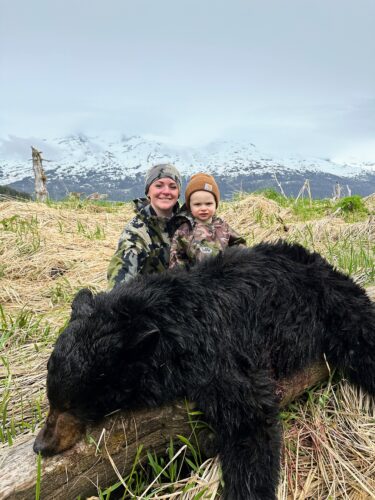
That evening, we headed to a familiar spot tucked deep in a quiet bay and far from boat traffic and noise. Over the years, we’ve harvested several bears from this area. A large glacier slide looms above the beach and grassy slopes.
We sat for a while glassing on the boat without seeing much, but then finally spotted one. A very dark black bear emerged onto the shale and moved through patches of bright green grass. There was no mistaking it – this bear was bigger than the one Jen had missed the night before. The look in her eyes said it all. She was ready.
We climbed back into the dinghy and paddled toward shore. The tide was low, which left a wide stretch of slippery ground between us and the bear. We moved quietly across mussel-covered rocks and seaweed that had been underwater just an hour before. We crossed a shallow stream and crept over slick stones, using every bit of cover the terrain gave us. The wind stayed steady in our favor, helping us close the distance.
Jen found a driftwood log to brace against and got into position. The bear was still feeding and unaware that we were there. She slowed her breathing, lined up her shot and squeezed the trigger.
The bear dropped instantly.
It was one of those quiet, powerful moments in the field. Jen had stayed composed, learning from the day before, and she made it count when it mattered most. Watching her walk up to that bear, smiling from ear to ear, filled me with pride.
We radioed the boys from the boat, and soon the whole family was walking across the beach together. We skinned and butchered the bear right there, saving every piece of meat along with the hide and skull. We packed it all into the dinghy and hauled it back to the Weldcraft.
Jen didn’t let the miss from the night before shake her. She didn’t get discouraged and she never lost hope. Instead, she stayed focused, trusted the process and stepped right back into the hunt with grit and determination. This time, she connected with an even bigger, more beautiful bear.
We brought back to the boat more than just meat that day. We brought a story of perseverance, redemption and a moment our family will carry with us for the rest of our lives. -Landon Albertson
NOVEMBER: FOR THESE VETERANS, IT WAS MUCH MORE THAN A MOOSE HUNT

Few people know the program as well as Rusty Craig, one of its founding members and longtime volunteers. He helped shape the Warriors on Safari hunt into what it is today: an operation backed by SCI Alaska, the state Governor’s Office and the Alaska Department of Fish and Game.
“Without that cooperation, this hunt wouldn’t exist,” Craig says.
This year, Craig helped lead planning, track logistics and ensure every veteran had what they needed.
“Luck favors the prepared,” he jokes. “But really, when tears of joy are shared among warriors, no words are needed. Seeing their reactions to success is 100 times more rewarding than anything I could accomplish myself in the outdoors.”
He’s seen the program evolve through years of trial and error – becoming more organized, more supported by local businesses and better equipped for Alaska’s brutal weather.
“This year we had heaters for every tent, cold-weather sleeping bags and generators donated by local companies,” Craig says. “SCI Alaska purchased new gear so the hunters didn’t have to worry about baggage or missing equipment. The focus was on the experience.”
Craig says his biggest hope was that the veterans never saw the stress happening behind the scenes.
“My goal was to give them the hunt of a lifetime,” he says. “I think we accomplished that.” …
For everyone involved, Warriors on Safari represents more than tags and trophies. It’s about gratitude, giving back and connection to Alaska’s wild places.
“This program proves we’ve learned from the past,” Lantgen says. “Vietnam veterans were often forgotten. Programs like this show we understand now how important it is to support returning and wounded veterans. Something as simple as a hunting trip can have a massive impact.” -Tiffany Herrington
DECEMBER: FROM A TENT CAMP TO ‘FIVE STARS IN THE BUSH’ ON THE NUSHAGAK RIVER
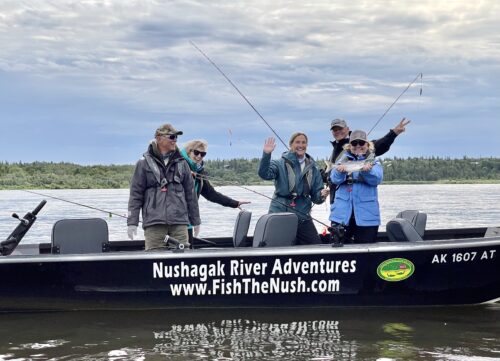
While the lodge provides comfort for guests, it’s the river that delivers the magic. Few people know that better than Will Stolski, one of Nushagak River Adventures’ longtime guides.
“I was born into a fishing family,” he says. “My dad’s a guide too. I started guiding on the Kenai in my early 20s and came to the Nush a few years later. I’ve been with Fish the Nush ever since.”
For Will, the draw isn’t just the fishing; it’s the people.
“We’ve got an incredible team here, and I love spending time with our guests,” he says. “Many of them come back year after year, and you really get to know them. You become part of their story.”
He recalls one guest in particular – an elderly angler from Germany named Willi who traveled alone each summer to chase silver salmon.
“He was in his late 80s,” Will says, smiling. “Every year, he made the journey across the world just to fish the Nush. I guided him for years. Even though his health keeps him from coming now, we still keep in touch. I hope when I’m his age I’m still fishing in Alaska.”
Stories like Willi’s capture what makes the Nushagak experience special: It’s not just about catching fish; it’s about connection, perseverance and joy.
“When choosing a lodge in Alaska, there’s a lot to consider,” Will says. “But here, we have it all – world-class fishing, excellent lodging and food, and a staff that truly cares. There’s a reason so many guests return.”
This past season, the lodge expanded its offerings to include fly-out trips for grayling, trout and char, adding diversity to its already renowned salmon fishery.
“It’s an amazing way to see more of Bristol Bay,” Will says. “Every flight reminds you how vast and untouched this place still is.” -Tiffany Herrington

Alaska Salmon 2011: Not Too Shabby

Prime Time For Face Time At Sportsmen’s Shows

EPA: Potential ‘Adverse Impacts’ On Bristol Bay Salmon Fishery With Pebble Mine; Comment Period On Draft Study Open Into July
About Author
