

A Deep Dive Into DIPAC: Southeast Alaska’s Salmon Hatchery
The following appears in the September issue of Alaska Sporting Journal:
BY BRIAN KELLY
The tide change was happening and all the fish that had raced past us on the incoming tide were now slowly making their way past us again.
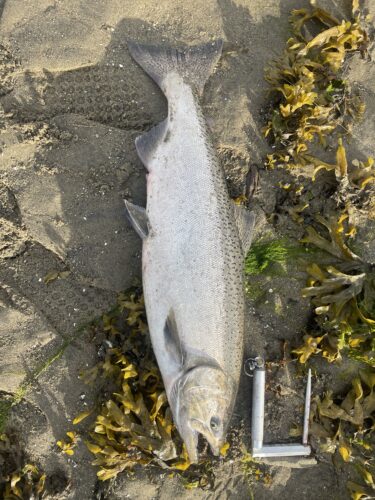
Kings were rolling all across the dwindling confines of the Gastineau Channel, as this was a good tide swing – it felt like someone had pulled the drain plug in the bathtub. Kings aren’t big fans of hanging around in clear, skinny water, so our bite window was going to be tight. And then, bang! An ocean-bright king chomped down on my homemade skirted chartreuse spinner with a size 6 blade.
The head shakes were violent and short, as were the runs, so I knew this wasn’t a big fish, but it was the first one of the trip. After beaching the dime-bright Chinook, my adrenaline was racing and I was ready for another shot at the bigger fish that kept showing themselves. Unfortunately, my “client” wasn’t feeling it: cold toes, cold hands and being thirsty and hungry weren’t cutting it for my wife Anne.
I failed miserably as a guide that morning for not packing proper nourishment and hydration supplies. But I must tell you I have this problem: I have been casting to rolling kings most of my adult life and know sooner or later that one will bite. That means ignoring hunger and thirst for hours at a time when the fish are rolling around and doing that thing that drives us nuts but keeps us in the game!
Anne took the keys and went up to the truck to get feeling back in her lower extremities while I kept flailing away to no avail. As I turned to head back to shore and grab my only fish of the morning, I saw that a large adult bald eagle was trying to stake his claim to it and had begun pecking away at the gills.
We had a short exchange of heated words before the eagle tried to take off with my fish, which was still on the stringer. Fortunately, the salmon was just a tad too large for his talons to grasp, and he dropped it before getting too far away.
Never a dull moment in Alaska!
JUNEAU’S HATCHERY ROOTS
Thanks to the foresight of a man by the name of Ladd Macaulay, the DIPAC, or Douglas Island Pink and Chum, Inc., hatchery was established in the mid-1970s, when wild salmon fisheries had reached historic lows and the state of Alaska began funding hatchery enhancement programs. While this hatchery started out raising pinks and chums to boost returns in the local streams, it has morphed into a world-class operation that raises millions of chum, Chinook and coho for both local commercial fishing interests and sportfishing opportunities for the entire community.
Juneau is more than just a stop along the cruise ship circuit; it has become a thriving angling destination thanks to the dedicated staff at DIPAC.
Let’s take a closer look at the Chinook fishery, as there are a number of smolt release sites around town for anglers to focus on for returning adult salmon depending on the time of year.
(BRIAN KELLY)
NORTH DOUGLAS: JUNE 1
The Alaska Department of Fish and Game usually keeps the Gastineau Channel and surrounding waters closed to Chinook retention through the month of May to allow wild stocks to make their way through town on the way to their home waters of the Taku, Stikine or Chilkoot Rivers to finish their spawning journey.
An emergency order is then typically released to announce the king opener for June 1 so anglers can focus on the DIPAC-reared Chinook that begin to make their way back to town. The broodstock for this run came from Andrew Creek, a tributary of the Stikine River that flows into the North Pacific near Wrangell.
Thanks to these Southeast Alaska genetics, this stock has proven to be adaptable in several locations from Ketchikan to Juneau, and while most are the juicy, orange-fleshed Chinook we are accustomed to, there are some white king genetics too.
It is quite a sight to cut into a chrome-bright Chinook with white flesh. Their meat is exceptionally firm and mild, almost like a flavor cross between a halibut and a salmon. Enjoy it if you run across one; my wife landed four of them on our trip, and these fillets have become a favorite in our house.
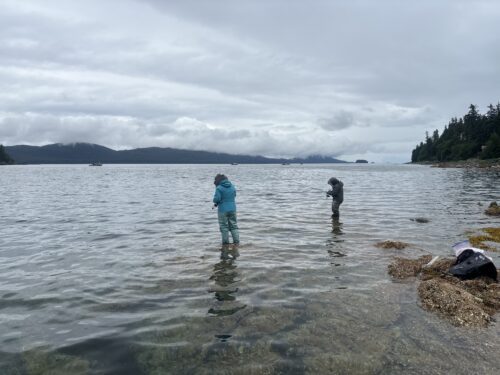
While the fish can be on either side of Juneau come the June 1 opener, the first push of staging kings tends to show up in Fritz Cove on the north side of town.
These are fish that will be pushing up into the shallow side of Gastineau Channel with the bigger tides, but early in the season the fish like to stage in the cove itself and are targeted by both trollers and shore-bound anglers; the latter either cast spinners or soak whole herring under a float.
The fish will linger around here for a week to 10 days, and when the big tides arrive, they will push up the channel and drop back into the cove for another week or two. This is when fly anglers shine, as the channel on the north side of Douglas is quite shallow compared to the south end of town.
Successful fly anglers lean toward two-handed Spey setups with full floating lines and weighted flies, since most of the holding water is less than 10 feet deep. The local fly shop, Alaska Fly Fishing Goods (alaskaflyfishinggoods.com), publishes a weekly fishing report that dives into the details fly anglers need for this rare shot at Chinook on a swung fly.
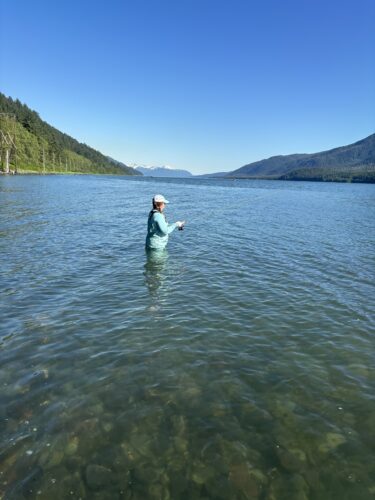
Gear anglers can also take advantage of this stretch of water; yours truly had some memorable days with skirted spinners and shallow-diving plugs. Since this section of the channel is quite shallow, one must time the tides and weather correctly, as the bite windows tend to be quite short.
While the fish blast up the channel with the incoming tide, they tend to be tight-lipped until the tide goes slack and starts to turn. The trick is finding how far up they pushed with the tide; they seem to bite better as they drift back down on the outgoing tide, especially with some clouds and rain.
Bright, sunny, warm days make for a tough bite. Oh, and bring your bug net when you fish this section; the no-see-ums can be brutal when the hatch is on. You have been warned.
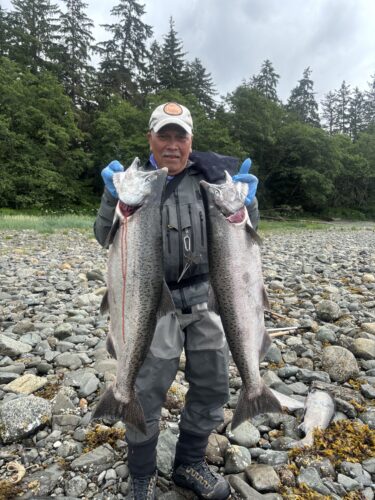
SOUTH SIDE: THANE ROAD
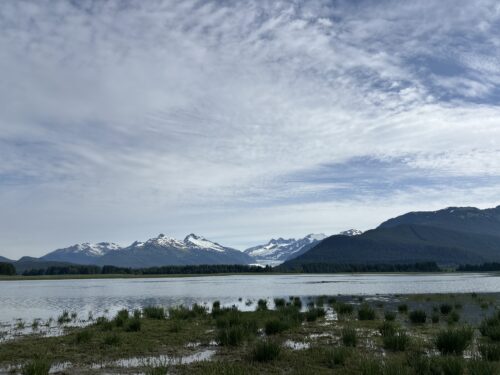
While the north side of Gastineau Channel can literally dry up on a negative low tide, the south side is a completely different beast. It’s big water, wide and deep; cruise ships enter port from this side of town, and the kings will also drift in this way. Even though this stretch along the Thane Road access areas can seem daunting due to its size, the fish do have a habit of hugging the shoreline and pushing in with the tide.
With 50 feet of water within easy casting distance from shore, the fish riding the incoming tide tend to take their time moving into town. If the fish aren’t showing themselves where you started, don’t hesitate to move down the road with the incoming tide. Sooner or later, the fish will show up and stop somewhere along the road, and the bite can fire up in a hurry.
Boat anglers take advantage of this fishery as well, as there is a sizable launch area on Douglas Island and a marina right in town. Most of the trolling activity starts down towards the Taku Inlet, at the point called Dupont Dock.
One can cover quite a bit of water from Dupont back to town, with the focus on the nearshore water from 50 to 75 feet. Flashers and herring are the typical rig of choice for the local trollers, but don’t overlook a plug – think a classic J-Plug or Tomic – trolled at a slightly higher speed than the normal flasher crowd. Big, hungry Chinook aren’t afraid to chase down a big presentation!
Most of the bank fishing in this stretch is done with herring or hardware. A Mepps Flying C is the preferred spinner, but don’t forget to bring a size 6 Vibrax as well. Chartreuse-themed baits seem to get most of the attention, but there are years when the kings act like their coho cousins and hit anything pink. Pack accordingly.
The other local method of choice is to fish a whole herring – either green- or blue-label size – under a 1-ounce float. Some days the fish want this twitched or brought in with a super-slow retrieve. On other days, peg the float at 4 to 5 feet and the fish will find it.
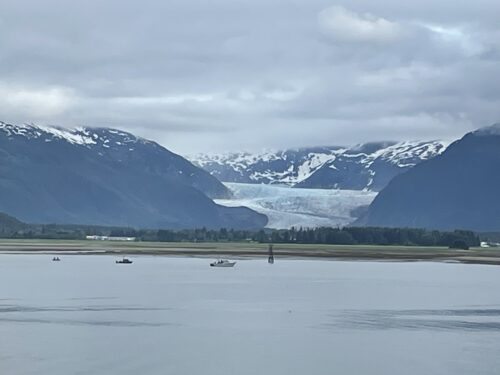
TERMINAL HARVEST AREAS
The beauty of this fishery is that Chinook smolt plants are spread around town, so it’s not a one-site, free-for-all situation when adults return. There tend to be areas where fish that aren’t yet ready to spawn gather and are still easily accessible for both shore and boat anglers.
DIPAC does release some fish at the hatchery itself, which is convenient for shore anglers in town. There is a public dock that is handicap-accessible, along with fish-cleaning tables for all to use. The hatchery is located at about the midpoint of the channel, which is a convenient place for returning fish that come in from either side of the channel.
The only drawbacks to this spot are the crowds when the fish show up in force, or if there’s a complete ADFG closure due to low returns and the hatchery folks need all the fish they can get back to the fish ladder. (Speaking of, in late August ADFG announced that a portion of the Gastineau Channel from the Juneau-Douglas Bridge to a half mile northwest of the Macaulay Salmon Hatchery would close to all sport fishing because coho broodstock goals were not expected to be met due to a “poor run.”)
Lena Cove is located on the north side of town on the mainland, an easy drive or boat ride from Auke Bay. This area sees quite a bit of trolling activity in June, as the returning fish tend to stage at the head of the cove, in deeper water, before pushing into the back of the cove, where bank anglers can get their shot by casting spinners or herring under a bobber.
Local trollers deploy the usual assortment of flashers with either herring or hoochies trailing behind, but don’t over- look a wide-wobbling plug like a Kwikfish, which can irritate a moody Chinook into biting. As June rolls on, the fish go from actively feeding into atrophy mode with the urge to spawn coming on strong. The bite can be red-hot one day, then dead for days. Be willing to put in the time, especially with a weather change.
Fish Creek is the final Terminal Harvest Area plant site in the Chinook fishery. This popular spot is located on northern Douglas Island in close proximity to the mouth of Fritz Cove. What makes this area unique is “The Pond,” which the fish pile into after a short run up Fish Creek itself. Anything goes in the pond, so be aware that snagging is legal. Even though the technique is allowed, it is frowned upon by the majority of sport anglers.
Cured eggs under a bobber tend to get bit the most here, but fish will hit a skirted spinner, plug or even a stripped fly. It takes a series of big tides, like over 15 feet, to get fish up the creek and into the pond. Most years, this area doesn’t really fire up until late June, with the peak running into the middle of July.
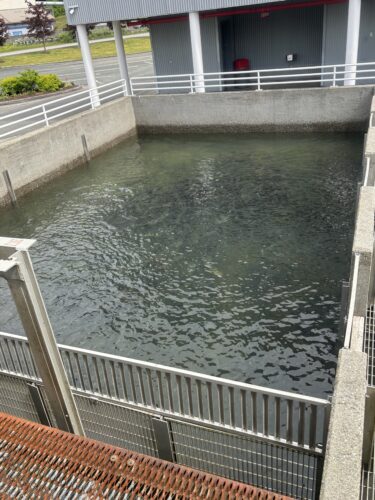
BREAKING DOWN THE PROCESS
The folks who operate the DIPAC Macaulay Salmon Hatchery are a proud sort and do a marvelous job of enhancing the fishery all around the Juneau area.
I spoke with Steve Wiechmann, who is the research and evaluation manager for DIPAC, about some recent infrastructure upgrades that should help enhance future Chinook and coho plants.
“We have a new recirculation system in our incubation room, which allows us to reuse water and control the temperature. Salmon development is closely tied to water temps, so this will allow us to better control their growth, as opposed to being reliant on ambient water temps, which can be a problem in cold winters,” Wiechmann says.
“We also installed new start tanks for the emerging fry that provide extra space for them to grow. Previously, our hatched fry would be transferred directly into large raceways, which was sometimes problematic because Chinook and coho take 20-plus months of rearing in our care before they get released, meaning we always have two brood years of fish in our facility.
If the younger fish developed too fast, they would be ready to leave the incubation trays before the older fish in the raceways were ready to be released. This would lead to overcrowding and inevitable mortality. The start tanks provide a gentler rearing environment for the fish, so they can get their legs under them, so to speak.”
According to Wiechmann, one final addition should help the fish at smolt stage.
“Finally, we installed larger saltwater net pens, both here at the hatchery and the rearing site out at Sheep Creek. Bigger pens and the same number of fish mean lower-density rearing conditions, which are often favorable to growth and health,” he says.
Wiechmann also assessed what these changes mean for future salmon plants around the Juneau area.
“The net effects of these upgrades should mean continued healthy releases into the future with an emphasis on consistency. While we cannot control what happens to them in the open ocean, we can give them the best possible start, which means a better chance of survival once they are released. We hope these changes will make our releases and returns more consistent year to year, provided similar ocean conditions (occur).”

KEEP SALMON RUNNING
In a day and age where hatcheries seem to be under constant threats from outside sources, it is refreshing to see the successful fisheries created by visionaries like Ladd Macaulay and hard work put in by forward-thinking managers like Steve Wiechmann.
If you visit Juneau and participate in this unique and thriving Chinook fishery, do pay a visit to the team at the DIPAC Macaulay Salmon Hatchery and see their work in action. ASJ
Editor’s note: For more information on Juneau’s DIPAC Macaulay Salmon Hatchery, go to dipac.net.

Alaska Salmon 2011: Not Too Shabby

Prime Time For Face Time At Sportsmen’s Shows

EPA: Potential ‘Adverse Impacts’ On Bristol Bay Salmon Fishery With Pebble Mine; Comment Period On Draft Study Open Into July
About Author
