

The Harvest You Sew: A Native Subsistence Hunter On Safeguarding Longtime Traditions
The following appears in the March issue of Alaska Sporting Journal:
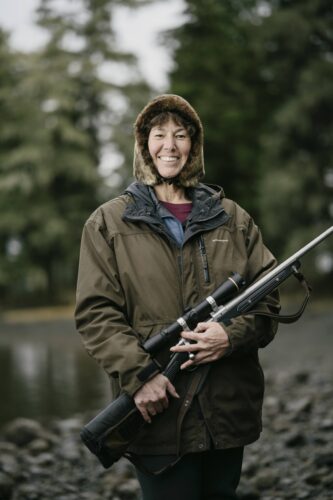
BY JILLIAN GARRETT
When it comes to the concept of tradition, some people may conjure up more recent memories, perhaps of mornings spent gathered around the Christmas tree or hanging out with relatives at the annual autumn deer camp. For Christy Ruby, tradition has a much deeper meaning, one that is imbued with cultural practices going back thousands of years.
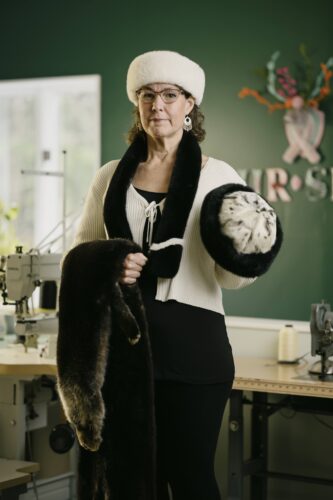
Ruby is an Alaskan Native Tlingit Eagle from the Kéet Gooshi Hít (Killer Whale Dorsal Fin House), an award-winning fur fashion designer, recent recipient of a prestigious Rasmuson Foundation grant and a skilled seal and sea otter hunter. Ruby may also be about the last person proficient in the art of proper sealskin tanning techniques, a knowledge that she hopes to still pass on to the next generation.
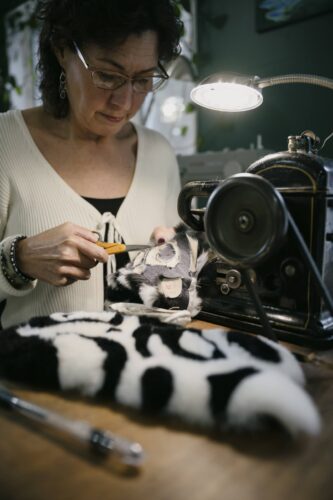
CHATTING WITH RUBY IS a bit like peeling back the layers of an onion, although any eye-watering is purely the result of laughter from her ribald sense of humor. Ruby sees the world with a clear eye, has lived one heck of a full life and isn’t afraid to speak her mind about the things that matter to her. She is also possessed of a sort of rare pragmatic optimism that makes it hard not to like her.
For Ruby and other Native Alaskans, carrying on tradition means maintaining cultural practices such as seal and sea otter hunting. This can be a tough pill to swallow for many modern-day sensibilities (especially when it involves “cute” animals), but continuing these hunts is an important way for Native Alaskans to reconnect to their ancestral roots, as well as help keep vital knowledge and skillsets alive to pass down to the next generation. “Using skills taught to us from the past will ensure we will never go hungry and we can always clothe ourselves,” Ruby is quick to point out, and it’s true: Hunting these animals provides both food and wearable fur.
Natural furs offer superior warmth from cold Alaskan winters, and unlike many of our modern petroleum-based synthetic textiles, are a far more sustainable clothing option; high-fat foods such as seal blubber and the rendered oil are prized as ways to help keep people warm, something not easily understood in today’s fat-free, diet-crazed world.
Though seals and sea otters are safeguarded under the Marine Mammal Protection Act, or MMPA, they are legally allowed to be harvested by Native Alaskans for the purposes of subsistence as well as for the creation of handicrafts. However, seal and sea otter fur may only be sold to non-Natives after it has been extensively altered to no longer resemble a whole pelt, such as by sewing it into a hat, purse, mittens or scarf (among other options). This is where Christy Ruby’s talent as an artist and fur fashion designer really shines: She has an exceptional eye for form and detail, meaning that her pieces are not only well made and highly serviceable, but unique works of art too. You won’t find any mass-produced items in her studio. Every piece she produces is carefully handmade and one of a kind.
While Ruby’s spectacular designs have won awards at fashion shows around the country (and some pieces are also on display in museums), it’s unfortunate that you won’t find her work gracing the runways at affairs such as New York Fashion Week. Natural furs have been largely banned at these types of events, thanks in part to years of campaigning by anti-fur activists.
WEARING FUR CONTINUES TO be highly contentious, in part because many people seem to confuse the questionable ethics of farmed furs with those obtained as part of a sustainable natural harvest. This lack of understanding makes it doubly difficult for Native artists to continue traditional cultural practices and modes of self-expression, negatively impacting their way of life. Plus, as any hunter certainly knows, hunting can be expensive, especially when it involves a marine animal; rifle, boat and fuel costs all add up, and once you include expenses such as tannery fees, can quickly turn into a very steep price tag. Being able to sell handicrafts made from these furs is a way to help recoup some of the costs associated with a lifestyle that still strives, even in modern times, to live in close connection to the land.
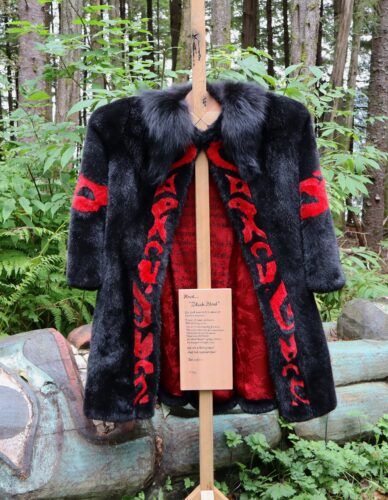
The ability to hunt and sell handicrafts is also a way for Native artists to continue to create beautiful clan art, as well as pass along tribal history and stories, something seen in many of Ruby’s clothing designs. One of her most notable pieces is the exquisite “Black Blood Coat,” a three-quarter-length fur coat consisting of 68 pieces of red- and black-dyed sea otter, with a custom-printed lining containing a poem that, translated into Tlingit, remembers the abused Native children of Alaska’s boarding schools.
The “Black Blood Coat” has won multiple awards, including the Innovation Award at the 2024 Santa Fe Indian Market, but it honestly deserves wider recognition everywhere, not simply for its expert craftsmanship but for the painful moral of its multi-layered story.
The irony of the anti-fur/anti-hunting movement is that it seeks to push so-called “modern” ideals onto Indigenous peoples, trying to end long-held cultural practices for which it has no stake and no understanding. It condemns Native Alaskans (as well as hunters and trappers everywhere) for killing animals and using their furs, without stopping to consider the larger context of the story. In short, those quick to criticize the “Black Blood Coat” and the practices involved in creating it are missing the entire point. Twice.
This lack of understanding about the importance of hunting and cultural self-expression through fur art is one of the many reasons that Ruby is motivated to keep working. “I want the story of my life to be accepted by all,” she says.
By continuing to uphold her ancestral values and remain deeply rooted in the natural world, she strives to find a way to connect with others who are often at times deeply disconnected from nature. It’s a testament to how she presents both herself and her lifestyle that even a few customers who would generally fall on the anti-fur side of the spectrum have been impressed enough to buy some of her pieces. That alone speaks volumes and provides an important element of hope for turning the tide of understanding.
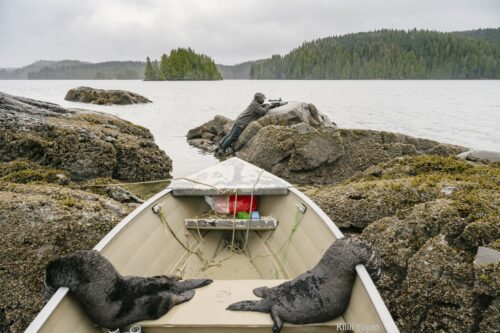
WITH THE ANTI-FUR AND anti-hunting crowd seeming to gain greater traction every year, it’s easy to get depressed about the future of hunting and tradition, but Ruby refuses to see it that way. She plans to keep living her life and sharing her experiences with the wider world, being a torchlight in the darkness. “I want to be the hope that there are good things in life,” she says.
That eternal optimism bore fruit in 2025, when Ruby received an Individual Artist Award from the Rasmuson Foundation, an Alaska-focused philanthropy created in 1955 by the Rasmuson family. The grant will allow her to build a small personal tannery for the purpose of processing seal and sea otter skins.
This grant-funded tannery will also aid her in teaching others how to tan these difficult skins, a knowledge that is in danger of being lost.
Few commercial tanneries remain that are able or even willing to work with seal skins, as they are easy to mess up given their higher oil and fat content and difficulty to process. “It’s like trying to shave pizza dough!” Ruby laughs. The skins also require five additional steps in the tanning procedure, making them much more expensive and time consuming for any tannery to produce, even those willing to jump through the hoops of applying for the U.S. Fish and Wildlife Service federal permit and dealing with the subsequent record-keeping requirements.
This lack of tanneries has hampered the ability of Native Alaskans to continue maintaining their traditional practices. It’s also led to a worrisome bottleneck of knowledge. With so few people and tanneries left that understand how to properly process seal and sea otter skins, how will this vital skillset continue to be shared with future generations?
With the help of her Rasmuson grant, Ruby hopes to change that.
The grant’s $10,000 award will allow her to design a small-scale tannery, as well as purchase (and in some cases build) the machinery needed to run it, including a hide-shaving wheel, flesher, sander, staking machine and a unique sawdust tumbler. The funding also provides for the creation of educational videos and classes on how to hunt, tan and sew seal and sea otter skins, thus aiding in keeping traditional knowledge alive for the future.
By creating and sharing design details for a smaller-sized tannery, Ruby hopes to encourage other Native artists to start up their own personal tanneries, thus leading to an increase in collective knowledge and a subsequent rise in availability of properly tanned skins. In this way, Ruby hopes to grow the number of skilled fur sewers, which will not only safeguard cultural traditions but will hopefully increase the exposure and therefore acceptance of a way of life that has been practiced for countless generations.
THIS SMALL-SCALE TANNERY IS the first step in what is a much bigger goal: the construction of a large Alaska Native tannery and sewing center in a “high-visibility” region of the state. The center would teach vital traditional skills and provide employment, as well as be an outlet to sell handicrafts for Native skin sewers, who would work with high-quality seal and sea otter skins produced by the tannery.
In turn, the tannery would support Native hunters by paying them for skins harvested as part of a subsistence lifestyle, continuing to ensure that nothing of any animal goes to waste. Any meat donated by the hunters would be given to the Native hospital in Anchorage for its traditional foods program, thus further supporting the community.
Amongst these important services, the center would also offer tours to showcase traditional skills and art, including to the thousands of cruise ship passengers who visit each day during the height of tourist season. With more exposure to and a better understanding of the importance of these cultural practices, the hope is to breed greater acceptance of their values by the wider world.
Yet the idea of the tannery goes far beyond being simply a self-supporting powerhouse for Native Alaskans wanting to preserve their traditions. At its core, it is a testament to the interconnectedness of that way of life, something Ruby refers to as the “Dream Tree.” It’s an understanding of the symbiotic relationship of how the land and the animals sustain the hunters who in turn sustain them; it’s about how those gifts from the land are then used to support the community, through food, clothing and art, and how the creation of these things ensures that thousands of years of culture remain alive and well into the future. ASJ
Editor’s note: To learn more about Christy Ruby and her work, please visit her website crubydesigns.com. Author Jillian Garrett is a hunter, farmer and conservationist living in northeast Washington State. Her writing and photography have appeared in numerous publications includingSports Afield, Backcountry Journal and Northwest Sportsman, and she has also been a guest on the Randy Newberg Hunt Talk Radio podcast (episode 263). You can find her on Instagram (@jillianoriginals).

Alaska Salmon 2011: Not Too Shabby

Prime Time For Face Time At Sportsmen’s Shows

EPA: Potential ‘Adverse Impacts’ On Bristol Bay Salmon Fishery With Pebble Mine; Comment Period On Draft Study Open Into July
About Author
