
Previewing Tomorrow’s Opening Day Of Still Cold Outside Ice Fishing Tournament At Big Lake
The following story will appear in the January issue of Alaska Sporting Journal:

BY TIFFANY HERRINGTON
Each winter on Southcentral Alaska’s Big Lake, a devoted group of hard-water anglers leans into the cold, drilling holes through the ice and chasing Arctic char during some of the toughest conditions Alaska can throw at them.
The Still Cold Open is more than a fishing derby. It is a season-long test of endurance, teamwork and skill that has turned strangers into friends and weekend ice fishermen into serious competitors.
Organizer Jerrid Hixon has watched the tournament grow from a local bragging-rights showdown into a multi-week event that draws some of the most dedicated anglers in Southcentral Alaska. A former fisheries biologist, Army veteran and guide, Hixon keeps one eye on the leaderboard and the other on the health of the fishery that makes the Still Cold Open possible.
In our conversation with Hixon, he talks about the history of the tournament, what makes Big Lake such a special place to fish and why protecting its native char and trout matters as much as the final standings.
Tiffany Herrington How did the Still Cold Open begin and what inspired you to create a tournament of this scale on Big Lake?
Jerrid Hixon The SCO began in 2015 when Jim McCormick began the tournament to give local guides and anglers something to look forward to and compete in during our long Alaskan winters. Legend has it that it began as trash talk, then bragging rights to earn the champion team jackets.
I did not take this tournament over until Jim asked me after I had competed in the tournament five times, but he approached AJ Hoffman, Mike Hudson and me when I was staff at 3 Rivers Fly and Tackle in Wasilla (a major sponsor and highly active in the community of Mat-Su Valley fishing). I took over the tournament in January of 2022 in a trusted effort by Jim to retire from guiding in Alaska and move to Arizona.
We are all grateful for his building of this tournament, but we all want to see this go to the next level with teams from Canada and the Lower 48 states. As I am entering my fourth season running this tournament, which has seen a revitalization in participation, more staff and leadership, the organization has drastically improved, and prizes have exponentially gotten bigger and better with local businesses participating with sponsorships.
As a result of this tournament, and working with (Alaska Department of Fish and Game) for two years, I have provided enough data that will protect the amazing trophy-class Arctic char that are uniquely native to the Big Lake area to catch and release only. We pride ourselves as stewards of the lake, cleaning up trash and being vehement voices of protection for this finite resource. As a former fisheries biologist, Army veteran and local guiding business owner, I, among many others who compete, want to see these wonderful fish flourish and be protected for generations to come and enjoy.
TH The event is described as Alaska’s toughest and longest ice fishing tournament. What makes the SCO stand out from other derbies in the state?
JH As a former competitor and now director, I can say with confidence that this tournament can take a novice angler and exponentially turn them into an expert at targeting these coveted Arctic char for those willing to endure the conditions and display resilience. We have fished days where it was minus 47 degrees out there beginning at 9 a.m. to 4 p.m. in the elements with the best gear ice anglers can find to protect themselves.
Many of us are avid outdoors folks who have learned many tough lessons on how to survive these conditions, continue to compete ferociously and, most importantly, take care of these fish once they are exposed to the harsh elements out of water. Speed, practice, learning from others, education and awareness are key to mastering the ability to compete at this level. The staff takes extra precautions to ensure the safety of the anglers and the fish alike with briefings every competition morning before the shotgun release.
Anglers race off with team plans to hit their favorite spots, where they believe the fish might be, in a spectacle of a rush to lock down their positions on the lake, working quickly, exhibiting teamwork, working diligently all day in sometimes extreme cold, snow and wind, exposed the entire time, to overcome obstacles that may arise, catch their five best fish for turn-in times, and return all fish alive successfully.
Anglers begin this tournament on the first Saturday of every January and fish every other week until the first Sunday of March, which is the championship weekend. Catching fish with bait any angler can do. However, on Big Lake, by ADFG regulations there is a single-hook (restriction), artificial lure (only rule), no scent allowed, and no chumming allowed.
Getting the Arctic char to hit is sometimes a chore all in itself, with these fish being notoriously finicky. The right barometric conditions help, (as do) the angler’s ability to get the fish to hit. All of the seasoned SCO veterans call Big Lake “the Mistress,” with many beginners abandoning their short-lived efforts to fish it. To the ones who are determined and land their first big char, they describe it as wrecking their life with a crippling addiction to chasing these big native fish. It can literally become an addiction that replaces all the anglers’ spare time – hence why she is called “the Mistress.”
We are not currently aware of any other tournament in North America that lasts as long as this tournament does, and we definitely know that no other ice fishing tournament in Alaska lasts like this one does. These anglers and staff work all year to compete in this tournament, ensuring that they even have work days off to compete, for instance. These are, without a doubt, the toughest ice fishing junkies I have ever heard of and witnessed. Many (others) do not have the fortitude or willingness to endure this type of commitment required to compete at the highest level required to win a first-place championship SCO.
TH What do you love most about Big Lake as the home of the tournament and what makes it such a special fishery?
JH To those who recreate on Big Lake, let alone in the winter, we all know why it is locally dubbed “Alaska’s Playground.” Riding snowmachines in very extensive trail systems that Iron Dog racers use to get to Nome and back begins at Big Lake. A massive pond hockey tournament is conducted by Burkshore Marina that has concerts and celebrations that are amazing to attend. There is the Islander Lounge and Grill you can only access by boat in the summer and sleds or side-by-sides in the winter, with many others who recreate the same way.
We all have a big family and meet new, awesome people who are so amazing to recreate with, all because we all do these things together. Our amazing host, Susitna Brewing Co., with permission from Matt and Whitney Dow, has been absolutely outstanding working with us and hosting us every year since I took over.
Big Lake is one of my favorite places in Alaska, and … uniquely harbors trophy-class Arctic char. With abundant salmon runs that enter the lake from Cook Inlet to Fish Creek to Big Lake and onward, this brings a lot of food for the resident fish species in the area. There are no other lakes this accessible in the Valley that have native Arctic char this big.
It is imperative that we treat this fishery responsibly, as well as the dwindling salmon runs that remain in stiff contention as a topic of controversy in Southcentral Alaska. Ultimately, we have a gem that is a short drive away from many of us Valley residents where we can all enjoy getting outdoors, whether it is fishing, boating or riding snowmachines. It is just the icing on the cake that Big Lake has these big fish that fight so hard and are beautiful species to target. Our participants deeply love this fishery, and I can attest that they take protecting this resource very seriously, as well as being responsible outdoors people.

TH The SCO focuses heavily on teamwork, strategy and endurance. What do successful teams usually have in common?
JH I would be a fool not to mention the Hughes team of Josh and Caleb. They have been five-time champions out of 11 annual tournaments now, and their competitiveness, coupled with hard work, is unrivaled. Having a plan and sticking to that plan with rigor is their mantra.
Not to discount everyone else, by any means, (but) they have discovered a regimen within all confines of the rules that works, and that rule is simple: Work hard, do not waste time, know the lake structure and know the target fish behavior. Even the best of us can say that this lake will humble the best, including the Hugheses, from time to time.
I know I have received many comments or questions about Josh and if he will be competing. They usually have the attitude, “If they are competing, then why even enter?” My reply to this attitude is hilariously simple. This is a big dawg tournament. If that is the attitude you have, then you have already lost. You have to fish this lake a lot, and you have to have a good team that is willing to work hard and fish tenaciously and consistently. I always quote the great Ric Flair: “If you wanna be the man, you gotta beat the man; woooooooooo!”
Now, there are teams I know that can dethrone the Hugheses, but they are going to have to earn that right because they are that good. Many teams are very friendly and share knowledge with each other, and we all know by this point that the best strategy is your fishing work ethic and tenacity.
TH The tournament targets Arctic char, rainbow trout and awards bonus points for pike. What draws anglers to these species and what challenges do they present?
JH To avoid controversy and state facts, the pike here are invasive and have not had thousands of years coexisting with the native char, trout, burbot and salmon.
With that being said, I have personally witnessed what has happened to the Alexander drainage system, where these pike were initially introduced. Since 1953, the pike were illegally introduced by a local angler into Alexander Lake at the foot of Sleeping Lady (Mount Susitna), with Alexander having the most prolific salmon fishery in the Upper Cook Inlet. Since then, nearly all salmon have been decimated, along with many other native species, to the point of complete closures of fishing besides pike. Along with invasive elodea, theorized to have been brought in by float-planes landing there, the habitat has been uninhabitable due to human interference. Many other factors are at play here, but to keep it short, this is not up for debate.
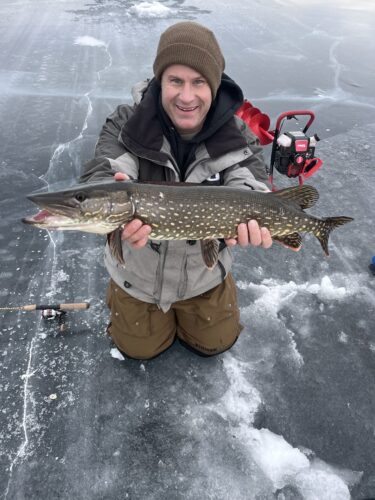
We target pike as an incentive to use angling to keep the pike population in check to help the Big Lake native species in their ecological niche that they have evolved over thousands of years to first occupy. To keep things fair, the pike can grow larger than the other species, so competitors can target pike, kill them by regulation, and bring them (up to five) to turn in for bonus points, with a potential of plus-25 points max.
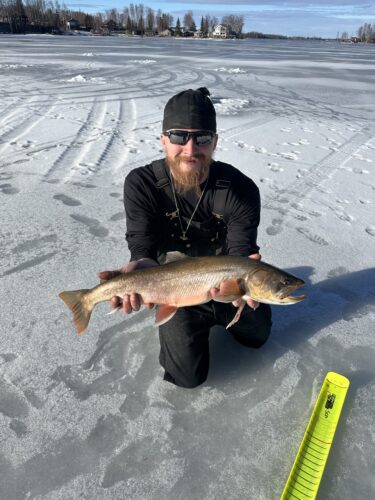
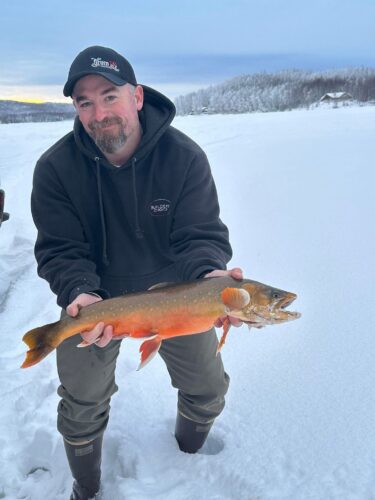
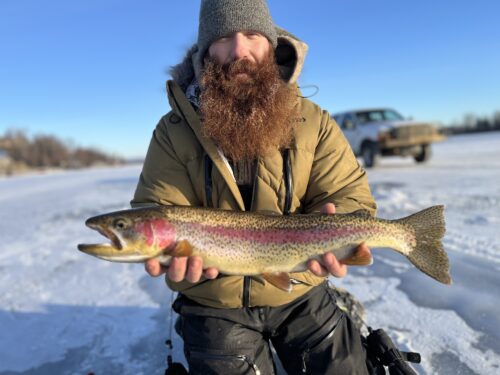
The char are by far the most targeted for a good reason. They accumulate the most points by length that is rounded up to the inch. I have caught 30-inch char in Big Lake before, with 27 inches-plus considered trophy-class. This is the reason we primarily target the char. However, rainbow trout are allowed to be used as length points as well. Both char and rainbows must be released immediately after a picture on a bump board with measurement, as long as they are 12 inches or larger.
The char can be found from shallow to deep, and anglers inadvertently catch burbot and sockeye sometimes, which do not qualify for submission. There were two very large Big Lake rainbows that hit 25 inches last season, but most rainbows are in the 12- to 18-inch range, so it behooves the teams to replace those potential submissions with larger char.
It is safe to say that five submitted char will almost always beat five submitted rainbows. This is difficult because you never know what is going to bite sometimes. Because everyone is targeting char and rainbows, they intelligently rig their lines specifically for these finicky fish to fool them into biting. The most frustrating thing for me personally is when a pike bites your rig off with their thousands of sharp teeth and big mouths that inhale your lure almost immediately, causing anglers to re-rig their lines. Every once in a while, you can hook a pike just right and land it, but if you want to target them, using a long steel wire rig to your lure is best.
TH The multi-week format and the split between pro and recreational divisions give the tournament a unique structure. How did you develop that system and what do you feel it brings to the experience?
JH It first came to fruition, like I said before, as a macho bragging thing, coupled with something to keep us busy constantly throughout winter. The divisions get split as teams jockey for position in the first three weeks of competing. Upon the closure of week three, the top half of the participant teams are divided evenly in half, with the top half being the professional division and the lower half being the recreational division.
We all know luck plays a bit into fishing, but you have to create your own luck by competing hard as well. This was devised to keep competitors involved instead of dropping out, because the recreational division top three can win prizes, embroidered champion hoodies and trophies as well. The pro division receives top-three trophies, embroidered jackets, prizes and cash payouts divided by positions. We have discovered that with proper incentives, doing random drawings weekly for big gift cards and prizes at the end of daily competition, regardless of performance, teams stay involved and continue to com-pete with higher retention and returns. Some anglers are out there having a good time for the experience, not worried about how they place, and others are ferociously competing. With our system, it all sorts itself out as fairly as possible to keep the majority happy.
We encourage everyone who is properly equipped, regardless of skill level, to come compete and stick with it, because they will drastically improve as an ice angler being around this group of competitors. We have had everyone from high-school-aged teens to seniors out there getting after it.
TH How do winter conditions on Big Lake influence the competition and what kind of preparation do anglers need to have?
JH Since I have been there competing or directing, we have only cancelled one tournament after a very unseasonably warm winter with lots of rain that degraded the ice so much that areas of the lake were unsafe or inaccessible at entrances (we did this after week four). We certainly keep safety at the uppermost importance for competitors, although liability waivers are signed acknowledging the risks of this tournament. In such cases, we move the competition to the proverbial right and continue when Mother Nature allows.
There are many years when we have zero interruption from conditions and compete as normal. We had a winter a couple of years ago with tons of snow causing mass amounts of overflow (naturally from weight and gravity, not ice holes) that caused a lot of problems for competitors with massive snowdrifts from high winds. These are problems that competitors must monitor and draft plans to overcome to continue to compete effectively.
Last season, with little snow and warm spells, the lake was accessible everywhere by vehicle instead of the popular snowmachine setups many use consistently. A big point of contention was a cold snap that had not been seen in 30 years in the area – many pleaded to postpone on a tournament day. We held a vote that overwhelmingly said, “This is what we signed up for and we are fishing.” Many noncompetitor barstool and couch referees blasted us on social media, saying us competing would harm the fish when it is minus 47 degrees at the start. We instead had competitors bring insulated temporary shelters with heaters to set up to prevent cold-weather injuries to the competitors and the fish. All fish were reported released alive and successful with no freezing of the gills and eyes.
Many teams prefer the run-and-gun techniques to cover as much structure as possible, yet this is a part of the tournament, to adapt and overcome. Sitting in one spot in this tournament is risking getting the dreaded “skunked” label, returning with no fish on Big Lake.
Since I have been competing, I am aware of one competitor getting a minor frostbite injury on that brutal cold day, with full recovery and even stating it was their fault for not being properly equipped for that particular day.
TH The SCO is known for its strong community feel. What does the community aspect mean to you and how have you seen it grow over the years?
JH I will say that when I first started, the feeling was much different, with an almost elitist attitude and big egos compared to what the second half has transformed into. This tournament has changed complete strangers into best friends. Everyone helps each other and shares limited information respectfully. The Big Lake locals have gone from hating us out there drilling holes to either ignoring us or being respectful to one another, sharing the lake for everyone to recreate.
The staff of the SCO preaches constantly that everyone competing is a representative of us all and that one bad apple can ruin it for everyone. We have had to dismiss teams before for being egregiously disrespectful and warn teams of the repercussions of not being professional. However, I can say that all of our current competitors the last couple of years have been outstanding, with some teams even showing up to clean areas that were trashed or fireworks littering the lake, for instance. Our teams pack it in and pack it out. I have personally made so many good friends who are in the ice fishing community and eliminated points of contention within the tournament and outside the tournament with lake residents, for instance. We have definitely had a positive impact on the lake as a whole, and this tournament will create memories that will last a lifetime.
TH The event supports local youth and veterans groups. Why is giving back an important part of the tournament and how do participants respond to that?
JH As a community, the Valley definitely is very outdoors oriented. We love the fact that former competitors like Colton Connor, who is a teacher at Wasilla High School, began an ice fishing club that is getting kids off iPads and drugs while getting them outdoors fishing in a positive and constructive team-building environment.
As an Army combat veteran, I am a VFW member at Post 9365, where we donate by Alaska state law using their gambling permits, donating a portion of our proceeds to that VFW. Last year, the Wasilla High School ice fishing club asked the VFW for a $1,000 donation that we encouraged members at a meeting to give to the club to provide more gear to the students participating. This motion unanimously passed, all in favor,
to donate that money we raised to high school students out there enjoying the great Alaskan outdoors. Everyone was in agreement that this was an outstanding way to donate in a charitable fashion to veterans and students.
Many veterans compete in the tournament, and everyone in our community supports our service members, thankfully, and the high school students have turned into competitors in the SCO as a result, which keeps the circle going. We could not be happier to see this going this well at this point and are very thankful for our supportive community, local businesses, students, competitors and sponsors.
TH What have been some of the most memorable catches or standout moments from past years?
JH For myself, it was my first 30-inch male char I landed. I do not believe I have been so exhilarated before that coveted mark, and I can say, from hearing all the excitement out on the ice and celebrations that have gone viral on Instagram, that all our participants feel the same way.
The largest char landed in the tournament was Colton’s wife Alyssa, who is still on our page – front and center – for landing the largest char in tournament history. I have said, if anyone can beat hers, they can get the photo spot.
I believe, for all of us, the best parts are hearing the exciting stories when everyone comes back, the banter on the brag boards during the tournament, and, of course, seeing all the big fish, regardless of species, caught that day. Nabbing first place on the day or how everything shakes out on the spreadsheet leaves everyone tense with anticipation, but the one team that lands the largest fish on the day always has a very cool moment with massive bragging rights.
TH What do you hope new anglers or first-time teams take away from their experience with the SCO?
JH All the staff always gather all the new competitors before day one begins to go over some encouraging points. We want people to have fun first, compete, learn immensely, increase sportsmanship, display resilience, and integrate with the veterans of the tournament to become what they are, which are prime examples to emulate in how they have become conservationists for a fishery, community and lake they all love.
At the end of day one, we get all the teams that get skunked, if they do, and give them encouragement, go over points that would increase their success, teach and highly encourage them to keep on going toward realistic goals they have set. I do not know anyone at this tournament who walks away without learning and getting better.
TH Looking ahead, what are your hopes for the future of the Still Cold Open and how do you see the tournament evolving? JH I believe that all of us staff, who are absolutely wonderful and donate so much of their time to make this tournament grow, all want the same thing. We want this tournament to max out participation of 50 teams every year, gain more popularity, have high demand for competitor slots available, have coverage like the Iron Dog or Iditarod, TV time or on the Outdoor Channel, and huge high-dollar prizes to raise the stakes, which increases the level of competition and the best competitors who would travel to compete with us. I think it would be amazing to have a Norwegian team, a Canadian team, a Minnesota team, a Michigan team, and so on that travel here to fish for these char.
We have many sponsors who have been absolutely amazing, such as Cabela’s, Bass Pro, B&J’s Sporting Goods, 3 Rivers Fly and Tackle, Home Depot, Bear Paw River Brewing, Susitna Brewing, Big Dipper, Kodiak Custom Tackle, Dead-Stick Fishing, Hooked on Alaska Fishing, Hooks of Alaska lures, Bunker Baits, and several more to come. Hopefully I did not forget anything in the shout-out that I am rambling off without looking, but everyone who helps out is incredibly generous and so helpful. We greatly appreciate everything that our community is helping us out with. ASJ
Editor’s note: To learn more about the Still Cold Open, including registration, rules, dates and updates throughout the season, visit the tournament’s Eventbrite page at eventbrite.com/e/ice-fishing-tournament-for-the-2026-still-cold-open-tickets-1855914182279?aff=erelexpmlt or follow the event on Facebook at facebook.com/ scofishing.

Alaska Salmon 2011: Not Too Shabby

Prime Time For Face Time At Sportsmen’s Shows

EPA: Potential ‘Adverse Impacts’ On Bristol Bay Salmon Fishery With Pebble Mine; Comment Period On Draft Study Open Into July
About Author
