
Living The Gold Standard: Alaskan Paralympic Champion Andrew Kurka’s Remarkable Journey
From one Winter Games to another, it’s time for Milan Cortina to turn the page from the Winter Olympics to the Paralympic Games. The former ended with a bang yesterday when the Team USA men’s hockey team followed the lead of the American women with a thrilling overtime win over Canada.
Here’s our February cover story on Andrew Kurka, an Alaskan and former Paralympic champion who will ski for another medal with the Paralympic Games starting on March 6 in Italy:

BY CHRIS COCOLES
One of Andrew Kurka’s coaches once had some sage if not preordained advice for the then promising preteen Alaskan wrestler, who seemed destined for success and even a career in his sport.
“My wrestling coach said, ‘Remember now in this moment that there’s always going to be someone better,’ and that’s one of those things that, especially as a young man, I thought, ‘Why am I even doing this?’” Kurka says. “Obviously, I wanted to do it to be the best; that’s why you compete in many things.”
He has indeed followed that advice to reach the absolute top of his competitions. But he sure never could imagine just how it would happen.
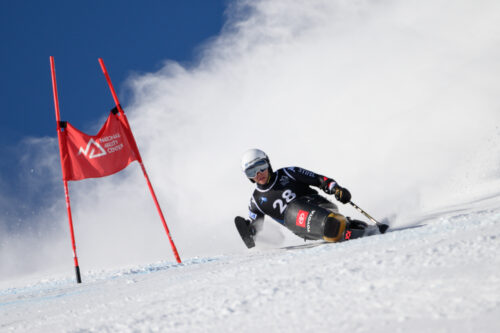
Yes, Kurka has achieved the ultimate level in sport – namely winning a gold medal as best of the world. Except it’s not as a wrestler, and it happened years after a devastating ATV accident near his Mat-Su Valley home as a 13-year-old. Kurka’s crash resulted in a broken back, partial paralysis and the sudden end to becoming a college and Olympic wrestler, and even a professional wrestling gig, which all seemed so attainable before that fateful day. Rather, Kurka went to the 2018 Paralympic Winter Games in Pyeongchang, South Korea, where he was the Paralympic champion in sitting downhill skiing, one of the milestones in a life full of plot twists before and after the ATV accident. And he’ll appear in the Paralympic Games in March, likely his last, when the Italian cities of Milan and Cortina host after this month’s Winter Olympics.
“I’m a keynote speaker and give speeches, and I try to help people to realize those opportunities in their lives as well. You have these challenges, these pains and these issues, but it’s a lot easier for people to fathom them when I say to them, because I’m a young man who broke my back and became disabled,” Kurka says. “It’s either yes or no; I had two options. It’s either overcome or succumb to it. I had to overcome, and everyone has those same options in their lives – whatever it is.”
A LIFE-CHANGING MOMENT
Nothing about his wreck so many years ago is a blur for Kurka, who turned 34 on January 27. A lifelong outdoorsman who grew up on a family homestead property in the tiny village of Nikolaevsk, near Homer, Kurka moved to Palmer when he was 12 years old. The next year, Kurka and a friend jumped onto their ATVs to fish in Jim Creek, a 15-minute ride from his Palmer home, and then down to where the creek confluences with the Knik River, 30 minutes further.
“I flipped the four-wheeler and it landed on my head, compressing my spine and breaking my back. There was instant pain but also instant paralysis. It affected my spine right away. I knew something was wrong, and I had cracked my skull and injured my head; – blood was pouring out into my eyes. I had fractured T10 through T12 in my spine,” he recalls.
“I was conscious through the whole thing – just a 13-year-old laying in the sand scared for his life.”
Just like that, the aspiring wrestler had a whole new outlook on his life. He’d competed in the 135-pound weight class. But the effects of the accident would soon reduce Kurka to 90 pounds of body weight.
When something like this happens to anyone – let alone a talented 13-year-old athlete – the physical pain from the accident is one thing; the mental scars can be even worse.
“It’s the pain of the why me moments that help you to grow into someone who’s better. You can’t ever grow and be a better individual without first having pain,” Kurka says. “It’s the most important process to growth. The why me moment is the best teacher that you can have. And I had lots of ‘why me’ moments.”
For two years, the wrestler grappled with the consequences of his paralysis. Kurka was experiencing that physical and emotional growth process from boy to young man. Becoming that person was critical to not letting this worst of setbacks prevent anything more tragic from happening.
“Between 13 and 15 there was so much depression. ‘How did this happen? What did I do to deserve this? What’s the reason?’” he recalls. “When I was 15, 16, I started to realize that the reason is whatever I choose to make it. And I’m going to make it the best that I can.”
His mother Amy Weideman, a single parent, also proved crucial in not allowing apathy to win out.
“Mom said, ‘This happened to me for a reason; the reason is whatever you choose to make it.’ And when she told me that, it helped to understand that it doesn’t really matter what happens to me throughout my life; what matters is how I handle it,” Kurka says.
“I’ve met so many people who don’t have disabilities who are so much less capable than I am just because they aren’t willing to try or willing to work. That’s really all there is to it. That’s something that I’m proud of,” he adds.
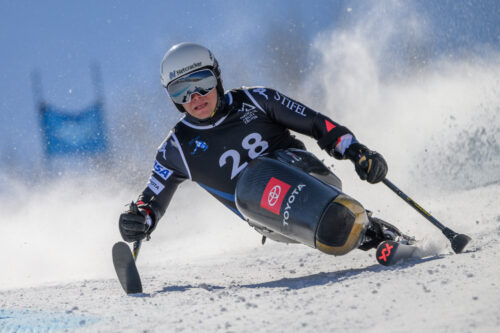
when I go outside,” Kurka says. “But the moment when you’re ski racing (and) you start to feel the wind in your ears even with the helmet on, or you start to feel the helmet pick up because you’re going so fast and start to feel the wind pressure on your chest, it helps you to feel alive.” (ANDREW KURKA; BELOW: US SKI & SNOWBOARD)
HOMESTEAD ON THE RANGE
From an early age, Andrew Kurka learned toughness from the older generations of his family. “My grandmother is 96 years old and going strong; still tough. She still walks two flights of stairs every day just to get to her bedroom. She has zero quit. My grandma, two years ago, fell on the ice and broke her hip, but she walked herself to the hospital,” Kurka says.
“My mom broke her ankle while golfing and continued her round of golf! So I don’t know if it’s genetic as much as it’s just ingrained in us, but there’s something there,” he says. “It definitely comes from them and it’s something that I’m super proud of, whether they taught it to me or they willed it into me.”
Nikolaevsk, in Kurka’s words, “was a Russian- and English-mixed town.” The family has Eastern European roots, but he spoke Russian as well as English growing up. (“My Russian has tapered a lot. I hardly speak it anymore.”)
The family lived on 640 acres just outside of town. Kurka and his brother had an almost 2-mile walk just to get to the school bus stop. He grew up around farm animals, the Alaska outdoor lifestyle and hard work. With a mom and grandmother as tough as sandpaper, excuses wouldn’t be tolerated.
“From the moment I was 5 years old, I was hauling 5-gallon buckets to go take care of the animals and chopping firewood,” he says. “It didn’t matter what the temperature outside was; if it was 40 below we had to chop even more wood to stay warm. Our house didn’t have conventional heat, so we heated it with wood.”
The kids made their own fun – literally. They’d handcraft board games and squiggly swords to play with. Ingenuity became a family trait. Work hard, play hard became more than a mantra; it was their narrative. “We constructed life skills by just figuring it out.”
As for the outdoor playgrounds at his disposal, Kurka was more than a willing participant. He proudly can tell the difference between the sound of a bear or moose taking steps in the woods.
The do-it-yourself, no-excuses existence the family lived, coupled with the easily accessible hunting, fishing and hiking in their backyard offered Kurka a sense of freedom as a child. The outdoors was “ingrained” in him.
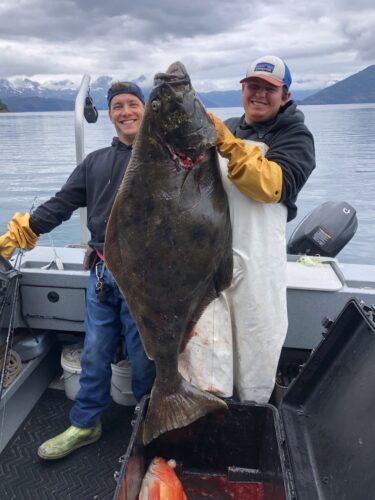
“We killed a moose every year and we had that throughout the winter time. In the summers we fished, and I still do that,” he says, adding that all the aspects of his childhood – the grunt work, the creativity, the wrestling aggression – didn’t happen by accident.
“Both being raised on the homestead and being a wrestler, all of that came from the way that I was raised. It transcended into the way that I wrestled and into the way that I am now – to overcome my injuries,” Kurka says. “What I think is the most important aspect to my successes in life is grit. Especially nowadays, there are so many people who aren’t raised to understand work ethic or hard work. They don’t understand it because they’ve never truly had to. That’s one of the things that I’m most truly grateful for.”
WHAT NOW?
For Kurka, wrestling wasn’t just a sport; it wasn’t just work; it was his opus. “I had tried so many sports as a young man, but wrestling was really where I shined. I did well and it’s something that molded my future,” he says. “I had a good time with wrestling. To me that wasn’t work. It’s funny that so many people say, ‘You must have downtime; you have to have downtime.’ But you don’t have to. Yeah, downtime is nice, and a lot of people say it’s hard work, but if you love what you do, that’s your relaxing time.”
But all of that changed after the accident, the broken back, the prognosis, the uncertainty. By the time the initial shock waned and reality set in, there was no way Kurka wouldn’t pursue something challenging.
He actually tried wrestling again, but “I was getting my butt beat up … It was so hard – 10 times harder than it was before.”
Fate would intervene in the form of a persistent physical therapist. Kurka was at a wrestling tournament when his PT picked him up and suggested skiing as an alternative to wrestling.
“I almost never skied. But (the physical therapist) believed in me,” he says. “She was like, ‘Look, I’m going to take you there and pay for your first ski lesson. You’re going to go out and ski because I think you’re going to do great.’”
They went to popular Alyeska Resort in Girdwood, outside Anchorage.
“My very first time on the mountain, I slid balanced straight down the mountain, hit the bottom, fell and said, ‘I love this. This is for me.’ I got to go fast and the biggest thing was I felt alive again,” he says.
“I feel alive when I catch a fish, and when I go outside. But the moment when you’re ski racing (and) you start to feel the wind in your ears even with the helmet on, or you start to feel the helmet pick up because you’re going so fast and start to feel the wind pressure on your chest, it helps you to feel alive.”
Even after crashing on that initial run, something clicked. Kurka was competitively wrestling all over again. He says, “I’ll never forget the instructor I had skied down with asked, ‘Do you feel OK?’ ‘Hell yeah!’ I just went straight and crashed and was loving it so much.”
At that point, 15-year-old Kurka may as well have been Ricky Bobby, Will Ferrell’s narcissistic but lovable NASCAR driver from his film Talladega Nights: The Legend of Ricky Bobby. His “I wanna go fast” mantra is one of the flick’s signature lines.
Ferrell’s Bobby also poetically would say, “If you ain’t first, you’re last.” And Kurka was that kind of competitor, whether it was working the homestead, chasing outdoor adventures or excelling at sports.
“At the beginning of my career I was just fast. I asked people, ‘How do I go fast?’” Kurka says. “No one had really taught me tactics. So I didn’t know how to stay safe on the mountain, when to do what, or how to even do certain safety tactics. I just didn’t know. But I learned, and I learned quickly. I really took the time to learn those things.”
OLYMPIC DREAMS
As he became more adept as a competitive sitting skier, those preaccident Olympic wrestling goals were churning inside again. Could he get there via the Paralympics? When Vancouver, Canada, hosted the 2010 Winter Olympics and Paralympics, then 16-year-old Kurka got to attend as part of the Future Paralympians program as his skiing career was about to blow up.
Around that same time, he competed in his first Paralympic Nationals event in Big Sky, Montana.
“When I was sent to Vancouver to watch the Paralympics, I thought, ‘Man, I can beat these guys.‘ I hadn’t had any professional training or anything. It was just like, ‘Good. So fast,‘” he says. “That motivation in life that gives you those moments; it was one of those for me. ‘I can do this.’ And I did.”
Four years later, in Sochi, Russia, he was supposed to get that chance to prove himself.
NOT AGAIN!
Kurka was coming into his own – competing in several World Cup races and qualifying when Sochi hosted the world in the 2014 Paralympic Winter Games. But in a training run for the men’s downhill, he crashed. No big deal, right? This guy’s been in the darkest corners and deepest crevices and rebounded.
“I didn’t know that I had broken my back until the doctors came in and told me. I said, ‘Oh, I can still go down. I’ll be fine.’ But they were like, ‘No, you can’t go back out,’ and they sent me home,” he says.
Talk about a terrible break – literally. And if that wasn’t enough, after rehabbing his latest back injury, when back on the slopes Kurka took another bad spill, suffering a compound fracture and broken femur.
How much can one man take?
Apparently, a lot.
“People throw the word inspiration around in life a little too much. But I think a little inspiration in life is so important. It was these moments that made me say, ‘OK, I want to do that.’ I wanted to do these things,” he says. “I just needed to be shown that, ‘Hey, you can; just figure it out.’ There are so many people going through those same instances in life and simply don’t believe in themselves. So many situations in life, especially when you have a disability, where people tell you what you can’t do anymore. ‘You’ll never walk again. You should just give up on ever doing these things again.’ That’s not the case. In today’s day and age, you can figure it out and can find a way. It’s going to be difficult, but nothing is impossible.”

GOLD RUSH
After another four years, more podium finishes in World Cup races (golds in downhill, super-G and giant slalom races), Kurka would have another opportunity at the 2018 Paralympics in Pyeongchang, South Korea.
In the downhill race, Kurka seized that opportunity to ski the gold medal-winning race of his life.
“It was a reminder that, ‘Hey, maybe I am doing this for a reason.’ Kind of my life’s reason was to be as good as I could in something that I loved and I really wanted to do, and the moment I was able to get that gold, I was like, ‘OK: it’s worth it,’” he admits. “As an athlete, it’s really hard. So many athletes just quit being an athlete to go to school or go for something that’s more fathomable. Being an athlete is kind of a made-up dream that’s really, really hard to accomplish. And the moment I was able to win that gold medal, it was worth it. I did it, and all the broken bones were worth it. My story is now meaningful.”
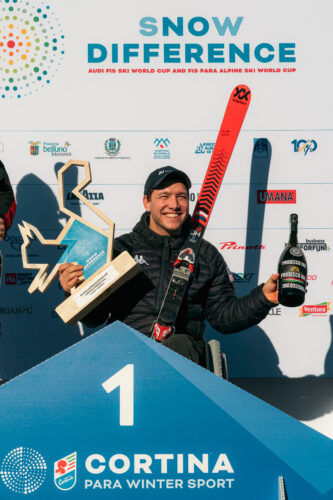
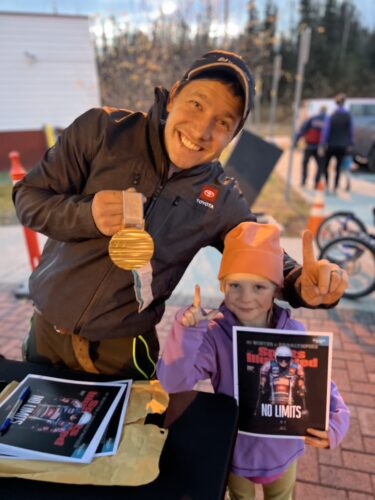
And while actually receiving his medal and hearing the national anthem was amazing, and having family members on hand made it that much more special – Kurka also won silver that year in super-G sitting skiing – something else stands out.
Just before he knew he’d be a Paralympic champion, as each skier completed his run, the athletes in medal position waited together at the finish line. They’d get replaced if their spots were overtaken by faster times.
“I had a rival, Corey Peters from New Zealand (an eventual Paralympic gold medalist), and we’re sitting there on the podium, and Peters, he just talks sh*t and almost never said anything nice. But this was a moment when he said something nice to me. He said, ‘Kurka, you had a killer run; no one is going to beat you.’”
“In that moment, it was just, ‘OK; I won.’ It wasn’t the medal; it was Corey saying that to me. The recognition is cool and all, and the medal is cool, but it’s just a representation of who I am. I accomplished the dream of being the best in the world at something. No one can ever take that away from me. That’s so cool. On my deathbed, I can think about that.”
Peters would be that guy four years later in Beijing, China. Kurka crashed again 45 minutes before the race, suffering a broken arm, among other injuries, when a gust of wind blew him into the fence along the course. He still competed in the downhill and managed fourth place.
“After the two medals, I had a little bit of burnout, and I started focusing on the other things in life,” Kurka says. “I was planning on retiring after Beijing. I felt like I had a great career, I thought I was going to win another gold medal and I’m going to call it. I got fourth place – awesome – but it’s not a medal. I don’t need to win, but I just can’t go out like that.”
ONE MORE TRIP DOWN THE MOUNTAIN
Italy is set to be the last stop on Kurka’s skiing journey. He plans to hang up the gear after next month’s games. But he still has plans to go fast in life. He and his wife Verónica have built a bed and breakfast lodge in Palmer, the Golden Standard, which features rooms that are accessible to disabled guests (see more on page 9), something that the couple insisted upon in their plans for the business.
Furthermore, Kurka has studied to be a licensed sport pilot and is now taking his lodging customers – many of whom have mobility issues – on adventures they’d otherwise may never get to experience.
He’ll soon work toward earning certification to be a flight instructor, with the hope that he’ll someday teach disabled pilots to fly.
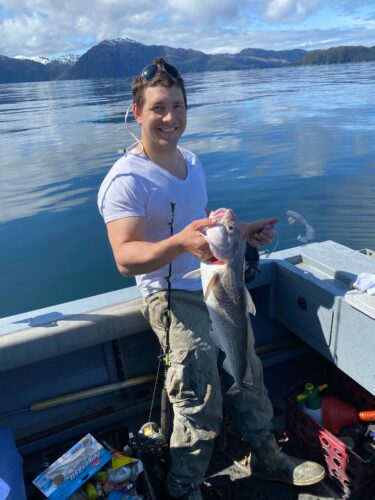
“Oh man; that’s what I love to do and that’s where a good portion of my personal passions lie. Being a person who’s able to help people just like I was helped. Being that guy for other people; I want to be that person,” he says. “I own a boat and I’m able to take people with disabilities out on the ocean to go deep-sea fishing, or take them flying – things that they never thought they’d have a chance to do. I want to be able to inspire more people with disabilities. And that they can grow from them.”
He’s become in demand to be a keynote speaker at events, where he can share his remarkable tale of highs and lows. It’s been quite a ride, and in March, he’ll ski down the peaks of Cortina d’Ampezzo’s Tofane Alpine Skiing Centre in the Italian Alps.
“Going in I have goals set. Medals are on the table; I’m good enough to get them. Do I need to get them? No. But I can’t go out with a broken arm,” he says of his performance in Beijing.
“I need to be able to say I gave it my all in my last games. I think I’m almost more (hungry), to be honest … I’ve got to work a bit harder, because I’m 34 years old, and a good portion of my competitors are 26 to 28 years old. But I have the experience to get through it, but I don’t have the physicality, so it takes much more mental determination to get through this. All of my competitors respect me. That’s all I can ask.” ASJ
Editor’s note: The Paralympic Games are March 6-15 in Milan Cortina. For more on Team USA, see teamusa.com/milano-cortina-2026/paralympics. For more info on the Kurkas’ Golden Standard Bed and Breakfast, go to goldenstandardbnb.com or call (907) 707-7613. Follow Andrew Kurka on Instagram (@andrewkurka).
Sidebar: GETTING BACK OUTSIDE THE HARD WAY
When Andrew Kurka was it so much. It’s amazing when you go the skin flap over, the genitals smacked recovering from a broken back through something so traumatic and so me right in the face!”
that left him partially paralyzed, he was determined to find a way to get back outdoors. He’s an Alaskan, after all.
One day, while he was still wearing a back brace after returning home, a good friend, Daniel Bedwell, stopped by to visit Kurka.
“He came in and he picked me up out of my wheelchair, carried me out, set me in the truck, drove me to the river and he got his boat out, got it ready, picked me out of the truck and set me in the boat and said, ‘Next time you have to do this on your own,’” Kurka recalls.
“We had an adventure and went fishing. I was in excruciating pain but didn’t say a single word. But I enjoyed it so much. It’s amazing when you go through something so traumatic and so painful, you take a moment where even a ray of sunshine on your face can mean the world.”
Kurka credits that kind of tough love for the adults and friends in his life during those challenging days after the ATV accident. A common battlecry as he tried to be normal again? “Figure it out.”
He has so many memories of the fishing and hunting in the Last Frontier, both before and after his injury. He remembers moose hunting with his grandpa post-accident as a 15-year-old.
“It was a 52-incher in a super secret spot. We were gutting the moose, and as he was gutting up from the belly, the genitals were attached, and as he tossed the skin flap over, the genitals smacked right in the face.”
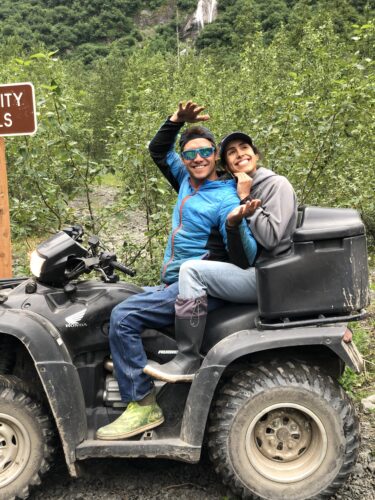
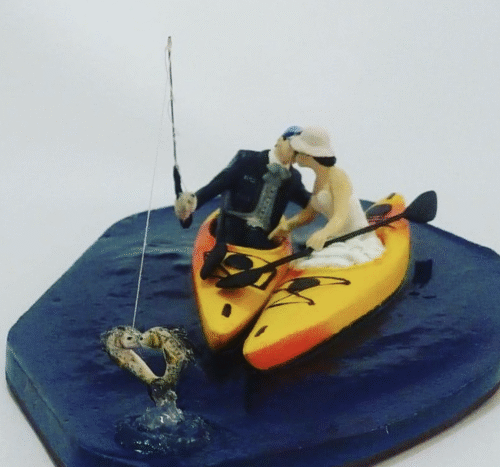
So much of his identity is in his Alaska roots. When he married Verónica, their wedding cake topper featured the bride and groom smooching on two kayaks and a rod and reel in hand fighting a fish. “That was her idea,” he says.
But it’s a fitting tribute to an Alaska lifestyle the couple still savor these days, with their bed and breakfast in Palmer allowing for more fun in the field.
“I love it. Any opportunity when the weather’s nice, I fish here in Alaska and get out on the ocean,” he says. “Being able to fly a plane or get in a boat in Alaska, you can still go places where people haven’t been. It’s such a cool place. That’s why I’m here.” -CC

Alaska Salmon 2011: Not Too Shabby

Prime Time For Face Time At Sportsmen’s Shows

EPA: Potential ‘Adverse Impacts’ On Bristol Bay Salmon Fishery With Pebble Mine; Comment Period On Draft Study Open Into July
About Author
