
First Alaska Trip To ‘Where The Halibut Bite’
The following appears in the April issue of Alaska Sporting Journal:
BY RICHY J. HARROD
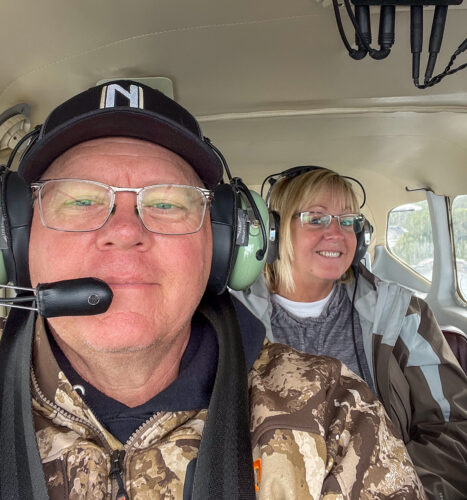
Ketchikan disappeared behind us as the plane sped towards Thorne Bay somewhere in the unknown distance. The hum of the Beaver’s 450-horsepower Pratt & Whitney engine and the views of the towering mountains surrounding Clarence Strait were mesmerizing.
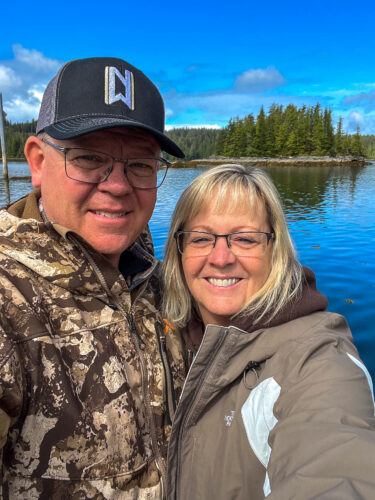
My wife Vicki and I were on the last leg of multiple flights to go fishing with our good friend Gary Anderson, who lives in this remote Southeast Alaska town. Flying is an unpleasant experience for Vicki, and I was worried the small plane ride would be difficult. Turning quickly, I expected to see strain on her face, but instead she was smiling ear to ear as she pointed to beautiful snow-covered peaks and enchanting small islands. Her first Alaska experience was off to a promising start.
A NEW ADVENTURE
Traveling to remote areas to hunt or fish is familiar to me. A dozen states, including Alaska, plus British Columbia, have provided cherished memories of pursuing elk, deer, upland birds or multiple species of fish. Vicki has always supported these adventures and patiently awaited my return, sometimes weeks later. Not a hunter or fisher herself, she doesn’t emotionally connect with stories of close encounters with elk or trophy kokanee fishing in isolated, crystal clear lakes.
In my opinion, outdoor experiences are best shared with family or close friends, so it was with great anticipation that Vicki agreed to join me on a saltwater fishing journey on Prince of Wales Island.
THE LODGE
The pilot finally guided the plane from the wide strait into the narrow and winding Thorne Bay. Gary had been out setting shrimp pots outside of the bay. I sent a message letting him know we were leaving Ketchikan, and he replied that he’d race in once he spotted our plane. As our pilot started his descent, Vicki spotted a boat speeding towards town. We made eye contact and nodded with a smile, acknowledging that our friend was nearby.
Gary is the owner and operator of Anderson Lodge Alaska. The quaint lodge and onsite tackle shop are situated on the waterfront in the town of Thorne Bay. He offers guided or self-guided opportunities to fish for salmon, halibut, lingcod, black seabass or yelloweye. You can even catch your own crab for supper in the bay within eyeshot of your room. The lodge itself has charming accommodations, and its staff prepares amazing home- cooked meals in generous portions. Gary’s goal has always been to treat his clients like family, making lasting memories for guests.
We met Gary at various sportsmen’s shows in the Pacific Northwest, as we both had vendor booths for our businesses. He had sent invites many times to visit in early June, before his lodge opened for the season and guided clients arrived.
“You guys can help me find the best fishing spots before customers arrive,” he would say enticingly. Now, years after his generous offer, we were finally standing on the dock wondering why it had taken us so long to travel to this beautiful coastal island.
The remoteness of the bay and nearby forests was immediately apparent. The only sounds were the gentle lap of saltwater on the shoreline and shrill, high-pitched calls of bald eagles. “Look at all the bald eagles!” Vicki exclaimed while taking multiple pictures. The majestic birds have always fascinated her. “I’ll bet you’ll see several every day,” I replied.


HAIL, HAIL, THE GANG’S ALL HERE
Gary showed us around his lodge, store, outside deck and dock area. A couple of his cousins, Jim and Tim, and Tim’s friend Heather had arrived the day before. Coincidently, Vicki and I knew Tim, who was also a vendor at sportsmen’s shows and often our booth neighbor. Jim and I worked together at a county fire department in the Spokane, Washington, area. “I still can’t believe these two turkeys are your cousins!” I exclaimed, laughing out loud. “It really is a small world,” Gary replied, shaking his head in disbelief.
We spent the evening in good- humored conversation, eating fresh crab at the large lodge table and preparing the boat and gear for the upcoming halibut fishing adventure. We would fish in big water on the west side of the island, and again I worried that Vicki would be apprehensive. She’s no stranger to fishing boats, but the swells in saltwater can be intimidating.
“You nervous about tomorrow?” I asked with concern. “Not really; Gary’s boat is huge, so it should be alright,” she said confidently. After chatting about an eventful travel day, we slowly drifted to sleep in the dusky light of an Alaska spring evening.
OTTERS AND MORE
Gary was up early making final preparations for his boat’s first spring trip, a trailered ride across the island. Jim, Tim and I awkwardly helped, unaware of the routine. The kitchen staff practiced their routines too. Breakfast sandwiches and coffee were soon ready for our departure. The ride across the island on a winding, narrow, two-lane road would take about an hour. The excitement in the vehicle was palpable, especially for Gary. He shared stories about deer, bear and moose as we passed his familiar landmarks.
The small boat launch at Naukati Bay was beautiful as we took in views of small islands and the wide fjord. The sun was shining on calm water while seagulls called to each other and eagles glided overhead. I watched with delight as my wife reveled in the sights, sounds and smells of this coastal paradise. Gary gave us clear directions about how to help with the boat launch. We felt more like helpful deckhands, and Tim, Jim and I soon had the 28-foot vessel lashed to the dock.
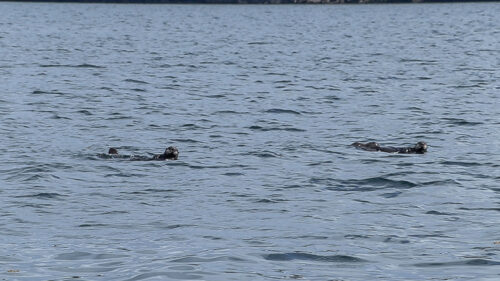
After a safety briefing, we pushed off and were underway. Rafts of sea otters dotted the small bays and coves. Vicki swore they waved to us as we motored by. Gary’s route weaved around numerous islands and through narrow fjords. Some of the passages were rough from large swells arriving from open water, but Vicki and the rest of the crew were unphased. Ultimately, we stopped at an undisclosed spot in the middle of dark blue saltwater.
FIRST FLATFISH
Halibut are typically caught with either bait such as herring or squid on a circle hook, or by jigging heavy leadhead jigs with soft plastics tipped with a small piece of bait. On this trip, Gary outfitted each of our rods with 4- to 6-ounce jigs and herring pieces. The technique was to drop the jig to the bottom (150 to 200 feet deep), raise it up a couple feet, then let it return to the bottom in free fall. Unlike with a circle hook, a quick jerk when bit set the hook on biting fish.
“(Do) you understand how to do it?” I asked Vicki as we started dropping our gear to the depths. “Yeah; will I know when I’m on the bottom?” she asked. “Yep; just like our bottom bouncers for walleye, it will abruptly stop.”
Everyone onboard had some fishing backgrounds. I’m an experienced boat captain and could help Gary with maneuvering the boat so he was able to fish as well. With the boat on a slow drift with the current and wind, the six of us found bottom and soon our rod tips bobbed up and down as if being operated by a perpetual motion machine. It didn’t take long before the action started.
Tim was the first to break the ice. “Oh yeah, here we go!” His halibut rod bent over the rail as he reeled hard to bring the tugging fish from just over 200 feet deep. “Wahoo! Good job, Tim!” Heather cheered him on.
Gary and I stared into the water watching for color and some indication of size. “Not sure it’s really big,” Tim said. “I see it; nice fish, but just chicken-sized,” Gary observed as the 20-pounder neared the surface (the term “chicken” is used to describe small halibut).
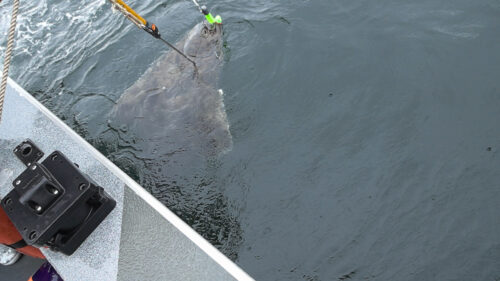
Vicki watched with envy as Gary gaffed the fish and pulled it onto the deck. That feeling was short-lived since her rod was the next to get bit. “Oh gosh; I’ve got one on,” she said nervously. “Keep steady pressure and reel; you got this,” Gary reassured her. Vicki pinned the rod butt into her hip and reeled until her arms and back tired from a halibut refusing to leave the bottom. Finally, a slightly larger 30-pound halibut appeared from the inky depths. Gary reached over the rail to quickly gaff the dark brown flatfish and flipped it directly into the onboard cooler.
“How about that? You landed your first Alaska halibut!” I said while beaming with husbandly pride. “It seemed like it would never get to the surface. I’m not sure I could land a bigger fish!” she said with a laugh.
Gary had found some hungry halibut. Making multiple passes on the same GPS track resulted in numerous bites. We tried two more spots marked on his depth finder and continued to find biting fish. There was constant chatter, laughter and appreciation for the bounty. Less than three hours passed before we each had hooked and landed our two chicken halibut.
With a boat full of fish, we returned to Thorne Bay to process our catches. In a team effort, Gary and I removed meaty filets, while Tim and Jim separated skin from the meat, and Vicki and Heather rinsed, dried and bagged the filets. A vacuum sealer in the lodge made quick work of preparing portions of meat for the freezer.
With the catch processed, we sat down at the oversized island in the lodge to enjoy a home-cooked supper and recount stories from the day.

IN SEARCH OF BIGGER ’BUTS
The following day we repeated our steps, returning to the west side of Prince of Wales Island for another day of fishing. The weather was very different, however. Clouds, rain and wind buffeted the boat as we returned to the halibut grounds. The narrow passages boiled with large swells and white water broke over exposed rocks. Again I worried that the conditions would be unnerving for Vicki, but just as before, she rolled with the boat like she’d experienced it 100 times before.
Gary decided to start fishing at a more protected stretch of water and hoped to locate some larger fish. We dropped our jigs to the bottom in slightly shallower water, and Vicki was the first to hook a halibut. “Seems like about the same size as yesterday,” she said, now with a more experienced tone from the previous day. A quick lift with the gaff and a 15-pound, mottled brown flatfish hit the deck.
“Good job, Vicki; you broke the ice,” Gary stated.
We hooked and landed a couple more small halibut and Pacific cod on the next drift. But then no one got a bite over the next hour. The water lapped on the boat sides and we could hear the distant roar of waves crashing on the rocky shoreline. The rain pelted our raincoats while we jigged in silence. “How are your hands doing?” I asked Vicki with concern as I noticed their red hue. “Uh, they’re almost numb,” she reluctantly replied. I suggested she could sit inside for a while, but Vicki refused my offer and kept fishing. Her decision was fortuitous.
“Oh my gosh! I think I have a really big one!” Vicki said under the strain of a bent rod. Gary put his halibut rod into the holder and hustled to the rail to evaluate her catch. “Oh yeah; just take your time. You’ve got a good fish on,” he said with a big grin.
Vicki’s fight lasted nearly 20 minutes, as the big fish would head back to the bottom, negating her reeling progress. I’ve fought 7-foot sturgeon in the Pacific Northwest’s Columbia River, which left my arms feeling like useless lead weights. “Are your arms burning?” I asked, remembering my big fish experience. “Oh yeah,” she replied with a tired-sounding deep breath. Gary leaned close to subtly ask, “Do you need help?” “No. I can do it.”
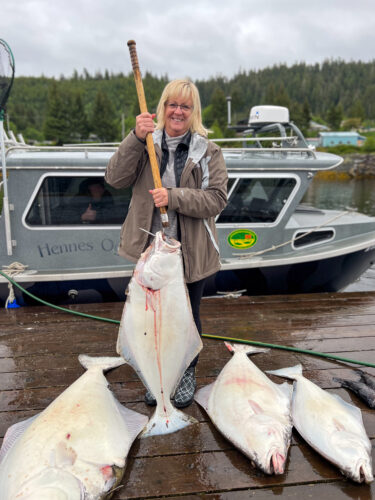
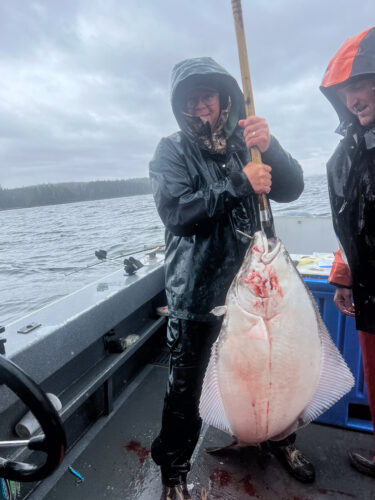
Her effort paid off when the brown and white colors of a 60-pound halibut neared the water’s surface. “Keep the fish below the surface. I think we can just gaff this one. Give me a hand, Tim,” Gary said. The two tall men grabbed the gaff handle and lifted Vicki’s prized fish over the rail. It flopped loudly on the deck.
“Nice fish, honey!” I said, beaming with excitement.
“I’ve never caught a fish that big! Oh my gosh; that’s a big fish,” she said while admiring the prehistoric-looking fish.
The bite was slow, but we landed two more big fish. I was fortunate to land an 80-pound halibut, while Jim caught the fish of the day at about 150 pounds! Halibut can reach weights of over 500 pounds, and we tried to imagine the herculean effort required to land such a fish. As we quietly marveled at our fish, Gary suggested we leave the halibut grounds to return to the warmth of the lodge.
MORE THAN THE FISH
Wind and rain worsened the following day. Fishing on the halibut grounds would have been dangerous, so Gary took us on a shore fishing adventure near the lodge. A short hike brought us to a beautiful river. We cast spinners and caught small brook trout.
“It’s so beautiful and quiet here,” Vicki said as she admired the bright green vegetation contrasted against the dark green water. She had never fished a stream before, but after some practice she caught several trout.
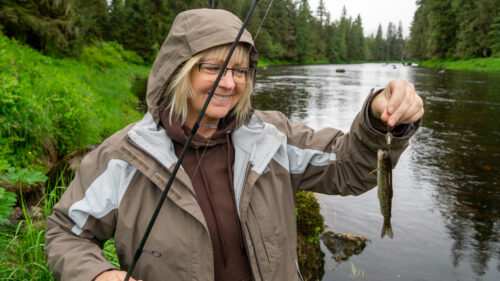
and embraced the difficult conditions,” Richy writes. “She discovered that being uncomfortable can be rewarding.” (RICHY J. HARROD)
A NEW APPRECIATION
Fishing the river was an enjoyable ending to Vicki’s Alaska experience. The cool, wet weather was a challenge for her, but she persevered alongside the rest of us. An outstanding meal and drinks in the comfortable lodge gave Vicki time for reflection.
“I think I understand why you like doing this,” she said. “Oh yeah; why?” I asked. “It was fun spending time with friends. Catching those big fish was exciting. Watching everyone’s excitement was so enjoyable,” she replied.
I simply smiled and nodded my head in silent agreement. I was proud of my wife. Vicki overcame her apprehensions and embraced the difficult conditions. She discovered that being uncomfortable can be rewarding. She appreciated more than ever the meals from the halibut we caught because she understood the effort required to obtain the amazing protein. There is mutual understanding in doing hard things together. Our relationship was strengthened during this time together. Vicki now has a better understanding of my passion for the outdoor way of life after having ventured to where the halibut bite. ASJ
Editor’s note: Anderson Lodge Alaska’s website is andersonlodgealaska.com, or call (907) 419-0957. For more on Richy J. Harrod, check out harrodoutdoors.com.

Alaska Salmon 2011: Not Too Shabby

Prime Time For Face Time At Sportsmen’s Shows

EPA: Potential ‘Adverse Impacts’ On Bristol Bay Salmon Fishery With Pebble Mine; Comment Period On Draft Study Open Into July
About Author
