
A Sunken Argo Ordeal In The Arctic (Part I)
The following appears in the January issue of Alaska Sporting Journal:

FIRST OF TWO PARTS
BY SCOTT HAUGEN
Editor’s note: Alaskans know the value of an Argo when it comes to tundra travel. In part one of this adventure story, Scott Haugen and his Iñupiat hunting partner get themselves into a life-threatening situation when their Argo sinks in the middle of an Arctic river.
The numbness in my feet made its way up both legs. I could no longer feel my calf muscles. After 15 minutes of standing in the glacial waters of the Kalutagiaq River, I had to make a decision: wait for possible help or ford the rampaging, chest-deep river.
Not only was the chilling water affecting me, but the 30-mile-per-hour winds, blowing snow and 24-degree temperatures were beginning to take their toll. With the sun slipping behind the towering Brooks Range, temperatures rapidly dropped into the low teens. I couldn’t stand the pain in my legs any longer.
Fearing numbness would plague my motor skills, I knew I had to try swimming to shore. If I stayed where I was any longer, I might not be able to feel my legs, rendering me incapable of maintaining my balance while trying to cross the raging river. The potential of cramping muscles also entered my mind, which would mean sure death by drowning.
I FOUND MYSELF IN this predicament while hunting Dall sheep, moose and caribou with my good friend and lifelong North Slope resident Ben Hopson Jr. The now late Hopson was a Native Iñupiat man who grew up in the village of Wainwright before moving to Anaktuvuk Pass, where we both lived at the time. My wife and I were schoolteachers in this village on Alaska’s North Slope, just over 250 miles north of Fairbanks.
Hopson was one of the most knowledgeable men I’d ever met when it came to Arctic survival, hunting and trapping. The outdoors was a part of Hopson’s culture for many generations, and he was most happy when out, exploring new territory in the challenging Arctic. He had a sixth sense that was fascinating to witness in the wild, and it added to his level of confidence and fearlessness in this most unforgiving of environments.
While living four years in Anaktuvuk Pass in the mid-1990s, I had the good fortune to hunt and trap with Hopson on numerous occasions. I spent more time in the wilderness with him than anyone during my time there and will be forever grateful for all he taught me about the Arctic. On more than one occasion I entrusted Hopson with my life.
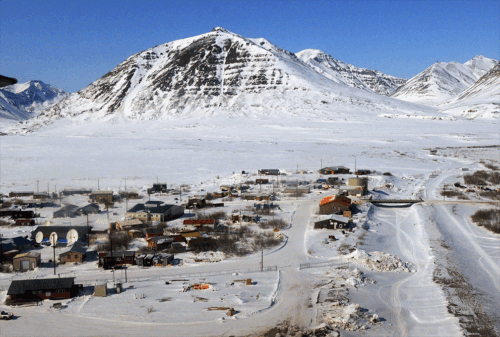
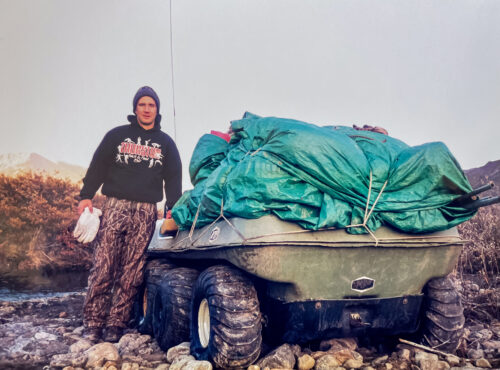
ON THIS 23RD DAY of August 1994, our plans were not going as hoped. With 3 inches of fresh snow on the valley floor, there was not yet enough powder to break out the snowmachines. Instead, we took Hopson’s Argo. The all-terrain, amphibious, eight-wheel vehicle is an important mode of transportation for the people of mountainous Anaktuvuk Pass, as they are for many people in Alaska.
I have been in Argos that have climbed up and down hillsides so steep it felt like the machine was going to flip over at any moment. I’ve crossed creeks and rivers where water has flowed into the cab, but the machine kept going. The amphibious vessel even has a place for an outboard motor, making the maneuverability much more efficient in deep water versus depending only on the fat, paddle-treaded tires. On our river crossing, we had no outboard motor.
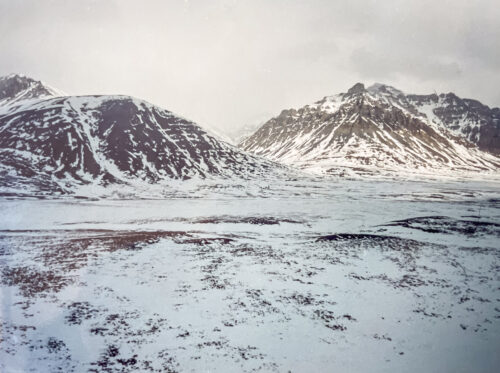
Our August day began as a good one. Hopson and I traveled 11 miles south of Anaktuvuk Pass to a point where we could look over thousands of acres. We glassed multiple mountainsides and one creek drainage, along with the John River. Picking up no sign of moose, sheep or caribou, we moved south into the Kalutagiaq River drainage.
After starting the machine, we went only a few feet before a throttle cable broke. We came up with a makeshift fix; I reached across Hopson and worked the cable while he steered. Argos don’t have a steering wheel, per se; rather, two levers you pull back and push forward, much like the steering on a Caterpillar tractor. We bounced about the topless Argo and practically gave each other concussions with every bump we hit. That’s when we stopped and Hopson used his CB to radio the village. Within all Arctic villages – as in most villages throughout the Last Frontier – CB radios were the foremost source of communication. On this day it proved a lifesaver.
MIRACULOUSLY, SOMEONE FROM THE village heard us as they prepared to head in our direction in search of caribou. Two hours later we had a new cable. It was midafternoon, and whoever it was that dropped off our cable continued south to Masu Creek.
Hopson and I went over a few more knolls and glassed for caribou. With no luck, we, too, headed south toward Masu Creek, a big drainage known to hold moose and caribou. As we neared the Kalutagiaq River, Hopson commented on how high it was. I’d never seen this part of it. We had been getting an unusual amount of rain and snow during the month. The increased runoff led to high water levels in all of the valleys. Then, as we approached the river, the Argo died. It just quit running 50 yards from the riverbank. Hopson started it up, seemingly not too concerned about the mishap.
We crawled to the river’s edge and surveyed the rapids with the engine idling. Again, the Argo died. My confidence in the machine quickly diminished, knowing we would soon be crossing this river. Hopson noted how the Argo had never behaved like this. He started it up again and turned along the bank to where a trail led down to the river. A big lump formed in my throat. I had never crossed a river of this magnitude in an Argo. I got hot and sweaty under my layers of clothes.
After much discussion, Hopson decided to attempt a crossing. The heavy silt being transported in the glacial river prevented our seeing the bottom, so we had no idea how deep it was. Even if we had to float a distance, as long as we kept the paddle-treaded balloon tires moving, we figured we could maintain our momentum and reach the other side of the river. Hopson eased the front end of the Argo into the river. There was no turning back.
Immediately the current tugged at us, whipping our front end straight downstream. It was deep enough that the Argo didn’t touch bottom, and we began floating downriver, not across as planned.
Right when Hopson started making headway straightening the Argo out, the engine died again. Now we drifted out of control. We had no oars. I could see a massive, partially submerged root wad sticking out from the riverbank, 40 yards downstream. We were headed straight for it.
AFTER FLOATING OUT OF control for 25 yards, our tires finally found gravel. We figured we could ease our way up the submerged gravel bar we were treading on. Instead, we got high-centered on a big rock in the middle of the river. After several attempts, Hopson got the machine started. But our efforts to move forward were futile, as the wheels just spun. Realizing our predicament, we began rocking the Argo from side to side. As the machine bobbed up and down, a wave caught the front end, kicking us loose.
We were again on the move and out of control. Again, the engine died. The root wad downstream grew larger as we swiftly drifted right for it. Knowing we had to get by the root wad – or face getting tangled in it and inevitably sinking – I crawled onto the front end while Hopson moved to the back to maintain our balance.
Drifting at such a high speed, I realized we had too much momentum for us to alter the course of the half-ton Argo. I reached out as far past the hood as I could, trying to keep us from getting entangled in the gnarled heap. I grabbed the closest root and shoved with all my might. It wasn’t enough. The left front end caught the root wad, spun us 180 degrees and slammed us into the rest of the mass. Instantly we began taking on water over every edge.
Ben grabbed what gear he could as it floated away. I lunged for my rifle – my late grandfather’s Winchester pre-1964 Model 70 .30-06 that Grandma gifted me when I turned 12. Then I lunged for the CB. Seeing the radio was submerging in water, and fearing it would short out at any moment, I yelled for help. I shouted into the CB microphone, “This is Ben and Scott; we’re sinking in the river! We’re on …” Tcchhhhhhh.
As I held the microphone in my hand yelling for help, static came from the receiver as the unit shorted out. Whether anyone heard us, we did not know. We were now on our own, sinking, and being carried downstream out of control. The current began forcing us back into the middle of the river. I grabbed my pack as other odds and ends floated out of the Argo and carried away downstream.
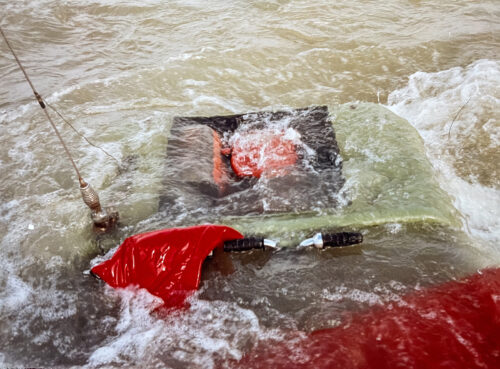
WE FOUGHT TO MAINTAIN our balance. After drifting another 40 yards out of control, the Argo’s tires finally settled on the bottom. Though we were now in only 31?2 feet of water, we were far from safe, as the swiftness of the river was overpowering.
With the Argo totally submerged, Ben and I stood knee-deep in the glacial water. Our feet faced downstream so water could be kept out of our boots’ eyelets.
I’d lost my gloves to the river, and all of our extra clothes were soaked. We lost our food, a tarp, some cushions and a few other minor items. Coming to rest at the widest portion of the stream, smack in the middle of the river, we were in trouble.
We still had another 30 yards to reach the riverbank, opposite from where we had entered. If we could successfully get to the bank, we would be on the opposite side of the river from the village. Crossing over to the village side of the river was impossible, as it was too deep and too swift. Death would have been almost certain. We also knew that nighttime temperatures would soon be reaching single digits.
We had to make a decision, and fast. ASJ
Editor’s note: Check out part two next month. For signed copies of Haugen’s best-selling book, Hunting The Alaskan High Arctic, visit scotthaugen.com. Follow Scott’s adventures on Instagram and Facebook.
Flight Of The Fledglings

Alaska Salmon 2011: Not Too Shabby

Prime Time For Face Time At Sportsmen’s Shows
About Author
