

Federal Subsistence Board Closes Moose Hunt; Safari Club International Alaska Asks To Reconsider Decision
Days after the United States Department of the Interior announced the Federal Subsistence Board would close portions of a moose hunt in the Tanana area, Safari Club International’s Alaska chapter is asking the board to reconsider. First up is Interior’s press release from late last week:
Bulletin: Federal Subsistence Board Approves Wildlife Special Action Request Regarding Moose in Unit 25D
09/03/2026
ANCHORAGE, Alaska – The Federal Subsistence Board (Board) approved Emergency Wildlife Special Action Request WSA26-09, regarding moose in Unit 25D remainder. The Board’s action was conducted via email consistent with the time sensitivity of the request and Board policy. This Special Action implements an April 2026 Board action in time for the season, as a result of a delay to the final rule publication in the Federal Register.
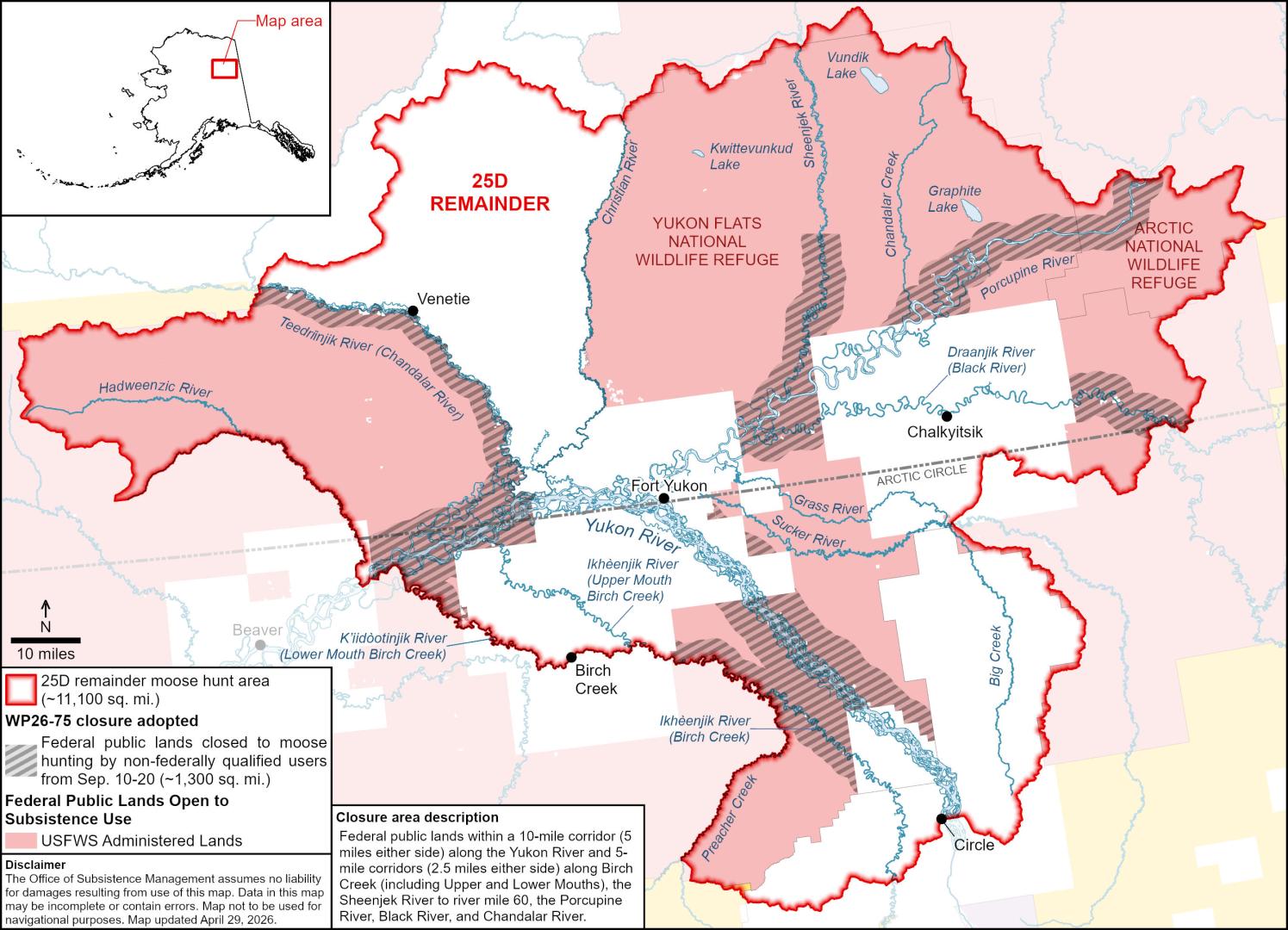
Wildlife Special Action Request WSA26-09, submitted by the Tanana Chiefs Conference (TCC), requested the Board close some Federal public lands to moose hunting by non-federally qualified users from Sept. 10-20 in Unit 25D remainder for the 2026 season due to the delay in publishing the wildlife final rule in the Federal Register. Specifically, the closure applies only to Federal public lands within a 10-mile corridor (5 miles either side) along the Yukon River and 5-mile corridors (2.5 miles either side) along Birch Creek (including Upper and Lower Mouths), the Sheenjek River to river mile 60, the Porcupine River, Black River, and Chandalar River (Map 1).
This request was based on the Board’s adoption of proposal WP26-75 in April 2026, to close Federal public lands along major river corridors in Unit 25D remainder to moose hunting by non-federally qualified users from Sept. 10-20. WSA26-09 aims to implement the Board’s intent on adopting WP26-75 until the new federal subsistence wildlife regulations are published.
More information about the Federal Subsistence Management Program is on the web at www.doi.gov/subsistence or by visiting www.facebook.com/subsistencealaska.
Missing out on the latest federal subsistence issues? To receive email updates on Federal Subsistence Management Program activities, send a request to subsistence@ios.doi.gov.
Here’s SCI’s statement on the closure (and this is their link to take action and reach out to Interior to reopen the federal lands for hunts):
FOR IMMEDIATE RELEASE
SCI Alaska: Federal Subsistence Board’s emergency moose closure days before season opens violates ANILCA, bypasses public process
Dispute centers on Board’s failure to follow process, not subsistence priority
ANCHORAGE, Alaska — SCI Alaska, joined by its Kenai Peninsula and Northern Alaska chapters, calls on U.S. Interior Secretary Doug Burgum and Agriculture Secretary Brooke Rollins to review and rescind immediately an emergency closure the Federal Subsistence Board (FSB) approved this week, mere days before Alaska’s moose season opens.
On Sept. 3, 2026, the FSB approved Wildlife Special Action Request WSA26-09, closing roughly 1,300 square miles of federal public land along the Yukon, Birch Creek, Sheenjek, Porcupine, Black and Chandalar river corridors in Unit 25D to non-federally-qualified hunters from September 10 to 20.
According to the Board’s own bulletin, the action was taken by email vote rather than at a public meeting. Deciding a statewide closure without a public meeting or comment period raises serious questions under the Administrative Procedure Act. SCI Alaska asks the Secretaries to require the FSB to explain its legal basis for bypassing the public process.
“This isn’t how the law is supposed to work, the Board’s action falls well outside what ANILCA allows,” said Jeremiah Williams SCI Alaska Chapter board president. “Congress gave the Secretaries, not federal staff, and not a board acting by email, narrow, specific authority to close federal lands, and only when it’s necessary to conserve wildlife or protect a genuine subsistence need. That standard was not met in this case, and Alaska hunters will pay the price.”
SCI Alaska’s legal arguments include:
- ANILCA Sections 804, 805 and 816 permit federal closures only when necessary for conservation of healthy wildlife populations or to protect a documented subsistence need, not for social or competitive reasons, and not to reduce the number of hunters in the field.
- The Ninth Circuit ruled in Alaska v. Federal Subsistence Board (the “Chistochina” decision, 2008) that FSB closures must be supported by “substantial evidence.” Despite that ruling, the FSB Board’s process still does not require it.
- ANILCA Section 815 requires the Board to avoid unnecessary impacts on non-subsistence hunters and to limit closures to the minimum time and area necessary.
- ANILCA Section 816(b) requires state consultation before closures are adopted. That consultation requirement has been sidestepped since 2010.
- Executive Order 14153, issued Jan. 20, 2025, directed the Secretary of the Interior to consider “the Alaskan cultural significance of hunting and fishing” and the “statutory priority of subsistence management required by the ANILCA,” a directive the Secretaries have yet to act on, more than 19 months later.
The Aug. 18 letter also states that in June 2026, the FSB Chair described the Board’s willingness to adopt closures whether “legal or not legal.”
SCI Alaska emphasizes its opposition is based on the Board’s process and legal authority, not on subsistence hunting itself. ANILCA’s subsistence priority protects rural Alaskans, Native and non-Native alike. SCI Alaska supports that priority as Congress wrote it. The objection is based on the FSB going beyond what Congress authorized and doing so via email vote rather than the public process required by law.
“Subsistence users and other hunters are not on opposite sides of this,” Williams said. “The people this closure impacts are hunters who followed the rules, planned and funded a hunt, and are now finding out, just days before the season, that the ground shifted under them without a public process. That’s a problem for everyone who cares about how these decisions get made.”
“It’s been more than 30 years since ANILCA was passed, and it seems like some of the people running this program have forgotten the compromises that were struck to make it law,” Williams said. “We’re imploring the Secretaries to remember and enforce them.”
About SCI Alaska
Founded in 1971, Safari Club International (SCI) is the world leader in preserving the freedom to hunt and is a major contributor to conservation efforts worldwide. SCI Alaska Chapter held its first banquet in 1975 and was formally incorporated in 1977. The Alaska Chapter has become a leading Chapter within SCI and is a proven leader in Alaska’s hunting community.
SCI’s four major mission areas are: advocacy, conservation, education and humanitarian services.

Alaska Salmon 2011: Not Too Shabby

Prime Time For Face Time At Sportsmen’s Shows

EPA: Potential ‘Adverse Impacts’ On Bristol Bay Salmon Fishery With Pebble Mine; Comment Period On Draft Study Open Into July
About Author
