

Potus Announces Plan To Repeal Roadless Rule; Outraged Reaction As Tongass, Other National Forests At Risk (Updating)
The Trump administration has longed to repeal the Roadless Rule, which if it’s a successful venture the pristine Tongass National Forest in Southeast Alaska would be coveted for large-scale logging projects and other business interests. Here’s the USDA Forest Service’s press release on the plan to repeal protections that date back to the beginning of the 21st century:
USDA acts to remove roadless rule restrictions that exacerbate rising wildfire risk
August 18, 2026
(Washington, D.C., Aug. 18, 2026) – Today, Secretary of Agriculture Brooke L. Rollins announced the U.S. Forest Service has filed a proposed rule to rescind in its entirety the national 2001 Roadless Area Conservation Rule, a one-size-fits-all restriction that has frustrated land managers and served as a barrier to wildfire risk reduction work across large swaths of America’s national forests.
“Our forests can’t afford another decade of inaction. Across the country, we’ve watched preventable conditions – overgrown stands, insect outbreaks and disease – turn healthy landscapes into tinderboxes,” said Agriculture Secretary Brooke Rollins. “For too long, outdated restrictions have kept tens of millions of forested acres off-limits to the very treatments that improve forest health and reduce wildfire risk to our communities. Today, we filed a proposal to restore authority to local forest managers who know the land best, removing the barriers that have kept them from doing the work the land demands. It’s time to turn the page on the failed roadless rule and return our forests to health and productivity.”
For 25 years, the 2001 Roadless Rule restricted road construction and limited the Forest Service’s ability to carry out critical active management work within inventoried roadless areas. Today, that includes more than 44 million acres of the 193-million-acre National Forest System. The rescission is intended to prioritize local agency decision-making over regulatory rules that are the same across the country, regardless of specific land management issues and needs.
“This proposed rule is commonsense policy sought since the first Trump administration. In the years since, the need for it has only become more apparent,” said Deputy Secretary Stephen A. Vaden. “It is a credit to President Trump that we can begin to put into place a rule that will allow us to properly manage our national forests, because the first step to managing forests is to have access to them.”
The agency will seek public comment on the proposal and on a draft of the environmental impact statement filed today in the Federal Register. The rescission removes national designation of roadless areas but does not mandate timber cutting or road construction. The action removes regulatory burden and sends decisions about roadless areas to the local national forest managers.
“Active forest management is not an option. It’s essential,” said Forest Service Chief Tom Schultz. “More than 40% of inventoried roadless areas, primarily in the West, have high or very high wildfire hazard potential. And only 5% of those areas have received hazardous fuels reduction treatments since 2014. At the same time, more than a quarter of these lands—11.3 million acres—are already near existing roads. Acting now, thoughtfully and decisively, is the best way to restore the balance, reduce wildfire risk, and secure the long-term health of our forests and neighboring communities.”
“For 25 years, the heavy thumb of Washington D.C. has hindered Montana’s ability to properly manage wildfire risk and road development on nearly 60 percent of Forest Service land across the Treasure State,” Montana Gov. Greg Gianforte said. “Today’s long overdue decision will empower states like Montana to pursue proper forest management on federal lands with local communities in mind. I’m grateful to President Donald J. Trump and Secretary Rollins for their strong leadership in restoring common sense to active forest management.”
“Utahns love our forests, and loving these places means taking care of them,” Utah Gov. Spencer J. Cox said. “For 25 years, the Roadless Rule has tied the hands of local land managers with a one-size-fits-all federal policy. Rescinding it restores the flexibility to make thoughtful decisions based on the needs of each forest and each community. We can protect the landscapes we treasure by actively managing them for the next generation.”
“Management of our public lands closer to the people that actually live, work, and play there has been a steady drumbeat of mine during my time as Governor of Wyoming. Proper management includes an opportunity to keep our forests healthy and less prone to fire dangers. Wyoming has demonstrated our commitment to sensible stewardship,” said Wyoming Gov. Mark Gordon. “The USDA and USFS, under the leadership of Secretary Rollins and Chief Schultz, are doing great work recognizing our efforts, making this trust a reality by rescinding the 2001 Roadless Rule. This step reflects a commitment to locally-driven, durable planning and empowering those who know these lands the best.”
The proposed rescission reflects the administration’s commitment to return authority to local line officers and ensure they have the tools needed to restore forest health and productivity. The rescission aligns with Executive Order 14192, Unleashing Prosperity Through Deregulation, to alleviate unnecessary regulatory burdens, Executive Order 14225, Immediate Expansion of American Timber Production, Executive Order 14154, Unleashing American Energy, and Executive Order 14153, Unleashing Alaska’s Extraordinary Resource Potential.
Returning roadless-area decisions to forest-level land management planning provides flexibility the national rule did not. Future land management decisions would be based on natural resource conditions and needs and informed by states, tribes, and communities. Rescinding the rule allows forest managers to address watershed, economic, and wildfire-risk conditions within the sideboards of existing laws, regulations, and policy. That would put those decisions within the same planning framework that guides individual plans throughout the National Forest System.
More than 95% of inventoried roadless areas are in 10 Western states: Alaska, Arizona, California, Montana, Nevada, New Mexico, Oregon, Utah, Washington, and Wyoming. The proposed rule does not apply to national forests in Colorado and Idaho because those lands are under separate state-specific roadless regulations.
To comment on the proposed rule and draft environmental impact statement, go to Regulations.gov. Public comments must be received by midnight on Sept. 21. Information will be available Aug. 19 on the Forest Service Roadless Areas webpage.
Among the reactions coming in this morning, the Center for Biological Diversity broke down the possible effect this legislation would have on multiple national forest areas, including the Tongass:
Trump Moves to Kill Roadless Rule in Biggest Assault on Forest Protections in U.S. History
WASHINGTON— The Trump administration today proposed scrapping the country’s most significant tool for protecting national forests, a move that would open nearly 45 million acres of wild, unfragmented forest across 37 states to road construction, logging and other development.
“Trump is pushing for the largest evisceration of public lands protection in American history and against what Americans want,” said Randi Spivak, public lands policy director at the Center for Biological Diversity. “These are some of the last truly wild forests left in the country, places that shelter endangered wildlife and protect our drinking water. Once you start bulldozing roads for commercial logging and industrial development, there’s no getting them back. Americans love their public lands and want them protected. We’re going to fight like hell to safeguard these wild places for future generations.”
Today’s announcement from the U.S. Agriculture Department will be followed by Wednesday’s release of the draft environmental analysis, giving the public until Sept. 21 to comment on the proposed Roadless Rule recission.
Here are statements from the Center’s regional experts on risks to roadless forests and wildlife across the country:
Northern Rockies
“Roadless forests are lifelines for grizzly bears and Canada lynx across the northern Rockies,” said Kristine Akland, Northern Rockies director. “Grizzlies need these areas to den and raise cubs and lynx populations are already declining as mature forest habitat disappears. Building roads and allowing logging in these wild areas would make an already difficult situation for these species even worse. People across the region know how vital these intact forests are for wildlife, clean water and recreation, and they overwhelmingly oppose dismantling the Roadless Rule.”
Alaska
“We’ll fight Trump’s monstrous proposal to gut the Roadless Rule, which would be disastrous for the Tongass,” said Cooper Freeman, Alaska program director. “Punching roads through 9 million acres of intact temperate rainforest would destroy world-class salmon streams. It would open the door for corporations to clearcut irreplaceable, centuries-old Sitka spruce for export overseas. Alaska’s wild places deserve better.”
Southwest
“Roadless forests are where wildlife live,” said Taylor McKinnon, Southwest director. “They’re home to jaguars, Mexican spotted owls, and ocelots, some of the most iconic animals on the continent. Plowing roads into their habitat will bring human-caused wildfires and disturbances that they don’t need and can’t afford. We’ve fought for years to protect the forests and animals of the Southwest and there’s no way we’re giving up now.”
Southeast
“Roadless areas protect the most beloved and endangered species in the Southeast,” said Will Harlan, Southeast program director. “The South Mills River harbors the country’s strongest hellbender population. Snowbird and Tusquitee Bald shelter endangered Carolina northern flying squirrels, gray bats and longsolid mussel. These forests sustain local economies, protect iconic recreation spots like the Appalachian Trail and safeguard drinking water for millions of people in Charlotte, Atlanta and beyond. Handing them over to loggers and construction crews isn’t sound policy, it’s a tragedy.”
| Why we need the Roadless Rule:Forests free of roads and logging provide crucial and connected habitat for animals and plants, protecting them from noise, pollution and other human-caused harms. The forests at risk — from Oregon to North Carolina — are home to scores of threatened and endangered species, including American wolverines, Canada lynx, grizzly bears and northern spotted owls. Rescinding the Roadless Rule would not only push these species closer to extinction but threaten countless others, including Alexander Archipelago wolves and Queen Charlotte goshawks. More than 370,000 miles of roads already fragment U.S. national forests, with a maintenance backlog in the billions of dollars. Most wildfires are human caused and occur near roads, with a decades-long, nationwide study finding human-caused wildfires are four times more likely in areas with roads than in roadless forests. National forests are the headwaters of many of the country’s major rivers and the largest source of municipal water supplies, serving more than 60 million people in 33 states. The Roadless Rule protects rivers and streams from roads, a major source of water pollution because of erosion and sediment. | |
| The Center for Biological Diversity is a national, nonprofit conservation organization with more than 1.8 million members and online activists dedicated to the protection of endangered species and wild places. |
From a conglomerate of conservation groups:
Conservationists Blast Federal Proposal to Bulldoze Forestlands
U.S. Forest Service announces proposal to rescind Roadless Rule, threatening millions of acres of national forestlands
WASHINGTON, D.C. — Conservation groups today called a plan by the Trump administration to rescind the U.S. Forest Service’s Roadless Area Conversation Rule an alarming threat to national forests that are overwhelmingly loved by Americans.
Enacted in 2001 with broad bipartisan support, the Roadless Area Conservation Rule protects 45 million acres of national forests. These are among the nation’s last-remaining, undisturbed wildlands, providing safe habitat for at-risk wildlife, clean drinking water for millions of Americans and abundant outdoor recreation opportunities across the country.
The proposed rule and DEIS seek to fully rescind the Roadless Area Conservation Rule, a bedrock conservation measure. The administration has falsely claimed this is a solution to the wildfire crisis.
Fires don’t start without cause, and according to the Forest Service 9 out of 10 wildfires are caused by people. New science builds on this, finding that fires are four times more likely to start near a road than in roadless forests. That’s because more roads also mean more people with cigarettes thrown out car windows, abandoned campfires, and hot under-carriages of cars igniting tall dry grass – inviting more wildfire at a time when federal fire-fighting capacity has been radically reduced.
The public will have 30 days to comment on the DEIS. This will be the last opportunity for the public to weigh in before the rescission is finalized.
Since U.S. Department of Agriculture Secretary Brooke Rollins announced in June 2025 that the Forest Service would rescind this rule, there has been a major public backlash, with more than 625,000 comments flooding the agency to oppose the rollback and a wide variety of people and organizations, including former Forest Service chiefs, voicing opposition. In recent months, people’s hearings were organized nationwide in reaction to the Forest Service’s refusal to hold even a single public hearing.
Organizations issued the following statements in response to the rule and DEIS.
“For 25 years, the Roadless Rule has kept our wildest forests intact. The benefits have been incalculable for people, for water, for wildlife, and for the climate,” said Earthjustice President Abigail Dillen. “Now, the Trump administration wants to gut the rule and open up 45 million acres of roadless forest to clear-cutting and other harmful development enabled by roading. Scientists, wildland firefighters, and hundreds of thousands of Americans have fiercely opposed this attack on our public lands. Earthjustice has successfully defended the Roadless Rule for a quarter century, and we are not going to stop now.”
“Roadless forests supply clean drinking water for tens of millions of Americans, are home to irreplaceable wildlife, and store enormous amounts of carbon,” said Gabrielle Berthel, forest advocate at NRDC (Natural Resources Defense Council). “Repealing the Roadless Area Conservation Rule would allow for the fragmentation of some of the last intact forest ecosystems in the country, with irreversible consequences for the communities that rely on these forests and the people who seek out these special places for recreation. These are public forests on public lands. The Forest Service has a duty to listen to every person who depends on and appreciates these forests.”
“Americans cherish their public lands and deserve leaders who protect them now and for future generations. Gutting the Roadless Area Conservation Rule is simply not an option – too many communities, ecosystems, wildlife species and local economies depend on keeping these wild forests healthy and undisturbed,” said Josh Hicks, Director of Conservation Campaigns at The Wilderness Society. “Opening our backcountry forests to more roads and development, and therefore more ignitions, is also not a wildfire solution, and never will be. The Administration needs to hear us loud and clear: our roadless forests are some of the most important ecosystems across this country and must be managed as such.”
“The Roadless Rule was hands-down one of the Forest Service’s best ideas — rescinding it is without question one of its worst,” said Vera Smith, director of national forests and public lands program at Defenders of Wildlife. “The rule is a big reason why national forests continue to serve as important habitats for our wildlife and losing it would be a major loss for all the species that call these areas home.”
“The Roadless Area Conservation Rule is the only thing preventing much of our wildest remaining national forests from industrial development,” said Alex Craven, Forest Campaign Manager at The Sierra Club. These forests offer critical habitat for wildlife; provide clean, fresh air and water for millions; and contain vast swaths of the last remaining old-growth forests in the country. For more than two decades, the Roadless Rule has protected the heart of our public lands, saved taxpayer dollars, and enjoyed overwhelming popularity with the general public. Once again, Donald Trump is showing he is eager to throw away a successful, commonsense policy, while offering nothing but baseless justifications for doing so.”
“Just as Americans are spending time outside in our public lands this summer, the Forest Service is proposing to open our wild forests to logging and new roads,” said Ellen Montgomery, Great Outdoors Campaign Director for Environment America. “We should be celebrating nature and protecting our remaining intact forests, not removing decades-old protections. We call on all Americans to submit public comments and to ask the Forest Service to keep our wild forests wild.”
“The Tongass National Forest is the world’s largest remaining temperate rainforest and one of our greatest defenses against the escalating climate and biodiversity polycrisis because of its unfragmented old-growth stands and critical habitat for keystone species. If the Roadless Rule is rescinded in the Tongass, industrial logging and mining will accelerate climate chaos, destroy ecological integrity, and threaten public wellbeing,” said Osprey Orielle Lake, Executive Director of the Women’s Earth and Climate Action Network (WECAN). “The planned rulemaking to rescind the Roadless Rule in the Tongass is a threat to Indigenous rights and sovereignty, and local economies in Alaska that rely on a healthy, intact Tongass Rainforest. WECAN stands with Indigenous women of the Tongass and people across the country to call for “No Action” on the Roadless Rule to defend communities, the climate, and our future!”
UPDATE: More reaction, as here’s The Boat Company (theboatcompany.org), a Southeast Alaska small boats cruising company that has supported plenty of conservation and environmental issues, had this to say about the possibility of the Roadless Rule repeal:
“We saw what the mining and logging companies did to the Tongass National Forest before it was accorded protections, and I can assure you we do not want to return to those dark ages,” said Hunter McIntosh, president and chief executive officer of The Boat Company. “The agency’s short-term bureaucratic thinking behind rescinding the Roadless Rule makes nosense, and their purported reasons are an obvious smokescreen for allowing wealthy corporations and individuals to monetize Southeast Alaska’s natural resources.”
From Earthjustice:
Earthjustice Responds to Trump Administration Attack on Roadless Rule
Despite widespread opposition, Forest Service seeks to lift protections across 45 million acres of national forestlands
CONTACTS
Elizabeth Manning, Earthjustice, emanning@earthjustice.org
SAN FRANCISCO —
The U.S. Forest Service took another step today toward rescinding the Roadless Area Conservation Rule, a bedrock conservation measure enacted 25 years ago to prevent industrial logging and roadbuilding across 58.5 million acres of national forestlands. The agency has released a proposed rule and environmental review, kicking off a 30-day public comment period.
The following is a statement from Earthjustice President Abigail Dillen:
“For 25 years, the Roadless Rule has kept our wildest forests intact.?The benefits have been incalculable for people, for water, for wildlife, and for the climate. Now, the Trump administration wants to gut the rule and open up 45 million acres of roadless forest to clear-cutting and other harmful development enabled by roading. Scientists, wildland firefighters, and hundreds of thousands of Americans have fiercely opposed this attack on our public lands.?Earthjustice has successfully defended the Roadless Rule for a quarter century, and we are not going to stop now.”
Background
Enacted in 2001 with broad bipartisan support, the Roadless Area Conservation Rule protects 45 million acres of national forests. These are among the nation’s last-remaining, undisturbed wildlands, providing safe habitat for at-risk wildlife, clean drinking water for millions of Americans and abundant outdoor recreation opportunities across the country.
The proposed rule and DEIS seek to fully rescind the Roadless Area Conservation Rule, a bedrock conservation measure. The administration has falsely claimed this is a solution to the wildfire crisis.
Fires don’t start without cause, and according to the Forest Service 9 out of 10 wildfires are caused by people. New science builds on this, finding that fires are four times more likely to start near a road than in roadless forests. That’s because more roads also mean more people with cigarettes thrown out car windows, abandoned campfires, and hot under-carriages of cars igniting tall dry grass – inviting more wildfire at a time when federal fire-fighting capacity has been radically reduced.
The public will have 30 days to comment on the DEIS. This will be the last opportunity for the public to weigh in before the rescission is finalized.
Since U.S. Department of Agriculture Secretary Brooke Rollins announced in June 2025 that the Forest Service would rescind this rule, there has been a major public backlash, with more than 625,000 comments flooding the agency to oppose the rollback and a wide variety of people and organizations, including former Forest Service chiefs, voicing opposition. In recent months, people’s hearings were organized nationwide in reaction to the Forest Service’s refusal to hold even a single public hearing.
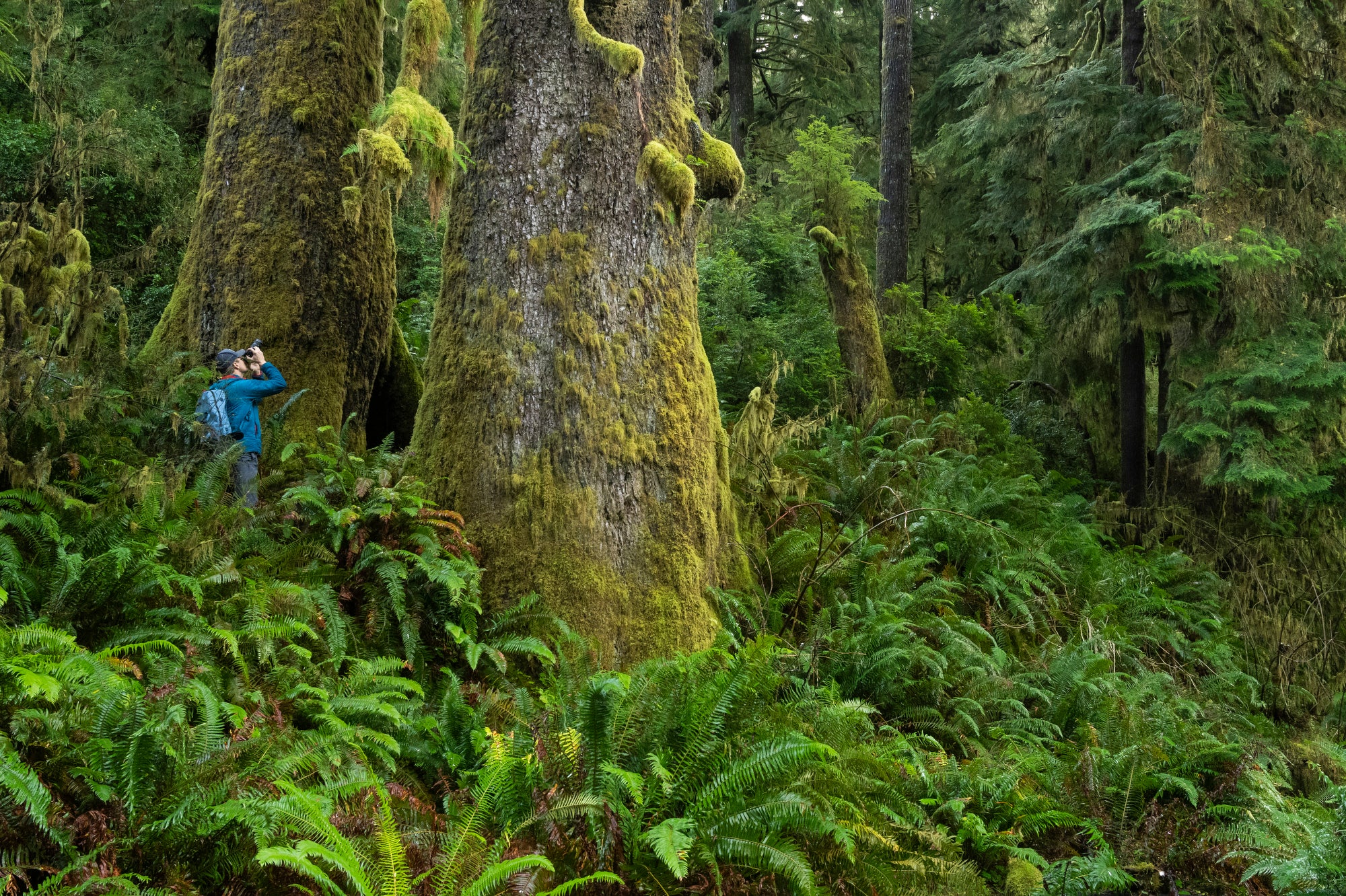
A photographer makes pictures of old-growth trees in the Siuslaw National Forest in western Oregon. (David Herasimtschuk)
Also, SalmonState and its partners made the following statement:
Out-of-touch withdrawal of Roadless Rule will damage Tongass fisheries, economies
This top-down, DC-driven move is something businesses, fishermen, and Southeast Alaska residents have repeatedly told the Administration we do not want.
August 18, 2026
FOR IMMEDIATE RELEASE
JUNEAU, AK— SalmonState, Alaska Longline Fishermen’s Association, UnCruise Adventures and The Boat Company today reacted with disappointment and frustration to the U.S. Department of Agriculture announcement of the Environmental Impact Statement that will withdraw the Roadless Rule Protections across the entire country, including from the Tongass National Forest.
Today’s announcement is a clear example of a top-down, DC-driven approach to management in the Tongass that is out of touch not only with what people here want, but with the reality of the place itself. The main claim in the USDA’s release is that stripping Roadless protections will minimize wildfire risk, but the Tongass is a temperate rainforest, with rainfall ranging up to 225 inches per year in the wettest locations. It does not experience wildfires like those in other places.
The Roadless Rule currently protects the remaining unroaded areas of the forest, preventing the building of taxpayer-funded logging roads, but not essential infrastructure or other approved projects. The stripping of Roadless protections is happening as the timber industry is aggressively lobbying for increased logging, the Forest Service has sustained historic staffing losses, and the agency is turning over management to the State of Alaska for increased harvest.
“The Tongass drives multiple billion-dollar economies in Southeast Alaska precisely because of its wildness,” said SalmonState Southeast Futures Program Director Dan Kirkwood. “The forest’s best-performing assets are fisheries and outdoor recreation. Ensuring those assets stay intact should be our priority. This certainly has nothing to do with wildfire in this temperate rainforest.”
“Fisheries support the economy, culture, and Southeast Alaska way of life,” said Linda Behnken, Executive Director of the Alaska Longline Fishermen’s Association. ”And they do so sustainably, year after year, providing we take care of the forest, rivers and estuaries that the fish depend on. Compromising the fisheries, which annually contribute over $800 million in economic impact to this rural region, for short-term timber extraction funded by the federal government is an unthinkable trade off.”
“For years now, Southeast Alaskans have been building locally-driven, reliable, sustainable economies based on our wild salmon and wild places,” said SalmonState Executive Director Tim Bristol. “This top-down decision from Washington, D.C. is a step backwards that takes Alaska’s future out of Alaskans’ hands, wastes taxpayer dollars, and will harm our wild salmon and wild economies.”
“The Tongass is where America comes to experience Alaska. It’s big, wild, and awesome. My business is all about sharing this magnificent and beautiful forest with people from all over the world. Repealing the Roadless Rule won’t do anything to help us, and will actually hurt us. Why does wilderness matter? It’s the reason visitors come to Alaska!” said Dan Blanchard, Owner and CEO of Uncruise Adventures.
“The natural values of intact watersheds are essential for the visitor industry in Southeast Alaska. People do not want to see clearcuts and decaying logging roads. There are thousands of jobs in Southeast Alaska in recreation and tourism. And there are thousands more in the seafood industry, which depends critically on salmon spawning streams in the old growth forests of the Tongass,” said Hunter McIntosh, President and Executive Director The Boat Company.
The 2001 “Roadless Area Conservation Rule” prohibits the construction of new taxpayer-funded logging roads into wild areas of the Tongass, which in many cases serve as critical undisturbed habitat for salmon and wildlife, provide high quality hunting and fishing opportunities and drive the booming recreation and tourism industry.
After decades of logging, Southeast Alaska already has thousands of miles of logging roads, many of which are dilapidated, unmaintained and blocking fish passage. Most corporations and former loggers have left the clearcut old growth logging industry, which was never profitable in Southeast Alaska except with taxpayer subsidies. Despite “America-first” promises, the remaining industry also ships valuable, 900-year-old forests to Asia for processing.
Background:
The top performing assets in the Tongass National Forest are wild lands and wild salmon runs. Tourism and fisheries together create 26% of the jobs in Southeast Alaska. Those jobs depend on the outstanding scenery and wild salmon runs that come from the Tongass. The Tongass is home to 13,000 miles of salmon streams that are the backbone of our wild salmon fisheries, which provide 25% of Alaska’s salmon catch. Each year the two National Forests in Alaska provide 390 million servings of wild salmon. That’s a salmon burger for everyone in the country, with leftovers. This diverse portfolio of habitat is protected, in part, by the Roadless Rule.
For the last half-decade, Southeast Alaskans have moved away from the destructive clearcut logging practices of years past to focus on new and more sustainable endeavors. Analysis of public comments on the Roadless Rule from the last comment period, in 2019, showed the vast majority of public comments supported Roadless protections. So did the vast majority of in-person Southeast Alaska testimony. Also during the last effort to remove Roadless Rule protections, Southeast Alaska tribes issued a formal petition asking for a Tribal Homelands Rulemaking that has not been addressed. Local communities and tribes are passing resolutions supporting conservation protections. Today’s announcement allows for comments through September 21, which is shorter than normal.
Today, the Tongass contains 1,700 miles of roads open for use and thousands more miles of abandoned, unmaintained logging roads. Agency experts have identified the need for decades worth of restoration work in order to stop and reverse the damage this crumbling infrastructure is having on fish and wildlife. In 2001, when the Rule was first implemented, the USFS identified a backlog of roughly $8.4 billion in deferred maintenance and reconstruction on the more than 386,000 miles of roads nationwide.
SalmonState works to keep Alaska a place where wild salmon and the people whose lives are interconnected with them thrive.
The Alaska Longline Fishermen’s Association represents and advocates for small boat commercial fishermen committed to sustainable fisheries and thriving coastal communities.
The Boat Company is the only non-profit educational organization offering luxury eco-cruises through Southeast Alaska. With almost 40 years of cruising and conservation in Alaska’s Inside Passage, The Boat Company has reinvested over $30 million into conservation efforts throughout the region.
UnCruise Adventures operates all inclusive, U.S.-flagged, small ship cruises in Alaska’s Inside Passage. Their mission is to provide guests an enriching adventure travel experience and inspire an appreciation of local cultures and the natural world.
Finally, the Southeast Alaska Conservation Council:
Tribes, municipalities, conservation groups criticize public process, call for continued protections for irreplaceable old growth forests
JUNEAU (ÁAK?W ?WÁAN TERRITORY)?— The US Department of Agriculture today announced that it has filed a proposed rule and environmental study repealing the Roadless Area Conservation Rule. The agency stated that its proposed rule would completely eliminate the Roadless Rule, removing protections against logging and associated roadbuilding from roughly 9 million acres in the Tongass National Forest and nearly 45 million acres nationwide. Public comments will be accepted through September 21.
The Southeast Alaska Conservation Council, along with a number of Southeast Alaska Tribes, municipalities, small businesses and individuals, has sought to defend Roadless protections on the Tongass for decades. During the scoping period following the Notice of Intent, 99 percent of the more than half a million comments and petitions submitted during a 21-day comment period opposed rescission. Since the rule’s inception and during past attempts at removal, public support for Roadless protections has consistently surpassed 90 percent.
Despite the immense scale of national forest land to be impacted by this rulemaking, the USDA has markedly reduced opportunities for public engagement at each stage of the process. The comment period for the Draft EIS allows only 30 days to read and analyze the proposed rule and environmental study and provide meaningful input.
The USDA has also elected not to hold public meetings; in comparison, in the two years leading up to the rule’s enactment in 2001, more than 600 public meetings were held across the country, including 30 in Alaska. In the absence of official meetings during this repeal process, communities across the country organized hearings of their own, with SEACC co-hosting four in-person events in Juneau, Kake, Klawock and Ketchikan, Alaska, inviting members of the public to testify.
Rescission of the Roadless Rule from the Tongass would remove safeguards against industrial logging and roadbuilding from about half the forest, and would add roughly 190,000 acres to an inventory of lands ‘suitable’ for timber production. Defenders of the Roadless Rule cite the value of these remaining stands of mature and old-growth trees as especially important habitat for wildlife, birds and fish, and as subsistence and recreational harvesting grounds. These lands also support robust industries like tourism and commercial fishing, provide recreational opportunities, and hold profound spiritual and cultural meaning to many.
Statements in response to the Draft Environmental Impact Statement
“It’s clear the processes required by the National Environmental Policy Act are being treated as merely boxes to check on the path to enacting an entirely political agenda to clear cut the last remaining in-tact old-growth forests in America,” said Maggie Rabb, Executive Director of the Southeast Alaska Conservation Council. “The wanton destruction of these irreplaceable ecosystems isn’t supported by the science, the public, or any of the inputs meant to shape this Environmental Impact Statement. It’s not even financially justifiable, with the Forest Service losing more than $1.7 billion in taxpayer dollars on Tongass timber sales over four decades. There is really no justification for opening up Roadless areas to logging, especially on the Tongass National Forest.”
“To have healthy people, water, salmon, and wildlife, you need a healthy forest,” said Organized Village of Kasaan Tribal President Mike Jones. “We have an obligation as tribal leaders and as a community to do what we can to protect what’s left of the old growth on Kíis Gwaay. So much has already been logged. If the Roadless Rule is rescinded, there won’t be any old growth left. We have important cultural reasons to care for the Tongass, but because these trees store so much carbon, the forest acts like the northern lungs of our planet. Rescinding the Roadless Rule will have a global impact too.”
“The Roadless Rule is a critical tool that helps protect intact, old-growth forests, and we will continue to defend it,” said?Earthjustice Attorney Kate Glover. “Keeping the Roadless Rule in place on the Tongass National Forest helps protect Indigenous ways of life, healthy watersheds, salmon streams, and Southeast Alaska’s economy, and buffers us from climate change. The Tongass is still healing from a half century of intensive, clearcut logging. The region has moved on, and its economy today depends on intact forests, not clearcuts.”
“How would repealing the Roadless Rule impact my business of growing Southeast Alaska oysters? Deforestation creates harm beyond just cutting the trees down to the tidelines. The increased quantity of runoff from clearcuts will have devastating impacts to marine life — that includes shellfish,” said James Greeley, co-owner of Tommaso Shellfish in Sea Otter Sound near Prince of Wales Island. “Our business relies on healthy oceans and forest ecosystems of the Tongass rainforest to grow our oysters.”
“The Roadless Rule is essential to the success of small businesses like ours,” said Hunter McIntosh of The Boat Company. “The natural values of intact watersheds are essential for the visitor industry in Southeast Alaska. People do not want to see clearcuts and decaying logging roads. There are thousands of jobs in Southeast Alaska in recreation and tourism. And there are thousands more in the seafood industry, which depends critically on salmon spawning streams in the old growth forests of the Tongass.”
“Officials in Washington D.C. may not understand how important Roadless Rule protections are for Southeast Alaska fisheries — the Roadless Rule was created in large part to protect fish habitat, especially salmon habitat, from damage caused by timber roads and clear-cut logging,” said Linda Behnken, Executive Director of Alaska Longline Fishermen’s Association. “Removing Roadless protections from the Tongass will harm our fisheries and devastate Southeast’s rural communities that rely on salmon, with salmon runs supporting 1 in 10 jobs in Southeast Alaska.”
Here’s more social media reaction:

Alaska Salmon 2011: Not Too Shabby

Prime Time For Face Time At Sportsmen’s Shows

EPA: Potential ‘Adverse Impacts’ On Bristol Bay Salmon Fishery With Pebble Mine; Comment Period On Draft Study Open Into July
About Author
